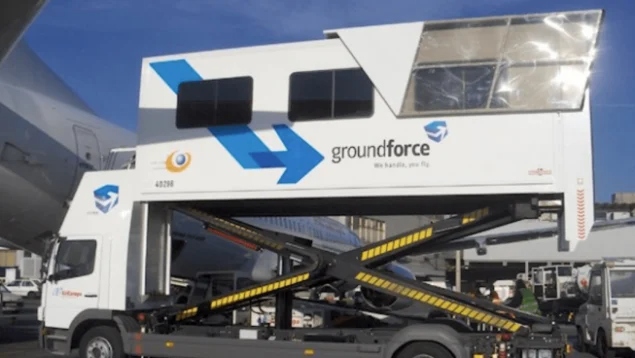
Since late March, the indefinite handling strike at Groundforce has affected four Canary Islands airports. Luggage was left behind, flights were delayed, unions spoke of "collapse." The stoppages are currently paused for negotiations — but there is no agreement, and the unions have made clear: without real progress, strikes will resume immediately. From tomorrow, 17 April, a second conflict begins: SAERCO air traffic controllers will walk out at five Canary Islands airports — indefinitely. Two open strikes in the air transport system of an archipelago that depends entirely on flying. If the Groundforce negotiations fail, the Canaries face an unprecedented double strike.
What Is Happening
Two independent labour disputes are running simultaneously in Canary Islands air transport — and from tomorrow they threaten to overlap.
Strike 1: Groundforce (ground handling) — called indefinitely since 30 March 2026. Stoppages were every Monday, Wednesday and Friday in three shifts: 05:00–07:00, 11:00–17:00 and 22:00–00:00. On 8 April, stoppages were paused for negotiations — a first round took place on 10 April. No agreement was reached. The unions CCOO, UGT and USO have stated: "If no real progress is made, mobilisations will resume." The strike has not been called off — it remains open. The Ministry's minimum services resolution runs until 29 April. Affected: Gran Canaria, Fuerteventura, Lanzarote and Tenerife. Around 1,000 workers in the Canaries, 5,578 nationally. Groundforce is the ground handling company of the Globalia group and serves Air Europa, KLM, Lufthansa, Air France, Turkish Airlines and SAS, among others.
Strike 2: SAERCO (air traffic controllers) — begins 17 April at 00:00, indefinitely. Affected: Lanzarote, Fuerteventura, La Palma, El Hierro and La Gomera. SAERCO is the private provider of air traffic control services at these towers. The unions USCA and CCOO called the strike after negotiations failed. Gran Canaria and Tenerife airports are not affected — their air traffic control is operated by ENAIRE, the state provider.
If the Groundforce negotiations fail and the handling strikes resume, the people who load the luggage and the people who guide the planes to the runway will be on strike at the same time across Canary Islands airports.
Why Groundforce Is on Strike
The Groundforce dispute is about pay. The company unilaterally adjusted its 2026 salary tables, giving certain groups — administrative staff and agents — a 4.58 per cent increase. Under the collective agreement, they should receive 7.82 per cent, based on cumulative inflation since 2022. The unions CCOO, UGT and USO consider this a breach of the current collective agreement.
In the first strike days on 30 and 31 March, over 40 flights departed without luggage. Thousands of suitcases piled up in sorting areas. The pattern repeated on every strike day until 8 April, when the unions paused the stoppages to allow a first negotiation round on 10 April. Minimum services were set at 60 per cent — the unions call this "abusive" because it effectively undermines the right to strike.
In the Canaries, unions reported strong participation during active strike days. At the same time, Groundforce opened disciplinary proceedings against striking employees, according to UGT — a step the unions call intimidation.
The negotiation pause is fragile. There is no agreement. The Ministry of Transport's minimum services resolution runs until 29 April 2026 — the Ministry itself expects the conflict could continue.
Why Air Traffic Controllers Are Striking
The SAERCO conflict has a different background. This is not about percentages — it is about staff. Or rather, the lack of it.
SAERCO is a private air navigation service provider that, following the liberalisation of Spain's control tower market, operates towers at 14 airports. The unions USCA and CCOO accuse the company of systematically reducing staff for years without replacing them. Approved holidays are cancelled, shift plans changed at short notice, rest periods not observed.
The core allegation is serious: the unions say staffing levels are so low that flight safety is compromised. "Aviation safety cannot be sustained by a workforce subjected to chronic fatigue, stress and permanent uncertainty," the strike notice states.
Before calling the strike, USCA and CCOO attempted to negotiate with SAERCO. According to the unions, the company repeatedly postponed or cancelled planned meetings. The unions then requested mandatory mediation through SIMA (Servicio Interconfederal de Mediación y Arbitraje). SAERCO has not commented publicly.
Which Airports Are Affected
The picture is complex because the two strikes affect different airports — and overlap at two:
Groundforce only (ground handling): Gran Canaria, Tenerife
SAERCO only (air traffic control): La Palma, El Hierro, La Gomera
Both strikes simultaneously: Lanzarote, Fuerteventura
Lanzarote and Fuerteventura are thus doubly affected from tomorrow: Groundforce handling strike (Mon/Wed/Fri) and SAERCO air traffic control strike (indefinite, daily). For these two islands, with no ferry connection to the mainland and entirely dependent on air travel, the situation is particularly critical.
La Palma, El Hierro and La Gomera — the three smallest islands with the fewest alternatives — are affected only by the controllers' strike, but it is precisely there that the airport is the only realistic connection to the outside world.
What This Means for Passengers
Anyone flying to or from the Canaries in the coming days should expect:
Delays in baggage handling at Groundforce airports, especially on strike days (Mon/Wed/Fri). The first weeks have shown that flights depart without luggage and passengers receive their bags hours or days late.
Possible flight schedule restrictions at SAERCO airports (Lanzarote, Fuerteventura, La Palma, El Hierro, La Gomera) from 17 April. The impact will depend on minimum services yet to be determined.
No direct disruption to air traffic control at Gran Canaria and Tenerife — these are operated by ENAIRE, not SAERCO.
Airlines using Groundforce as their handling partner: Air Europa, KLM, Lufthansa, Air France, Turkish Airlines, SAS and others. Airlines such as Ryanair and EasyJet use Menzies — where the strike was called off in late March after an agreement was reached.
The Third Strike Nobody Mentions
What usually goes unreported: there was a third strike. Menzies, the other major handling provider in the Canaries (Ryanair, EasyJet, Canaryfly, Norwegian), had also called an indefinite strike for Easter. It was called off on 31 March after an agreement with UGT on salary guarantees for subrogated workers.
That proves something: negotiations can work. At Menzies, they did. At Groundforce and SAERCO, so far, they have not.
Canary Islands: No Plan B
The Canary Islands have no railway to the mainland. No bridge. No fast ferry connection that could replace air travel. For tourists — the archipelago's primary source of income — and for residents visiting family on the mainland, flying is the only realistic means of transport.
In March 2026, over 5 million passengers passed through Canary Islands airports. Hundreds of flights land and depart every day. The entire economy of the archipelago — tourism, trade, logistics — depends on this system working.
Two simultaneous, indefinite strikes within that system are not a fringe issue. They directly affect the islands' lifeline. And they come at a time when the Canary Islands are already under pressure: the Middle East conflict is redirecting more tourists to the islands, infrastructure is stretched, and passenger numbers dipped slightly in March for the first time in months.