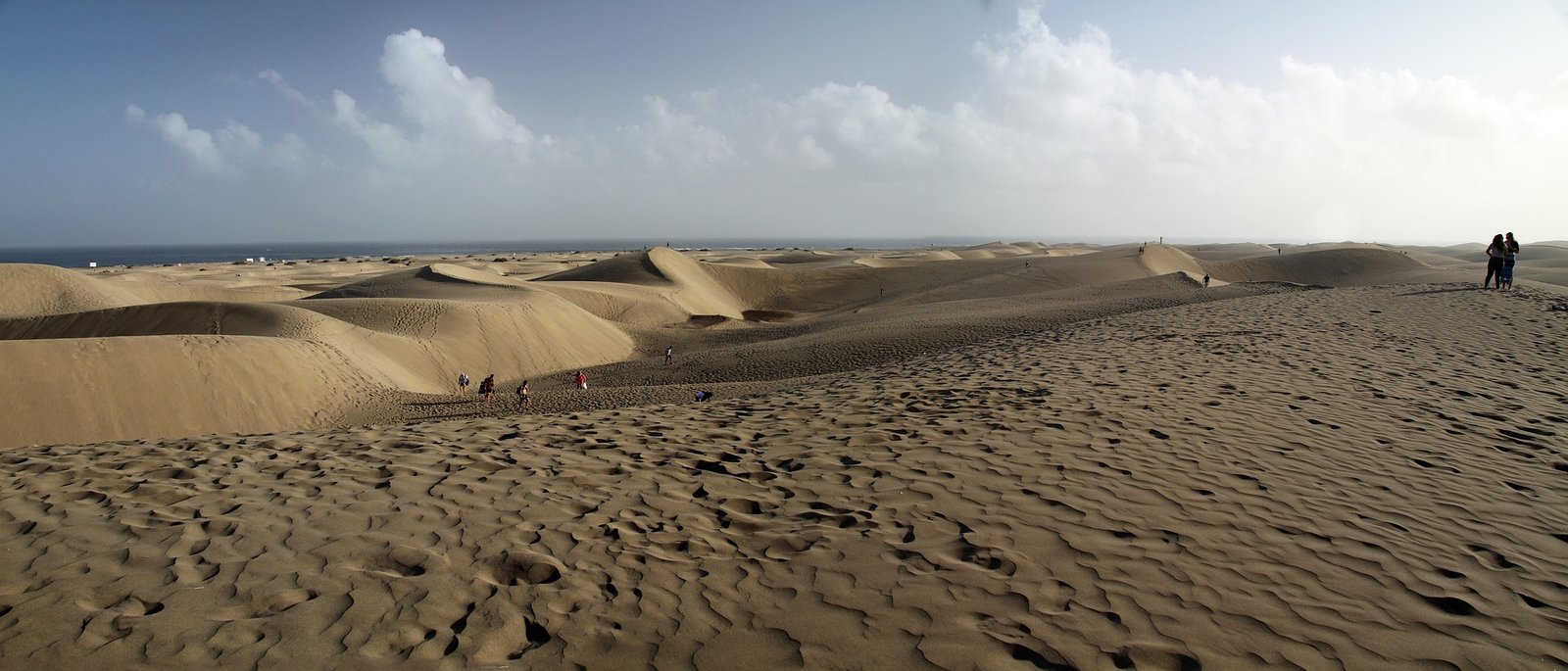
The Maspalomas dunes in numbers
- 404 hectares of nature reserve (Reserva Natural Especial), protected since 1987
- The dunes migrate 2–5 m a year with the trade winds
- Sand loss for around 50 years; at the current pace, risk of disappearing within a century
- MasDunas pilot: about 30,000 m³ of sand a year back into the cycle
- Scientific support: ULPGC plus Cantabria, Valencia and Seville
It is just after eight on the Paseo Costa Canaria, and the beach still belongs to the early risers. An older gentleman lays out his towel in the front row, where the sand is finest. He has no idea that the ground beneath him is on the move. Every day, every hour, with every breeze coming off the Atlantic, this sand shifts — and some of it never comes back.
That is exactly the problem that has occupied experts on Gran Canaria for half a century: the beach of Playa del Inglés and the famous Maspalomas dunes behind it are slowly but steadily losing their sand. Lie by the water today and you'll see nothing of it. Put the photos from forty years ago beside it, and you will.
Contents
Why the beach is shrinking
Sand on the move is no bad thing — on the contrary, it is the engine of the whole system. The Maspalomas dunes are not a dead postcard but a living landscape. The northeast trade winds push the sand hills two to five metres further each year, so the entire 404-hectare field is constantly reshaping itself. The sand travels from Playa del Inglés in the east across the reserve to Playa de Maspalomas in the west, where the wind carries it back towards the sea. From there it should be washed ashore again — a cycle (Cabildo de Gran Canaria).
But that cycle is broken. When the hotel strip of Playa del Inglés went up in the 1960s and 70s, the buildings changed the wind: in some places it is slowed, in others sped up. The result is that today more sand leaves into the sea at the western end than nature returns. The system loses more than it gains. If the pace holds, experts reckon the dunes could disappear within a century (Canarias7).
How the sand comes back
This is where the project with the pretty name MasDunas comes in. The idea behind it is surprisingly simple, almost a trick: you collect the sand where it would be lost anyway, and return it to the start of its journey.
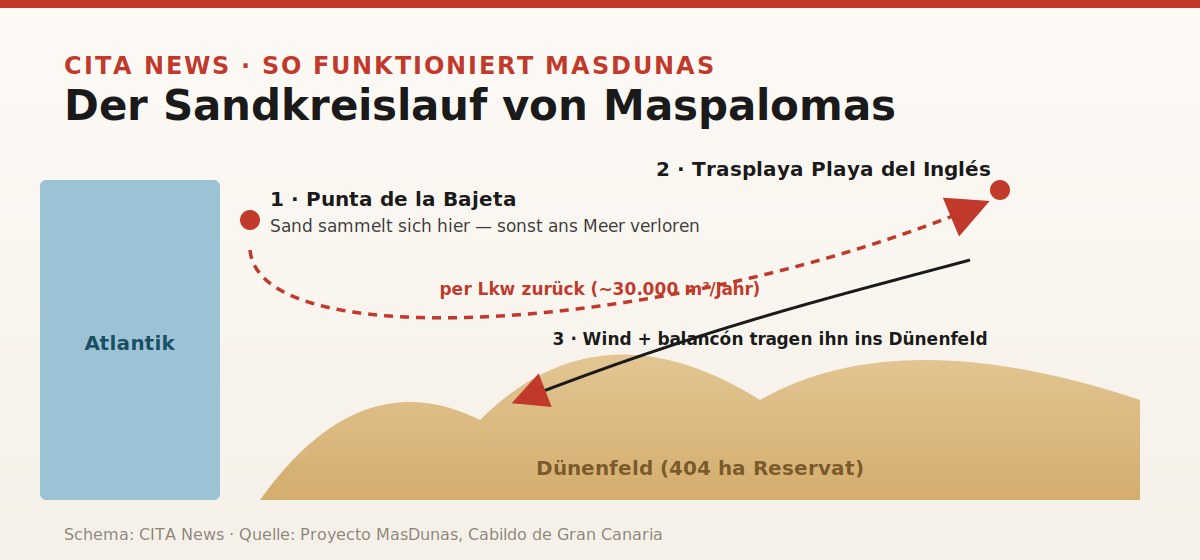
Specifically, at the Punta de la Bajeta, the western tip, the sand that would otherwise sink into the sea for good piles up. It is exactly this sand — around 30,000 cubic metres a year in the pilot — that workers excavate and truck back to the trasplaya of Playa del Inglés, the dry strip of beach behind the loungers. And then nature takes over again: the wind picks the sand up and carries it into the dune field, just as it has for millennia (Proyecto MasDunas).
It is helped by an unremarkable plant, the balancón (Traganum moquinii), a tough, salt-resistant shrub that grows among the dunes. It works as a natural sand trap: the wind catches in its branches, loses force and drops the sand exactly where new dunes are meant to form. Once you grasp that, you see the scrubby bushes at the dune's edge differently — they are the landscape's quiet builders.
None of this is guesswork; it is scientifically monitored. The measurements and concepts involve the University of Las Palmas de Gran Canaria along with researchers from Cantabria, Valencia and Seville, who track precisely how the beach and the Punta de la Bajeta change over the years.
Why it is contested all the same
As sensible as the plan sounds, carrying it out is delicate. The Maspalomas dunes have been a specially protected nature reserve since 1987 and mostly belong to the public coastal domain. Moving sand here requires permits — not only from the island authority but also from the state coastal authority, the Demarcación de Costas.
That this can stall has been shown recently. An earlier permit to move sand was revoked in 2023 after the environmental authority objected to repeatedly improper execution. Since then those involved have proceeded more cautiously. In parallel, the Cabildo set in motion a comprehensive plan in April 2026 to organise and better protect the whole reserve. The message is clear: the sand may be moved, but only under strict conditions and with judgement — the reserve is an ecosystem, not a building site (Canarias Ahora).
What visitors can do — and better not
For everyone holidaying here or living on the island, one simple rule follows from all this: the dunes are more fragile than they look. Staying on the marked paths is not bureaucratic fussiness but real protection — every step off the path compacts the sand and disturbs the delicate balancón plants that hold the system together.
The beach kiosks, too, are deliberately moved from time to time so wind and sand can pass freely between them. And tempting as it is: a little bottle of sand as a souvenir may seem harmless, but with millions of visitors a year that is exactly what adds up to the loss that trucks and researchers are painstakingly fighting.
The older gentleman will notice none of this that morning. He will enjoy his day by the water, and rightly so. But perhaps on his next stroll towards the lighthouse he'll look more closely at the scruffy bushes at the dune's edge — and sense that this beach is no foregone conclusion, but a landscape that fights for its own sand anew each day.