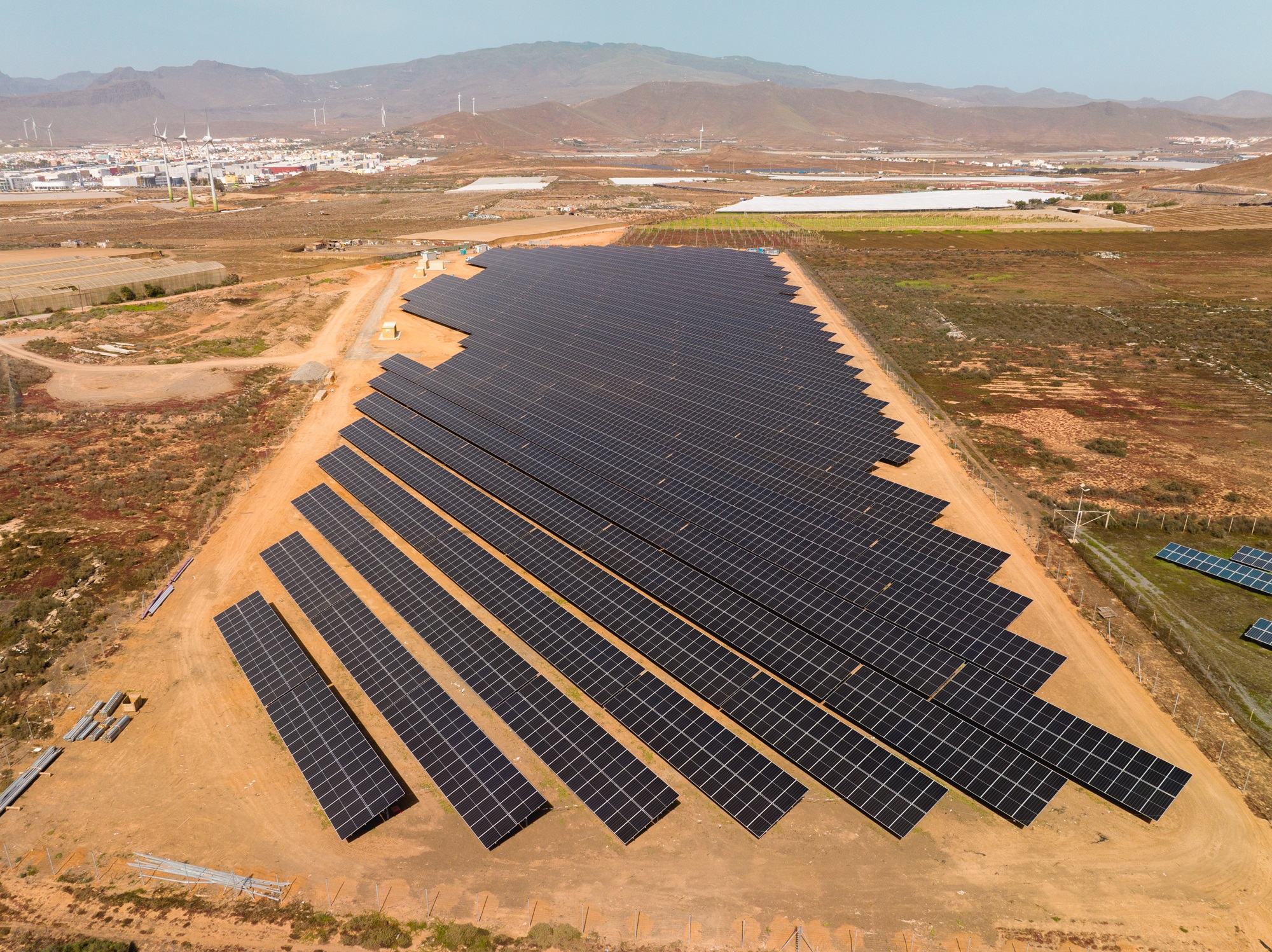
Gran Canaria's electricity grid has been operating under considerable strain for several years. Ageing infrastructure, rising demand and a sluggish rollout of renewables have left the island chronically short of generation capacity. The two emergency power plants now taking shape in the Telde industrial estate of El Goro represent the most immediate response yet to a problem that has been building for decades.
La Garita: Eight Otto-Cycle Engines Running on Propane
The first plant, known as La Garita, is being developed by DISA, one of the Canary Islands' largest energy companies. Rated at 14.8 MW, it uses eight Otto-cycle engines fuelled by propane gas. The plant will feed into the grid via the Cinsa-REE substation, a key node in the island's high-voltage transmission network.
Propane was chosen partly for its lower emissions profile compared with diesel and partly for its operational flexibility. Otto-cycle gas engines can be brought online quickly, making them well suited to covering sudden spikes in demand — the sort that typically occur on hot summer evenings when air conditioning load peaks across the island simultaneously.
El Goro: 15 Containerised Diesel Generators, 20 MW Total
The second plant, El Goro, is the larger of the two at 20 MW. It is being built by GPM Generación, a subsidiary of the Pérez Moreno group, using 15 containerised diesel generator units rated at 1.4 MW each. The total project budget is €15.1 million. Grid connection will be made to the CINSA substation via a dedicated underground cable roughly one kilometre in length.
The containerised format offers practical advantages beyond speed of deployment. Each unit can be serviced independently without taking the entire plant offline, and the modular design means the installation could, in principle, be relocated once it is no longer required at this site — a relevant consideration given its explicitly temporary nature.
Key figures at a glance
La Garita (DISA): 14.8 MW · 8 Otto-cycle engines · propane gas · connected to Cinsa-REE substation
El Goro (GPM Generación): 20 MW · 15 diesel containers at 1.4 MW each · budget €15.1m · connected to CINSA substation via 1 km underground cable
Combined: 35 MW of new capacity for Gran Canaria
Gran Canaria's identified shortfall: 138 MW (Red Eléctrica, March 2025)
Energy emergency declared: October 2023
Official publication: BOC (Boletín Oficial de Canarias), 27 March 2026, Expte. GE25/038
A Crisis Decades in the Making
To understand why two temporary plants in an industrial estate have become front-page news, it helps to grasp the scale of the underlying problem. Red Eléctrica, Spain's national grid operator, concluded in a March 2025 report that Gran Canaria needed an additional 138 MW of capacity urgently. Across the archipelago — with Tenerife, Gran Canaria and Fuerteventura most acutely affected — the total shortfall stands at 268 MW.
Much of the existing generation fleet is between 30 and 40 years old. Breakdowns have become routine rather than exceptional, and the reserve margin that grid operators rely upon to absorb unexpected outages has narrowed to an uncomfortable degree. Meanwhile, renewables account for only 22.7 per cent of the Canary Islands' electricity mix as of 2025, according to Red Eléctrica — a figure that lags well behind mainland Spain and the broader European trajectory.
The Canarian government declared an energy emergency in October 2023, unlocking expedited permitting procedures and allowing contracts to be awarded outside the normal competitive tendering timelines. That legal framework is what made it possible to push the Telde plants through approval as swiftly as they have been.
The Island Council's Reservations
Not all local authorities have welcomed the approach unconditionally. The Cabildo Gran Canaria — the island's governing council — has consistently argued against locking the island into inflexible thermal generation capacity. Its preferred strategy centres on flexible battery storage systems and the Salto de Chira pumped-hydro project, which would allow surplus renewable energy to be stored and dispatched on demand, reducing reliance on fossil-fuel peaking plants.
The tension between the regional government's short-term pragmatism and the island council's longer-term renewables ambitions reflects a genuine dilemma faced by isolated island grids around the world: how to keep the lights on today without foreclosing the clean energy transition tomorrow.
The Long-Term Plan: 1,000 MW Awarded in February 2026
In February 2026, the Ministry responsible for energy in the Canary Islands awarded contracts totalling more than 1,000 MW to four companies — Unelco, Sampol, DISA and Canary Carreteras. This represents the most significant long-term investment in the archipelago's generation capacity in a generation. However, construction of permanent plants takes years, which is precisely why interim solutions such as La Garita and El Goro remain necessary in the near term.
The legal basis for both Telde plants was published in the Boletín Oficial de Canarias (BOC) (Gobierno de Canarias) on 27 March 2026, under file reference Expte. GE25/038. For residents of Gran Canaria, the arrival of 35 MW of backup capacity will reduce — though not eliminate — the risk of the rolling power cuts that have disrupted daily life in recent years. Energy costs affect everyday life on the island — keep an eye on current fuel prices in Gran Canaria and track how energy developments influence the local property market.