
The national figures: Canaries among the climbers
The Interior Ministry published the full-year 2025 crime report in late February 2026. The result: crime in the Canary Islands rose by 3.1 per cent.
That puts the archipelago clearly above the Spanish average (+0.8 per cent) and among the ten Autonomous Communities with the steepest rise — behind Castilla y León (+5.8), the Balearics (+5.6) and Asturias (+5.4). For comparison: Catalonia (-2.9) and Madrid (-1.7) recorded falling numbers.
This is not new. The trend has been going for a while. The Fiscalía Superior de Canarias (regional chief prosecutor's office) wrote in its 2025 Memoria that in the Province of Las Palmas the number of preliminary proceedings opened in 2024 had risen by 20.59 per cent — from just under 54,000 to more than 65,000 cases. That was more than the regional average of 14.65 per cent.
The capital: first homicides in years
Especially striking is Las Palmas de Gran Canaria. The city registered 19,798 criminal offences in 2025, up 1 per cent on 2024. The figure sounds small. Behind it hide dramatic shifts in serious crime.
Eight intentional homicides and completed murders. In 2024 the figure was zero. Attempted homicides rose from 10 to 11. Cybercrime grew by 3.6 per cent, from 3,741 to 3,877 known offences.
That's the problem with Interior Ministry statistics: the headline trend can look moderate while violent crime explodes. In the first half of 2025 the pattern was already visible — at Canary Islands level, intentional homicides and murders rose by 223.3 per cent, abductions by 100 per cent, violent robberies by 14 per cent.
The Sureste: where the numbers turned first
In the Sureste — Ingenio, Agüimes, Santa Lucía de Tirajana — the warning signals appeared early. Canarias7 reported in September 2024 that crime had risen in Ingenio by 14.2 per cent and in Agüimes by 11.6 per cent in the first half-year. Violent robberies and intimidation tripled in Ingenio, from 3 to 9 cases.
2025 continued the trend. Santa Lucía de Tirajana closed the year with nearly 4,977 criminal offences — pre-pandemic levels. By late June, 15 violent robberies in 45 days alone. Statistically an outbreak.
In March 2026 the Guardia Civil caught a serial offender who had been hitting butcher shops, phone shops, sweet shops and beauty salons in Santa Lucía, Ingenio and Agüimes since mid-February. Damage: over 6,300 euros.
Barely four weeks later, on 14 April, the organised raid on the Horacio jewellery shop in Carrizal. Five perpetrators in black hoods, hammers and axes. A rental car stolen in Puerto Rico. They took only gold — leaving the silver untouched. The owner threw himself at one attacker and prevented a complete clean-out.
Twenty-five seconds. Then the gang switched to a second getaway car and vanished.
The residents themselves describe what they see. In Vecindario — the urban core of Santa Lucía — neighbours complain on social media about "a lack of visible patrols, deficient street lighting, a sense of neglect in problem zones." Incidents are reported in school surroundings, parks, main streets.
A witness at the Horacio jewellery put it this way:
«Llevamos más de una década con robos continuos.»
*("We've had continuous robberies for over a decade.")*
The South: hotels, empty centres, tourist town

In the tourist south — Playa del Inglés, Maspalomas, San Bartolomé de Tirajana — the numbers tell a similar story. The Centro Comercial Ronda still counts among the active centres — and was hit twice nonetheless.
On 20 February three masked men armed with large knives stormed an amusement arcade and took up to 100,000 euros in daily takings. They knew the internal routines, heading straight for the cash. In April it was hit again.
Many other shopping centres are no longer active at all.
The Centro Comercial Metro was bricked up years ago to stop drug dealing and illegal use. The Centro Comercial Plaza was sealed by municipal order from February 2022 to 2024. The party Primero Canarias pointed to the state of the centres in September 2025 — Metro and Plaza closed or in ruins, Gran Chaparral, La Sandía and the C.C. Cita in a "lamentable and deteriorated" state. "Hundreds of empty premises, families without work, tourists who perceive the decay."
It was in exactly this environment that the March murder of the 84-year-old tourist happened. According to the police, the perpetrator had systematically used dating apps to rob tourists — knowing many would leave the country without reporting it. He stole 20,000 euros from another victim.
Tenerife is hardly faring better. It has just emerged that four men armed with baseball bats, knives and hammers stormed a hotel in Adeje — smashing windows to gain entry. Anyone who thinks the security problem is confined to Gran Canaria is mistaken.
The most contested question: what about the migrants?
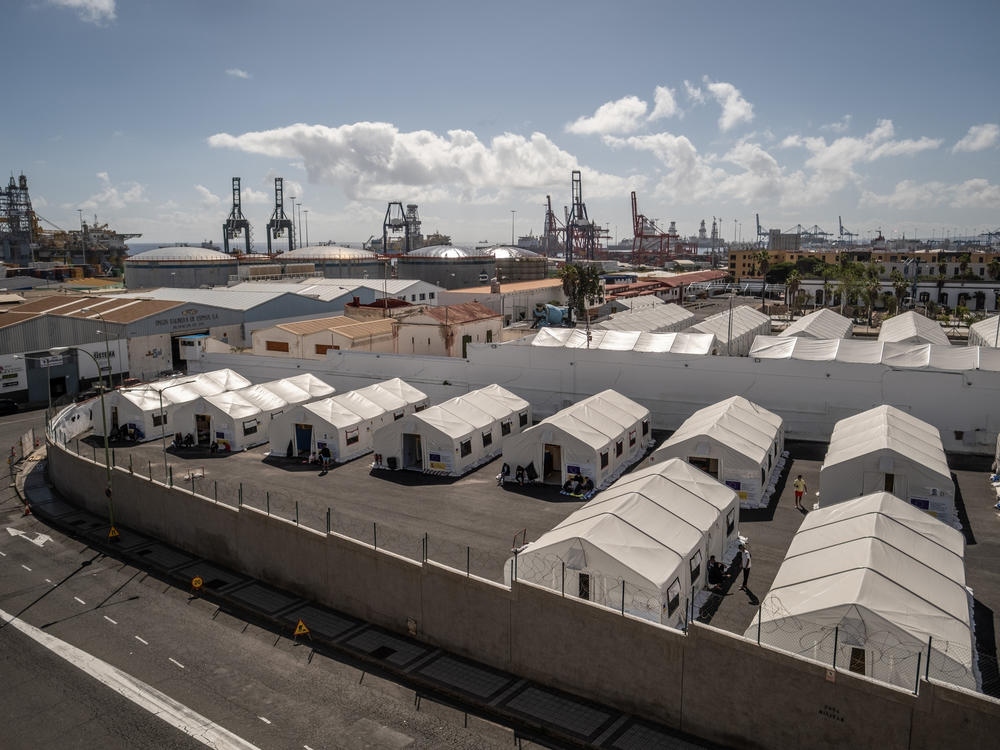
Here the debate quickly turns toxic — so let's stick to what is documented.
Fact 1: The Canary Islands Government looks after more than 5,000 unaccompanied migrant minors, the so-called MENA (Menores Extranjeros No Acompañados). Most of them are in Gran Canaria and Tenerife. They are housed in centres run by NGOs — some work, others don't.
Fact 2: The Fiscalía Superior de Canarias has stated several times in public in 2025 and 2026 that there has been "an increase in crime following the arrival of unaccompanied minors." But — in the prosecutors' own words before a European Parliament delegation in September 2025: "the offences are committed mainly against them."
The two prosecutors, María Farnés Martínez (Canaries) and Teresa Gisbert (Supreme Court), admitted that some minors do commit offences — but the majority are victims: of sexual exploitation, labour exploitation, fights and insults that frequently occur inside the reception centres themselves.
Fact 3: In May 2025 the Court of First Instance No. 3 in Las Palmas shut down the La Fortaleza I centre in Gran Canaria, run by the NGO Quórum 77, and ordered the arrest of nine staff members. Charges: bodily harm, hate crimes, threats, violation of the moral integrity of the minors in care. In total, four centres in Gran Canaria were closed on similar allegations. In October 2025 the Fundación Siglo XXI was also charged with allegedly laundering 2.5 million euros in EU funds earmarked for minor shelters.
Fact 4: In Gran Canaria there are documented vigilante initiatives that have attacked or aggressively pursued migrants. In December 2020 the Red Cross had to ask the 6,000 migrants housed in southern hotels not to leave their accommodation after residents gathered at the doors. WhatsApp groups in which machetes were brandished and "hunts" against Moroccans were announced have been documented.
So what's true? The matter is more complicated than either extreme of the debate claims. There is crime committed by minors — mostly small offences, when they escape from badly run centres and end up in the streets. There is massive crime committed against them — inside the centres by operators, outside by exploiters. And there is the narrative that the political right has successfully established: the MENA are the reason for falling safety. That narrative, measured against the prosecutor's own data, does not hold — at least not in its simple form.
What are the actual drivers?
Anyone reading the crime data across the archipelago sees several factors operating together, which often don't fit the political narrative:
Drug trafficking. The Canaries lie on the Atlantic route between Africa and Europe. Drug trafficking reached a record national figure of 22,731 cases in 2025. The prosecutor's office points out that this partly reflects more police activity — but the trend is real. Las Palmas became in 2024 the province with the highest concentration of drug cases in the entire archipelago.
Economic polarisation. The south of Gran Canaria is one of the richest parts of the island — and one of the poorest at the same time. Those who work in the hotels often don't earn enough to live in Playa del Inglés. Those who live in the old blocks of Vecindario watch the tourist money wave pass them by. Criminological literature — including the Spanish Interior Ministry's own studies — cites income inequality as one of the strongest predictors of petty crime.
Decay of the shopping centres. Where spaces stand empty, drug trafficking and petty crime move in. That goes for Playa del Inglés as much as for the Sureste. The state of the centres — Metro, Plaza, La Sandía, Gran Chaparral — is not a side note. It is one of the causes.
Migration — but in nuanced form. It's not the presence of migrants that's the problem, but what happens to them when they're here. When they are kept in centres that don't work. When at 18 they are left on the street, without papers, without a trade, without a network. When they fall victim to exploiters because no one protects them. Then more crime arises — not automatically, but statistically predictably — both committed and suffered.
Population growth and mobility. The Canaries have been experiencing population growth for years, reinforced by arrivals from mainland Spain, other EU countries and through migration. More people on the same surface means more opportunities for crime — also an internationally known effect.
What isn't happening: a serious debate
What isn't happening in the Canaries is an honest conversation about all these factors at once. Instead there are two camps.
One camp — Vox clearly, PP and parts of CC by now too — reduces the insecurity to migration and demands tougher deportations, more surveillance, more controls. The other camp — PSOE, parts of the Clavijo government, many NGOs — rejects the link altogether and emphasises the victim role of the migrants.
Both are partly right. Both partly ignore the data. And above all: both distract from the actual problem — that Canarian administration has been under-investing for years in:
- patrol policing in the Sureste and the southern tourist zones
- reception centres that work for minors
- integration for those at 18 who leave the system
- refurbishment of the decaying shopping centres
- social work in the poorer neighbourhoods of Las Palmas and Vecindario
Security is expensive. It doesn't come from press conference statements, but from personnel, structures and long-term planning. That is exactly what's missing.
What does this mean for CITA News readers?
Anyone living, working or holidaying in Gran Canaria should know the numbers — without falling into panic:
- The island remains, in Spanish comparison, safer than many mainland regions. The crime rate is "in the lowest band of the historical series," according to the Interior Ministry for Spain as a whole.
- The trend of the last two years, however, points upward — and faster than the national average.
- Particularly affected: Sureste (Ingenio, Agüimes, Santa Lucía), tourist zones with decayed shopping centres, violent crime in the capital.
- Less affected: residential neighbourhoods in Las Palmas like Tafira or Mesa y López, the north coast, the smaller villages inland.
- The usual precautions continue to work: don't leave valuables in sight, don't walk alone through abandoned shopping centres at night, arrange dating-app meetings in public places, in case of a robbery don't play the hero.
The question no one is asking
The question almost never asked in the Canarian debate is the simplest: if crime in the Sureste has been rising since 2024, if the prosecutor's office warned as early as 2024, if the Fiscalía Superior wrote a full Memoria on it in 2025 — why hasn't politics reacted long ago? Why aren't more police patrolling in Vecindario? Why is there no task force for the decayed shopping centres? Why aren't minor centres with known problems repaired before a court shuts them down?
The answer is the same as in many Canarian issues: because it doesn't hurt anyone politically not to act. The residents of the Sureste traditionally vote more for PSOE and CC, both government parties. The tourists don't vote at all. The shopkeepers who get raided ten times in ten years are too few to decide an election.
That's precisely why we are writing about it. Because someone has to.