What chest wall surgery does
The chest cavity — caja torácica in Spanish — protects the lungs and heart. When something goes wrong there, it gets complicated: a tumour in the lung or the mediastinum, a congenital deformity such as funnel or pigeon chest, or severe fractures from accidents. This is exactly the specialty of the Thoracic Surgery section at Hospital Insular. Doctors work hand in hand with the engineers of the Instituto Tecnológico de Canarias (ITC), who manufacture the 3D implants.
How 3D implants work
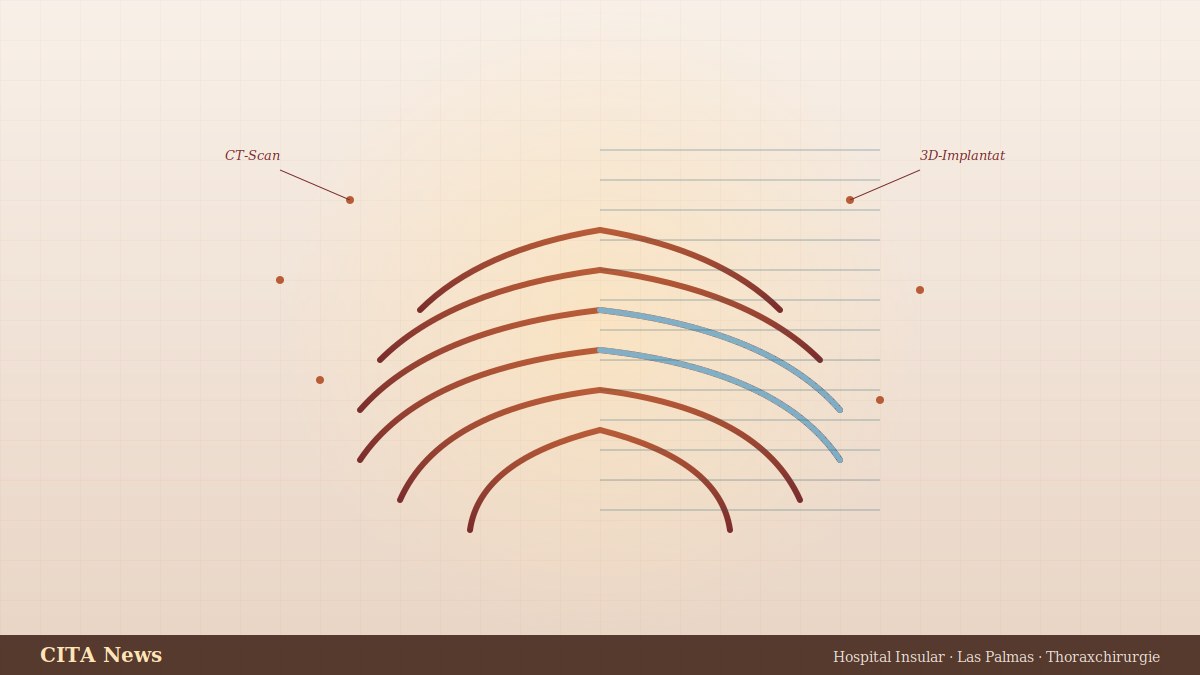
First, a high-resolution CT scan of the patient is taken. From that, a computer calculates in 3D which part of the chest wall is missing or deformed. Then the team designs a custom-fit implant — literally a replacement for the ribs or the sternum. The model is first printed in plastic so the surgical team can hold it physically. Only when everything fits is the final implant printed in titanium. It is then placed during the operation. Hospital Insular is the centre with the most 3D implants worldwide.
What robotics adds
Since 2021 the clinic has used the Da Vinci robot. It is not an automated robot — the surgeon sits at a console and steers small robotic arms inside the patient using ergonomic controls. The images are shown in 3D. The benefits: smaller incisions, less blood loss, faster recovery. Ideal for removing lung tumours with affected lymph nodes or operating on tumours in the mediastinum (between heart and sternum). For the robot-assisted first-rib resection — a particularly delicate operation — Hospital Insular leads Spain.
What it means for patients
Three things become tangibly better. First: operations that previously seemed too complex are now possible. Patients with lung cancer or chest wall tumours receive treatment that otherwise might not be performed at all or only at high risk. Second: recovery times shrink. Robot-assisted procedures with mini incisions allow faster healing. Third: with congenital deformities — funnel chest is the most common — young patients can be corrected using custom-made implants.
Why the world looks at Las Palmas
In the last two years, 35 surgeons from 23 Spanish hospitals, plus specialists from Germany and the UK, have come to Las Palmas for training. Hospital Insular exports its expertise to other clinics — even accompanying real operations on site. The results have been published in scientific journals, and the section received an award from the Spanish Thoracic Surgery Congress. That is not just recognition for the clinic — it is proof that medical excellence can also happen outside Madrid and Barcelona (SCS).
Frequently Asked Questions
- What is thoracic surgery?
- Surgical treatment of conditions of the chest cavity — lungs, mediastinum, sternum, ribs. Includes tumours, congenital deformities, and injuries.
- What are 3D implants?
- Personalised titanium implants, manufactured by 3D printing after individual patient measurement. They replace removed or missing bone parts.
- Who can be treated at Hospital Insular?
- Patients from the public health system of the Canary Islands and Spain; international patients are also accepted, often through research or collaboration agreements.
- What is the Da Vinci robot?
- A surgical system controlled by the doctor from a console. It allows millimetre-precise operations through tiny incisions with 3D visualisation.
- Which operations are particularly in demand?
- Especially the correction of funnel and pigeon chest with 3D implants, robot-assisted lung tumour removal, and first-rib resection.