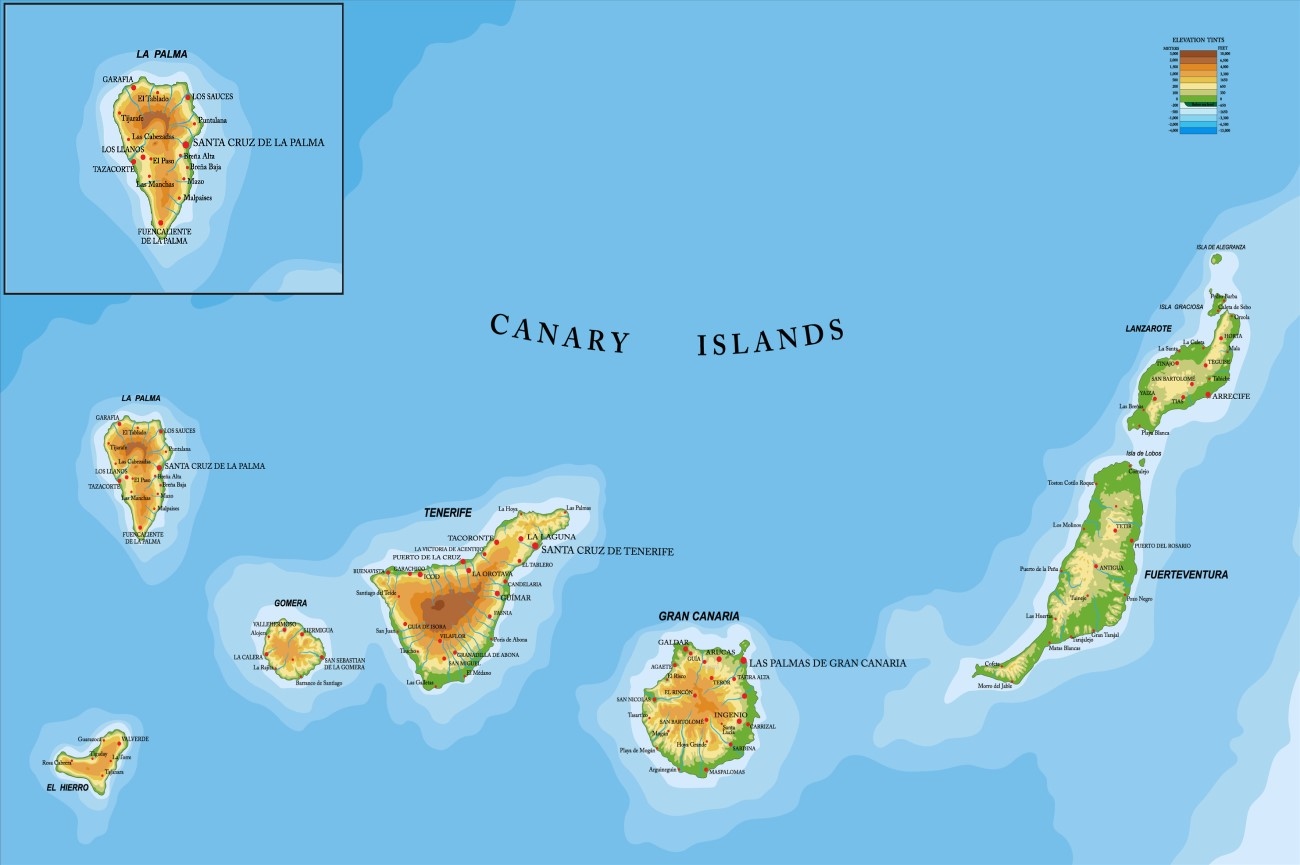
The Canary island of La Palma now figures on the map of European tax havens — and on 23 April 2026 Minister Ángel Víctor Torres officially extended the matter. At the Cabildo in Santa Cruz de La Palma he confirmed before Cabildo President Sergio Rodríguez: the 60 percent IRPF reduction stays in force for 2026 and 2027 (La Moncloa).
The measure itself is not new. It was introduced in 2024 as part of the "Agenda Canaria" — the investiture pact between PSOE and Coalición Canaria after the 2023 elections, in response to the Cumbre Vieja eruption of 2021 that hit the island hard economically and socially. The measure was originally foreseen for the years 2024 to 2027. Madrid's current confirmation makes clear that the pact is being honoured — and that for 2027 too "the precise mechanism for application" will be sought, in Torres' own words.
In concrete terms: anyone with main residence on La Palma receives a 60 percent rebate on the calculated Spanish IRPF liability. On a tax bill of 30,000 euros, you effectively pay 12,000. It is real, it is the EU single market, it is the eurozone, it is Atlantic climate — and compared with classical European tax havens, it is surprisingly competitive.
But how does La Palma actually compare with Madeira, Andorra, Malta, Cyprus, Italy, Switzerland, Bulgaria, Monaco and Liechtenstein? Here are the eight most relevant European tax models in 2026, sorted by target group — and at the end the direct comparison with La Palma.
In practice, the question typically arrives like this: a German pensioner with 80,000 euros gross annual pension calculates that the German tax burden plus health insurance plus the slow erosion of purchasing power on the Canaries costs him several thousand euros a year. He reads about Madeira, Andorra, Cyprus. The numbers sound tempting. But every country has its own conditions, its own minimum stays, its own catches.
Tax models for pensioners with foreign pension income
Cyprus — the classic for pensions. A special rule allows pensioners to have their foreign pension taxed at a flat 5 percent on the amount exceeding 5,000 euros per year. A PwC overview on Cyprus (PwC) confirms this annual option; the threshold was raised from 3,420 to 5,000 euros with the major tax reform of 1 January 2026. Minimum stay: 60 days per year (with home and economic activity in Cyprus); since the reform, the former requirement of "not tax resident elsewhere" has been dropped. Catch: contributions to the General Healthcare System (GHS, 2.65 percent on dividends, higher on other income) and the distinction between tax residence and domicile.
Malta Retirement Programme. Foreign pensions are taxed at a flat rate of 15 percent when remitted to Malta, with a minimum annual tax of 7,500 euros plus 500 euros per family member. The pension must constitute at least 75 percent of taxable income. UN pensions are fully exempt. Important — the 2026 reform introduced a tax exemption up to 16,636 euros for regular pensioners (Maltaway) which for many average pensioners is cheaper than the MRP special regime. Minimum stay: 90 days; employment in Malta is not allowed.
Italy 7 percent pensioner regime. Anyone moving to a municipality of fewer than 20,000 inhabitants in southern Italy (Sicily, Calabria, Sardinia, Apulia, Molise) pays a flat 7 percent on all foreign income — pension, dividends, capital gains — for up to 10 years. Requirement: not have been Italian tax resident for the previous 5 years, and the pension must come from a country with a double-tax treaty with Italy.
Tax models for remote workers and the self-employed
Andorra. Personal income tax (IRPF according to Govern d'Andorra (Govern Andorra)): the first 24,000 euros are tax-free, 24,000 to 40,000 euros at 5 percent, anything above 40,000 at 10 percent. No wealth tax, no inheritance tax. VAT (IGI) only 4.5 percent. Minimum stay: 183 days (active residence) or 90 days (passive residence). Andorra has a double-tax treaty with Spain and France, but not with Germany. Catch: in January 2026 an Omnibus law introduced a special tax on foreign real estate investment that significantly increases the cost of buying property for new residents.
Bulgaria — flat 10 percent on everything. The simplest tax system in Europe. 10 percent on all personal income, 10 percent on capital gains, 5 percent withholding on dividends, 8 percent on interest from 2026. For self-employed effectively 7.5 percent (10 percent on 75 percent of income after automatic flat-rate deduction). Bulgaria is a eurozone member as of 1 January 2026, Schengen since 2025. Digital nomad visa exists. Catch: total social contributions around 32.7 percent (capped), and life outside Sofia is not for everyone.
Madeira. Only interesting for companies — the International Business Centre (IBC) offers 5 percent corporate tax for companies licensed by 31 December 2026. Condition: 1-5 new jobs plus 75,000 euros investment, or 6+ jobs in the first six months. The Tax Benefits page of IBC Madeira (IBC Madeira) confirms the conditions, valid until 31 December 2028. For personal taxation in Madeira the normal Portuguese rates apply.
Tax models for the wealthy with capital income
Italy 100k Flat-Tax — now 200k or 300k. Anyone moving to Italy in 2026 or later who has not been Italian tax resident for at least 9 of the past 10 years can pay a lump-sum tax of 300,000 euros per year on all foreign income — regardless of the amount. The 2026 Budget Law raised the rate from 200,000 to 300,000 euros (IMI Daily). Family members: 50,000 euros per person. Anyone who moved between August 2024 and January 2026 keeps the 200k. Anyone who moved before 2024 keeps the original 100k. Worthwhile only from approximately one million euros of foreign income per year.
Switzerland — Pauschalbesteuerung. A foreigner without gainful employment who newly takes up Swiss residence may be taxed on cost of living rather than on worldwide income. Federal minimum base 2026: 421,700 Swiss francs. Cantons set their own, often higher minimums: Geneva around 500,000 CHF, Zug, Schwyz, Valais competitive. Effective tax in Zug on 421,700 CHF: around 60,000 to 80,000 CHF. In Geneva more like 130,000 to 160,000. Abolished in Zurich, Basel-Stadt, Basel-Landschaft, Schaffhausen and Appenzell Ausserrhoden. Source: Federal Department of Finance (EFD CH). Indefinitely renewable — the only one of the lump-sum regimes listed here without time limit. Catch: no gainful activity in Switzerland permitted, and double-tax treaty application complex with some countries.
Monaco — zero income tax, high entry barrier. No income tax, no wealth tax, no capital gains tax, no inheritance tax for spouses and direct descendants. French nationals are the only exception — they continue to pay French income tax under the bilateral treaty of 1963. Conditions for the residence permit: demonstrable financial self-sufficiency (typically minimum deposit of 500,000 euros at a Monégasque bank), own home in Monaco (rented or bought — Monaco has one of the most expensive real estate markets in the world), three months minimum stay per year. Swiss nationals and EU citizens do not need a long-stay visa, others need to apply via the French embassy.
Malta Non-Dom and Global Residence Programme. For wealthy non-domiciled persons not in the pensioner regime: foreign income is taxed only when remitted to Malta; foreign capital gains are generally tax-free even if remitted. Minimum tax 5,000 euros for non-doms with foreign income above 35,000 euros. Under the Global Residence Programme: flat 15 percent on foreign income remitted to Malta, minimum 15,000 euros per year. 74 double-tax treaties.
Liechtenstein as a hidden option
Liechtenstein is rarely mentioned but is an option for very large fortunes. Maximum income tax around 24 percent (federal plus communal), wealth tax notional via deemed return, inheritance tax abolished. Tax residence: 183 days. Residence permits are extremely rationed — only a few dozen are granted per year to non-EEA citizens, often by lottery. In practice Liechtenstein is not accessible to most German pensioners.
La Palma in direct comparison
La Palma is not a tax haven in the classical sense of lump-sum regimes. There is no 100k Flat-Tax like in Italy, no non-dom regime like in Malta or Cyprus, no special regime for foreign pensioners. What La Palma offers is the regular Spanish IRPF — minus 60 percent.
In figures: anyone with main residence registered on La Palma gets a 60 percent rebate on the calculated Spanish income-tax liability. Anyone who would owe 30,000 euros pays effectively 12,000. The rebate has been publicly confirmed by Minister Torres until 2027; the concrete legal act follows half-yearly via Real Decreto-ley.
Compared with the other models this means: La Palma beats Andorra and Bulgaria on lifestyle — Atlantic Ocean, Canarian climate, EU single market, eurozone for decades, German-speaking resident community on site, full EU labour-market access. La Palma drastically beats Italy and Switzerland on entry barrier — no 200k or 300k lump sum, no 421k minimum base. La Palma beats Monaco on housing prices by orders of magnitude. But La Palma loses to Cyprus and Malta on the absolute tax rate for pure pensioners, and against Monaco on wealth taxation there is nothing to compare — Monaco has none.
Concretely: La Palma is the right choice for German pensioners, freelancers and self-employed with moderate to medium incomes who want EU residential comfort, climatic quality of life and a substantial tax discount at the same time — without buying into lump-sum regimes with five-figure minimums. For very large wealth with capital income above one million, Italy, Switzerland or Monaco are structurally superior. For pensions between 50,000 and 100,000 euros per year, the calculation La Palma versus Cyprus or Malta is genuinely open — and depends on the concrete family, wealth and income profile.
Comparison table: 10 European tax models 2026 at a glance
| Country / Region | Effective tax rate | Minimum stay | Target group | Duration |
|---|---|---|---|---|
| La Palma (Spain) | Regular IRPF minus 60 percent | 183 days (main residence) | Pensioners, self-employed, mid-income | Confirmed through end of 2027 |
| Madeira (Portugal) | 5 percent corporate tax (companies only) | Substance requirements | Companies, IBC license | Until 31.12.2028 |
| Andorra | 0 percent up to 24k, 5 percent to 40k, 10 percent above | 90 or 183 days | Self-employed, wealthy | Unlimited |
| Malta (Retirement Programme) | 15 percent flat, minimum tax 7,500 EUR | 90 days | Pensioners with foreign pension | Unlimited |
| Cyprus | 5 percent on pension above 5,000 EUR | 60 days | Pensioners | Unlimited |
| Italy (7 percent regime) | 7 percent flat on foreign income | 183 days in southern Italy (<20k inhabitants) | Pensioners with foreign pension | 10 years |
| Italy (300k flat tax) | 300,000 EUR lump sum per year | 183 days | Very wealthy (foreign income > 1M) | 15 years |
| Switzerland (lump-sum taxation) | 60,000-160,000 CHF depending on canton | Residence, no employment | Wealthy without Swiss job | Unlimited |
| Bulgaria | 10 percent flat on everything | 183 days | Self-employed, digital nomads | Unlimited |
| Monaco | 0 percent income tax | 3 months, 500k EUR bank deposit | Very wealthy (except French) | Unlimited |
German exit tax under § 6 AStG
Anyone leaving Germany should know about § 6 AStG above all — Wegzugsbesteuerung. For substantial holdings in capital companies (at least 1 percent), the move is treated fictionally as a sale. Deferral rules exist for departure within the EU, but are subject to conditions. The double-tax treaty with the destination country must also be checked, otherwise double burdens arise that eat up the entire tax saving.
Anyone seriously considering the step should engage not only a tax adviser in the destination country but mandatorily also a commercial and tax lawyer in the country of departure. On the Canary Islands, for example, commercial lawyer Marco Preuschoff (Preuschoff) (Telde, Gran Canaria, LL.M.) is available for German emigrants — he supports clients with the change of location and the interlocking of German and Spanish tax circumstances.
The temptation to be dazzled by lump-sum rates is great. The reality: behind every tax-rate figure lies a web of minimum stays, substance requirements, credit rules and social security questions. Which haven is the right one does not depend on statistics, but on the concrete income structure of the individual. Before any move: do the maths.
Read on
- Europe's LGBT Beach Destinations Compared 2026Canary Islands · 21 October
- Canaries: housing costs 91.5% more than in 2015Canary Islands · 4 October
- 17.9 percent more mortgage money, 0.3 percent more loans: in the Canaries it is the loan size that grows, not the number of buyersCanary Islands · 28 September
- La Palma: Music Run Night on 14 November from 21:00La Palma · 26 October
- Puerto Naos water quality today: swim with cautionLa Palma · 25 October
- All events on La Palma →