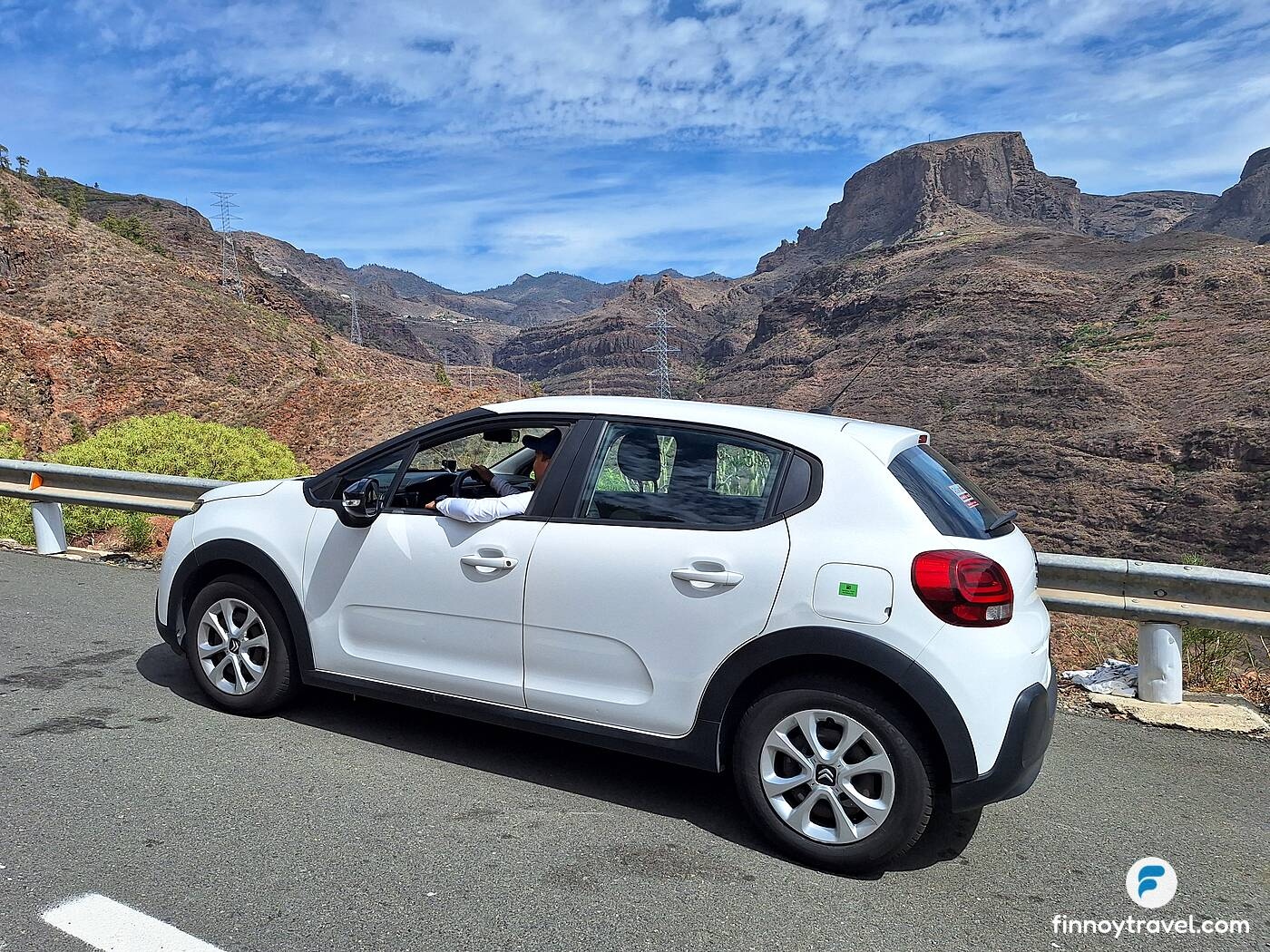
Why a car is almost mandatory in the Canaries
Without a car, the Canary Islands are tough. Public transport exists, but it is slow, patchy, and largely impractical for daily life outside the main cities. If you live in the south of Gran Canaria or anywhere outside the urban cores of Tenerife, a vehicle is non-negotiable.
The question is simply: buy or rent? The answer depends on three factors: how long you are staying, how much capital you want to tie up, and whether you are self-employed or salaried.
The three options at a glance
| Criterion | Purchase | Long-term rental | Renting |
|---|---|---|---|
| Capital outlay | High | None | Low |
| Duration | Unlimited | 1–12 months | 12–48 months |
| Insurance | Arrange yourself | Included | Included |
| Maintenance / ITV | Your responsibility | Included | Included |
| Depreciation | Your risk | No risk | No risk |
| Flexibility | Low | Very high | Medium |
| Cost from | €3,000–5,000 | €350–500/mo | €250–400/mo |
Option 1: Buying
If you are staying for more than a year or two and would rather not pay monthly for something you will never own, buying is the way to go. The Canaries offer a genuine tax advantage: instead of the 21% VAT (IVA) on mainland Spain, the islands apply the IGIC — between 7% and 13.5% for new cars. For electric vehicles and hybrids emitting less than 110 g/km CO₂, the IGIC rate is 0%.
New car from a dealer
IGIC is charged on the purchase price (7% for standard passenger cars). On top of this comes the Impuesto de Matriculación, which depends on CO₂ emissions — 0% below 120 g/km, up to 14.75% above 200 g/km.
Used car from a private seller
This is where the Canaries really stand out. On the Spanish mainland, private used-car sales attract the ITP (4–8% depending on region). In the Canaries, there is no ITP — used-car transactions between private individuals are tax-free. You still need to file Modelo 620 with the Agencia Tributaria Canaria.
Used car from a dealer
The dealer charges 7% IGIC on the sale price.
Importing a Car from the Mainland?
If you bring a vehicle from peninsular Spain or another EU country, you must declare it at customs (DUA) and pay IGIC on the vehicle's fiscal value: 9.5% for cars up to 11 fiscal horsepower (CVf), 15% above. Add ferry transport (approx. €1,500–2,500) and port charges. Those relocating for work may apply for a tax exemption under certain conditions.
Option 2: Long-term rental
Long-term rental (alquiler de larga duración) is the classic solution for the first few months after moving — or for anyone who values maximum flexibility. Several Canarian operators specialise in contracts from one to twelve months, including Cicar, TopCar, Autoreisen and Islacar.
Monthly rates range from €350 to €600 depending on vehicle class and typically include comprehensive insurance, maintenance and roadside assistance.
Advantage: zero capital outlay, zero depreciation, zero paperwork. Downside: more expensive than owning a car in the long run, and contract terms (mileage limits, damage excess) vary widely between operators.
International brands like Europcar or Hertz are usually significantly more expensive for long stays than local operators.
Option 3: Renting (leasing)
Renting is a hybrid between buying and renting — popular among freelancers and small businesses because the monthly fee is fully tax-deductible as a business expense. Operators such as Avanti Renting, myCarflix and Lencar offer contracts from 12 to 48 months, with rates starting at around €250/month.
The price includes insurance, maintenance, ITV and often tyre changes.
Advantage over long-term rental: lower monthly rate for a longer commitment. Downside vs. buying: you do not own the car at the end. Some operators offer a purchase option at residual value.
Driving licences for newcomers
EU citizens (including EEA: Iceland, Liechtenstein, Norway) can drive in the Canaries with their national licence as long as it remains valid. Exchange is voluntary but can be worth it — the Spanish licence is valid for 15 years and requires no translation.
Non-EU citizens may only drive with their foreign licence for six months after acquiring legal residence in Spain. After that, the licence must be exchanged — but only if Spain has an agreement with the country of origin. If there is no agreement, you must take the full Spanish driving test from scratch.
The exchange is processed at the Jefatura Provincial de Tráfico — on Gran Canaria in Las Palmas. Book via the DGT website or by calling 060. Required documents: valid foreign licence (original), NIE or DNI, empadronamiento, psychophysical fitness certificate (€30–40 at CRC centres) and a passport photo. Processing time: two weeks to six months depending on country of origin.
ITV — the Spanish MOT
The ITV (Inspección Técnica de Vehículos) is Spain's equivalent of the British MOT or German TÜV. Inspection intervals:
- New cars: first ITV after 4 years
- 4–10 years old: every 2 years
- Over 10 years old: annually
The test costs between €30 and €60 depending on vehicle type. On Gran Canaria, ITV stations are located in Las Palmas, Telde and Maspalomas. Without a valid ITV, the vehicle is uninsured and may not be driven on public roads.
Insurance and no-claims bonus
Third-party liability insurance (seguro a terceros) is legally required in Spain. Annual premiums for basic cover in the Canaries range from €250 to €500, depending on vehicle and driver profile. Comprehensive cover (seguro a todo riesgo) costs €600 to €1,200 per year.
Important: the Spanish no-claims bonus system (bonus-malus) is not directly comparable to other European systems. Newcomers from abroad typically start without any discount. It is worth bringing a claims-history certificate from your previous insurer — some Spanish companies (Línea Directa, Mutua Madrileña, Pelayo) will recognise documented no-claims years from abroad on request.
The recommendation: a staged approach
For most newcomers, a phased approach works best. Start with a long-term rental for the first one to three months — this gives you time to learn the island and figure out what kind of car suits your daily life. Do you need four-wheel drive for the mountains? Will a small city car do?
Then buy a used car from a private seller — tax-free, with room to negotiate, and easy to find on platforms like Milanuncios, Wallapop or local Facebook groups.
If you are arriving as a freelancer or business owner, look into the renting model — the tax deductibility can largely offset the cost difference compared to buying.