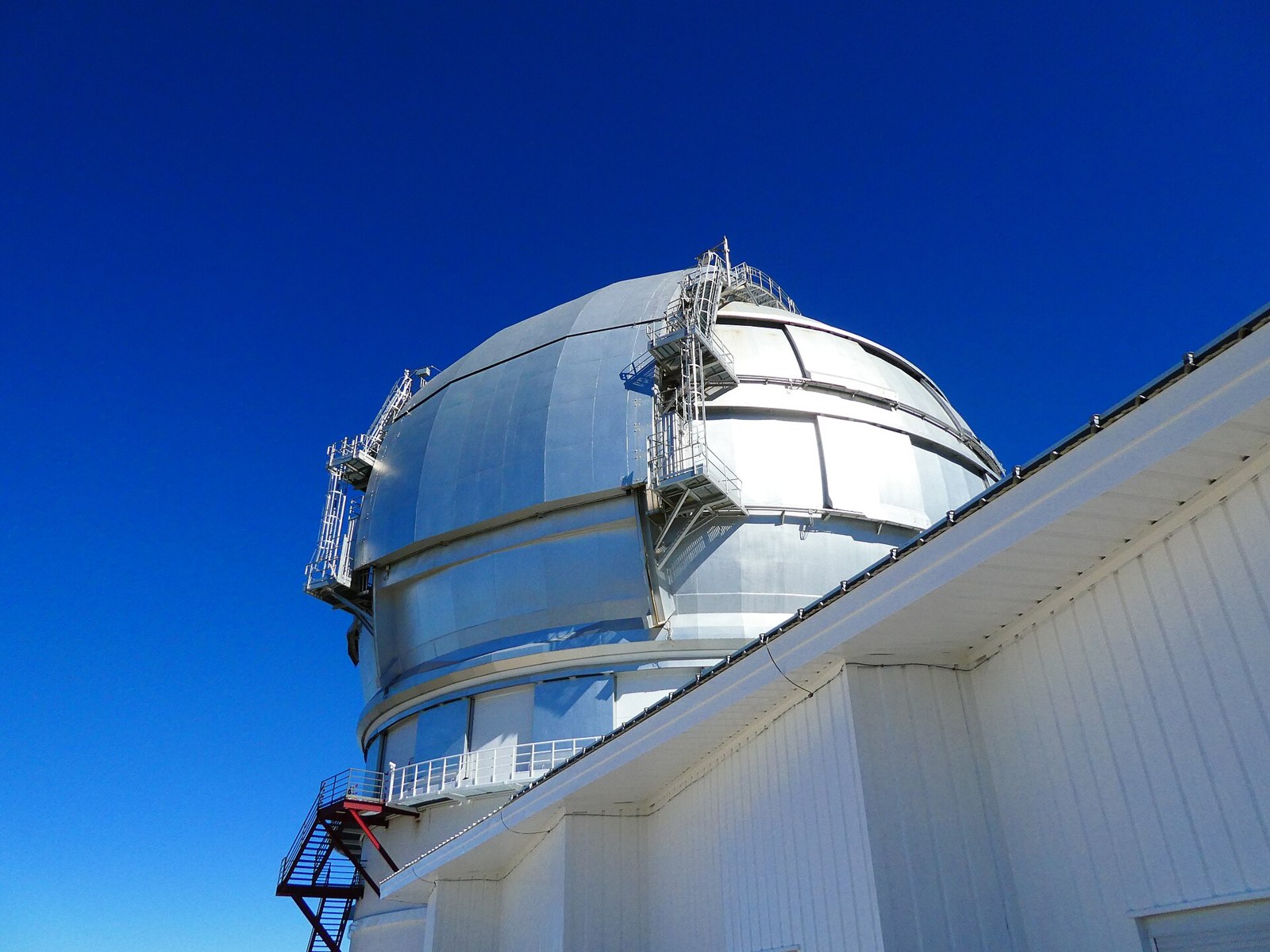
Key facts
What: Four giant telescopes that capture light from the most extreme places in the universe — black holes, exploding stars, galactic cores
Where: Roque de los Muchachos, La Palma, 2,396 metres above sea level
When: Inauguration 15 October 2026
Who: 1,500 scientists from 31 countries, coordinated by the Instituto de Astrofísica de Canarias (IAC)
Second site: Atacama Desert, Chile
Sources: IAC, Infobae, Diario de Avisos, elDiario.es Canarias, Max Planck Institute for Physics
Contents
15 October: the day 1,500 scientists have been waiting for
This morning, the council of the CTAO — the Cherenkov Telescope Array Observatory — met in Los Cancajos on La Palma. Delegates from more than ten countries. The outcome: a date. 15 October 2026 will be the day the four Large-Sized Telescopes at the Observatorio del Roque de los Muchachos are officially inaugurated.
The inauguration will be led not by a politician but by Japanese physicist Takaaki Kajita — 2015 Nobel Prize laureate in physics, one of the few people ever to have discovered a fundamental building block of the universe. The fact that he is coming to La Palma says everything about the standing of this project.
What the telescopes can do — and why it matters
Each of the four telescopes has a mirror 23 metres in diameter. 400 square metres of reflective surface. The camera behind it takes images fast enough to freeze the flash from a single gamma-ray collision billions of light years away — and reconstruct from it what happened out there.
Four telescopes working together are what makes it possible. Only when all four see the same flash from slightly different angles can the source be pinpointed precisely. The first telescope, LST-1, has been operational since 2018 and is already producing scientific results. The other three were built from 2023 onwards; their structures are complete and the final cameras were installed in recent weeks.
One observatory, two sides of the Earth
La Palma is the northern site. In Chile's Atacama Desert, the southern site is being built in parallel. Together they cover the entire night sky, around the clock. Hundreds of petabytes of data per year, open to the global research community — the CTAO operates on open science principles.
The goal: answers to questions physics has left open for decades. How does cosmic radiation originate? What is dark matter? What happens at the edge of a black hole? The CTAO is not a telescope that photographs the sky. It is an instrument that directly measures the physics of the universe.
La Palma as the world capital of astronomy
The Roque de los Muchachos already houses Europe's largest optical telescope — the Gran Telescopio Canarias — and the MAGIC telescopes, the CTAO's predecessors. With the four new LSTs, La Palma becomes the home of the most powerful high-energy observatory on Earth.
For the island, this means more than prestige. Local companies were given priority in construction and infrastructure, long-term operational jobs are being created. For La Palma, still rebuilding after the 2021 volcanic eruption, the CTAO is also a symbol — that the island has not just survived, but is attracting the world.
Frequently asked questions
- What is the CTAO?
- The Cherenkov Telescope Array Observatory is the world's largest observatory for high-energy gamma rays. It has two sites: La Palma (northern hemisphere) and the Atacama Desert in Chile (southern hemisphere). Over 1,500 scientists from 31 countries are involved.
- What is Cherenkov radiation?
- When gamma rays strike Earth's atmosphere, they produce a tiny blue flash of light — Cherenkov radiation. It lasts only nanoseconds and allows scientists to trace the gamma-ray source in deep space.
- When is the inauguration?
- 15 October 2026, at the Observatorio del Roque de los Muchachos on La Palma. Led by Nobel laureate Takaaki Kajita (Physics Nobel Prize 2015).
- How big are the telescopes?
- 23-metre mirror diameter, 400 square metres of reflective surface. Each mirror weighs 18 tonnes.
- What will the CTAO actually study?
- Black holes, supernovae, active galactic nuclei, dark matter, cosmic rays — the fundamental questions of high-energy physics.
- Can you visit the observatory?
- Yes — the IAC runs guided visitor programmes on selected days. Details at iac.es.