What's at stake
On 10 May 2026, the Dutch expedition ship MV Hondius anchored off Granadilla de Abona, in southern Tenerife. On board: a hantavirus outbreak.
14 Spaniards, one death, three further international fatalities, eleven confirmed cases worldwide — the sanitary situation was demanding, but under control.
What did not remain under control: the political reaction.
Within ten days, the crisis opened three front lines — between Madrid and the Canary government, between President Clavijo and his PP vice-president, and between Coalición Canaria and every other force in the Canary parliament.
The coalition that has governed the archipelago since 2023 is shaking. For residents this means uncertainty. For tourists, hardly measurable consequences so far.
Three fronts — and a president in the middle
First front: Madrid against the Canary government. Pedro Sánchez (PSOE, social democrat, Madrid's Prime Minister) took the ship in on a direct request from WHO Director-General Tedros Adhanom Ghebreyesus.
Legal basis: articles 13, 27, 28 and 44 of the International Health Regulations. Clavijo initially refused the docking.
Later he claimed that information about a positive case had been withheld from him. Madrid disputed this and pointed to 22 phone calls and 14 meetings ahead of the crisis.
Second front: between Clavijo and his PP vice-president Manuel Domínguez. The latter also attacked Sánchez on Sunday 10 May — but from a different position, with less force and without the cover-up accusation.
The difference showed up in wording: Clavijo spoke of «caciquismo, prepotency and arrogance», Domínguez of «lack of coordination». The CC-PP coalition publicly cracked for the first time.
Third front: between Clavijo and the Canary parliament. PSOE spokesperson Sebastián Franquis called Clavijo's behaviour an «indecent spectacle». Nueva Canarias secretary-general Luis Campos accused him of «lying and political alarmism».
And Vox spokesperson Nicasio Galván directly urged Clavijo to break with the PSOE and consider a Vox pact — as in Extremadura and Aragón.
With that, the Hondius crisis has opened the strategic position of Coalición Canaria.
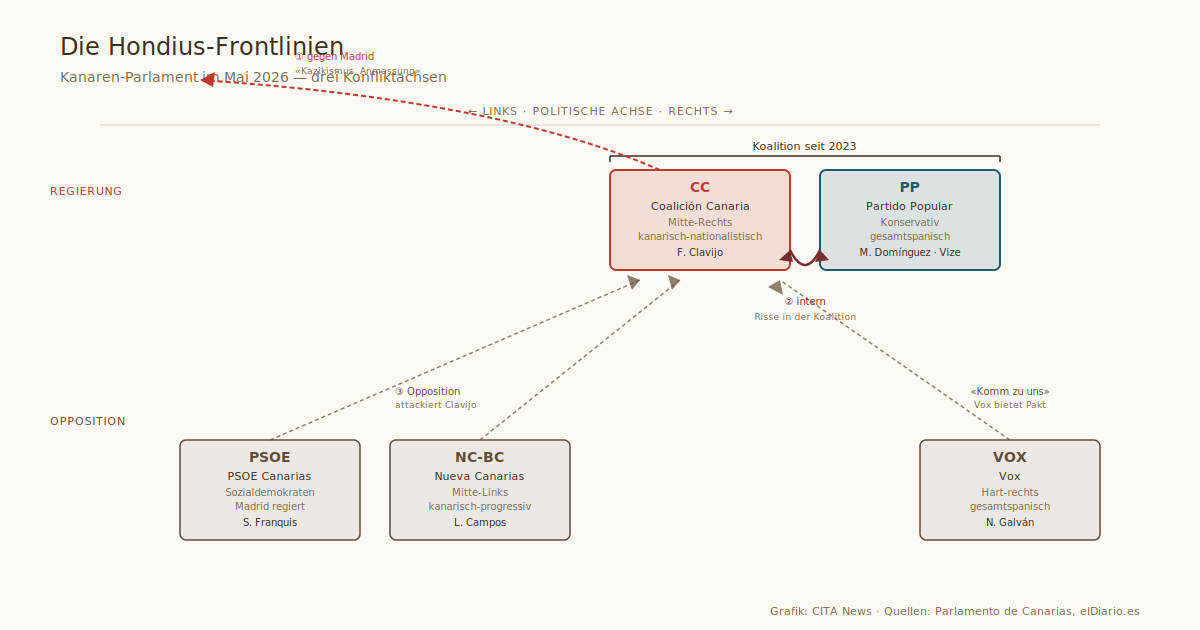
The three front lines of the Hondius crisis in the Canary parliament. Graphic: CITA News.
What Clavijo says
In the Canary parliament on 13 May, Clavijo said he had known «from day one» that there were infectious people on board.
He had therefore insisted on PCR tests before disembarkation, which the Ministry of Health had refused, because they would have revealed «his great lie». «An insult I will never forget», he said.
Asked whether he would break with Madrid's PSOE, he did not answer directly. But he criticised «the Canary socialists who straighten up when the advisers from Madrid call them».
His closing image was an evocation of the historical discourse of colonial overreach: «We will not accept that someone from Madrid endangers the safety of Canary residents while we bow our heads.»
What Madrid answers
The answer came in layers. Minister of Health Mónica García (Más Madrid, green-left, smallest coalition partner of the Sánchez government) said on the day the ship departed, 12 May, that the operation had been carried out «with efficiency, commitment, transparency and humanity».
Minister of Territorial Policy Ángel Víctor Torres (PSOE, former Canary president and Clavijo's main political opponent on the islands) directly contradicted Clavijo: the US citizen Clavijo referred to had first tested inconclusive, then negative — confirmed by US authorities.
On the Cadena SER programme «Hora 25», Torres said Clavijo was «trying to justify a complicated situation».
From the Moncloa Palace, as elDiario.es reported, the talk was of «deep disappointment» and «we expected more loyalty and less politicking».
PSOE Canarias spokesperson Sebastián Franquis documented 22 phone calls and 14 meetings between Madrid and the Canary government during the crisis. Clavijo, he said, had «leaked private conversations».
What the population feels
On 8 May around 40 people gathered in Las Palmas to protest the ship's arrival.
CNN Español wrote on 10 May of an «outbreak of global memories of COVID, very alive in Tenerife».
Tedros Adhanom Ghebreyesus addressed an open letter to the Canary population: «The pain of 2020 remains real. But you need to hear me clearly: this is not another COVID. The public-health risk from hantavirus remains low.»
The population's mistrust spreads asymmetrically: towards Madrid for deciding at the Canary Islands' expense; towards Clavijo for fuelling alarm; towards the medical authorities for not providing all the answers.
The WHO officially rated the risk as low. There were no cases in the local population — Granadilla is an industrial port, direct contact was excluded.
What tourists do
The tourism reaction was remarkably subdued. Pablo González, manager of the hotel association Ashotel, spoke on 12 May of a «minimal impact — no more than 1 percent» in cancellations.
Some complexes recorded up to 10 percent cancellations, but «insignificant in the overall volume». Ashotel president Jorge Marichal even said that the well-managed crisis image could bring the island «medium-term tourism dividends».
The Spanish travel-agency confederation CEAV said «bookings remain normal».
Inquiries to Ashotel asking whether travel to Tenerife was «safe» did rise — but the major tourism shock did not arrive.
Which is at least notable, because Canary tourism was already collapsing in April: Germans are missing at minus 16 percent, Scandinavians at minus 30 percent.
The Hondius crisis did not measurably amplify the strain in the sector.
Frequently asked questions
- What consequences for the Canary government?
- The Coalición Canaria–PP coalition publicly cracked for the first time. Vox offered Clavijo a switch. An early coalition crisis ahead of regional elections is not ruled out.
- Who formally took the Hondius in?
- The Spanish central government, at the request of WHO Director-General Tedros Adhanom Ghebreyesus, on the basis of articles 13, 27, 28 and 44 of the International Health Regulations.
- What was the risk to the Canary population?
- Low according to the WHO. Granadilla is an industrial port with no direct population contact. Human-to-human hantavirus transmission is rare, almost only documented for the South American Andes virus.
- How many tourists have left?
- Ashotel reports cancellations of around 1 percent. Some complexes recorded up to 10 percent. The Spanish CEAV sees no «significant impact» on bookings.
- Has the Hondius crisis worsened the tourism decline?
- Not measurably so far. The April collapse has structural causes (Germany minus 16 percent, Scandinavia minus 30 percent) unrelated to Hondius.
- How did the Hondius operation end?
- Disembarkation on 11 and 12 May was smooth. The ship is now heading to Rotterdam (arrival 17–18 May), 14 Spaniards are in a 42-day quarantine in Madrid, one of them positive with mild symptoms.