What's at stake
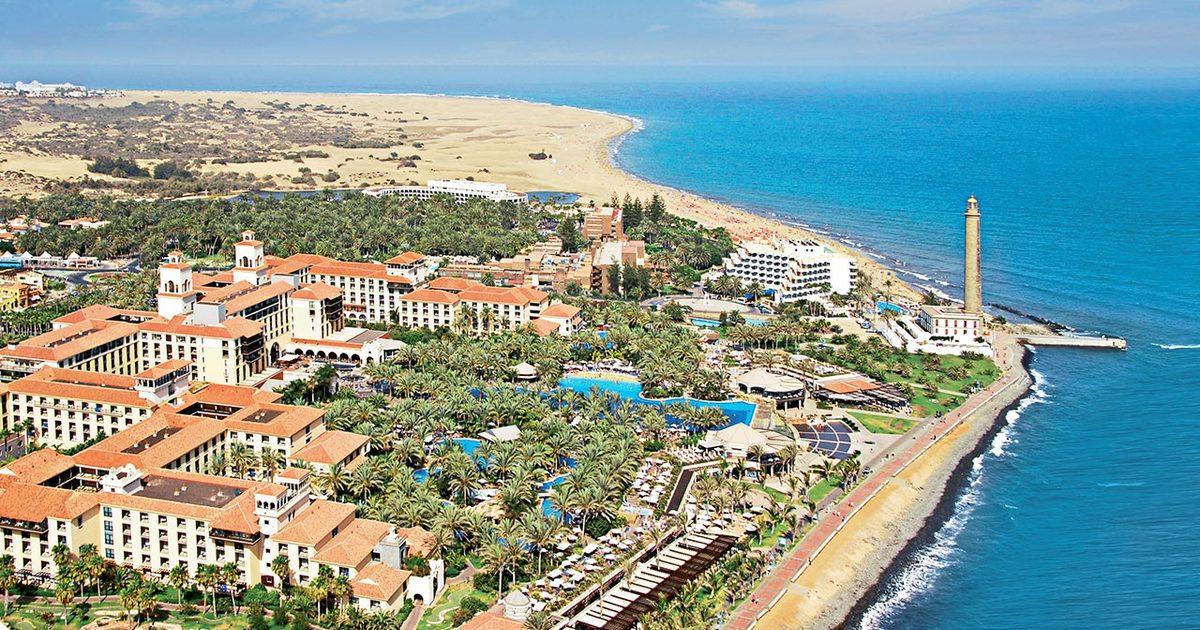
On 7 May 2026, the engineering firm TYPSA confirmed via LinkedIn that it had taken on the architectural design contract for the «Lopesan Meloneras Family» hotel. The project covers 953 rooms on a 160,000-square-metre plot in Maspalomas, southern Gran Canaria. At that scale, it would be the largest single hotel the Lopesan group has ever built. The confirmation lands in a phase when the key indicators for southern Gran Canarian tourism — repeat-visitor share, air capacity, overnight stays — are all pointing down.
What's confirmed — and what isn't
TYPSA's description of the project lists four restaurants, several pools, expansive gardens and dedicated leisure and retail areas. The hotel is explicitly targeted at the family segment and rated five stars. Neither Lopesan nor TYPSA has disclosed an official investment figure — the 300 million euros figure circulating online refers to a separate Lopesan project in Punta Cana, Dominican Republic. No construction start date is announced; with the TYPSA contract confirmed, the technical design phase is now underway.
The second, smaller Meloneras project is advancing in parallel: in April 2025, Lopesan began earthworks for a 5-star convention hotel of 533 rooms on a 48,276-square-metre plot next to the ExpoMeloneras convention palace. Investment there: 61 million euros, with a licence dating from November 2023. It was the first new Lopesan hotel in Meloneras since the Baobab opened in October 2009. With the «Family» project, the pipeline doubles in scope within fourteen months.
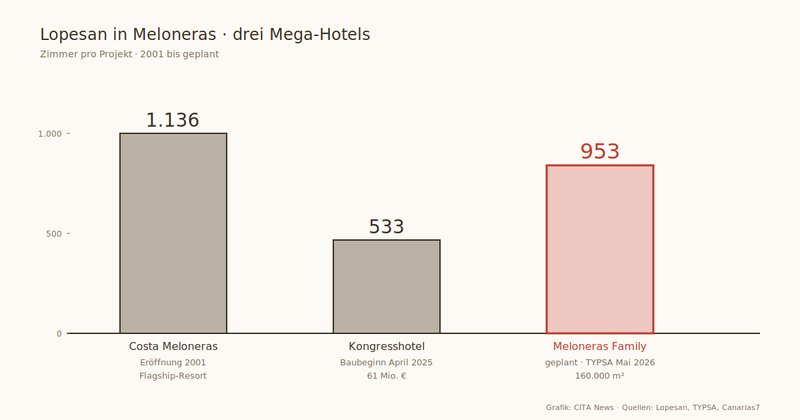
Lopesan in Meloneras: Costa Meloneras (1,136 rooms, 2001), Convention Hotel (533 rooms, under construction), Meloneras Family (953 rooms, planned). Graphic: CITA News.
Meloneras 2A after 20 years of standstill
The Family project isn't isolated — it's part of an urban-planning package. In 2025, the San Bartolomé de Tirajana town hall adopted a «Modificación Menor» of its Plan General, unlocking the Meloneras 2A sector that had been blocked for more than two decades. Within that framework, over 700 million euros in combined public and private investment are foreseen, alongside roughly 3,600 new tourist beds and 300,000 square metres of public land released for education, health, sports and green spaces.
One detail of the plan change makes it easier for investors like Lopesan to develop individual plots independently, without waiting for large joint operations. That is exactly what Lopesan is using now for the Family hotel — and in parallel for expanding the existing Villa del Conde.
The other statistics: southern GC loses its repeat visitors
While the permits for Meloneras 2A paint a picture of a destination on the rise, the ISTAC data points the other way. In the third quarter of 2025, the share of repeat visitors in southern Gran Canaria fell from 70.5 percent in the first quarter to 55.4 percent — a drop of 15.1 percentage points within nine months. The share of guests with more than ten previous visits halved from 14.7 to 8.4 percent in the same period. The share of guests who rated their stay as «worse or much worse than expected» reached 3.7 percent — the year's high.
The first quarter of 2026 added a second layer: overnight stays from Canarian travellers collapsed by 16.1 percent, those from mainland Spanish travellers fell by over 10 percent. Air capacity from the Spanish mainland dropped 10.4 percent in February 2026 — more than 53,000 fewer seats in a single month. Sweden cut capacity by nearly 35 percent, Germany by 8 percent. The Canary Islands' tourism minister, Jéssica de León, publicly cited «great uncertainty» and «clouds» over the German market.
Excelcan, the trade association that counts Lopesan as a member, had already forecast in May 2025 that 2026 would «probably be a year of small declines». Vice-President José Carlos Francisco spoke of «a soft landing for tourism figures». The Family hotel decision lands squarely in that landing.
Lopesan and its owner
Lopesan Hotel Group is majority-owned by Eustasio López González, born in 1953 in Villa de Agüimes, ranked by Forbes as the wealthiest person in the Canary Islands with an estimated fortune of 1.275 billion euros. The group today employs over 4,000 people across tourism, construction and energy. Its flagship Costa Meloneras (1,136 rooms, opened 2001) has been Lopesan's largest holiday resort for two decades.
In January 2025, Lopesan together with the Stoneweg Hospitality fund acquired the Madrid Hotel Miguel Ángel for around 210 million euros; a 100-million-euro refurbishment is planned, with reopening in 2027. In parallel, Lopesan announced a 300-million-euro resort in Punta Cana at the London tourism fair. Eustasio López has been formally accused since 2021 of two alleged offences in the «Caso 18 Lovas» complex (minor prostitution); he denies the charges, remains free and awaits trial. In a parallel investigation («Operación Íncubo») he appears as witness, not as defendant.
What comes next
With the TYPSA contract, the detailed technical planning begins. Typically six to twelve months pass before a building application is filed; permitting processes in San Bartolomé de Tirajana experience-wise take another one to two years after that. A realistic opening of the Family hotel therefore lies hardly before 2029. By then it will become clear whether southern Gran Canaria's structural indicators recover — or whether the largest hotel in Lopesan's history opens into a phase in which the volume model of sun-and-beach tourism is running into its limits.
Frequently asked questions
- How much will the new Lopesan hotel in Meloneras cost?
- No official investment figure has been published. The 300 million euros number circulating online refers to a different Lopesan project in Punta Cana, not Meloneras.
- How many rooms will the hotel have?
- 953 rooms on 160,000 square metres. That would make it the largest single-hotel project Lopesan has ever undertaken.
- When will the hotel open?
- Neither construction start nor opening date have been announced. With architectural planning awarded to TYPSA, the detailed technical phase has only just begun. A realistic opening lies hardly before 2029.
- Who is TYPSA?
- A Spanish engineering firm with over sixty years of experience that handles architectural design and construction management for major infrastructure projects. The contract announcement came on 7 May 2026 via LinkedIn.
- What is the Meloneras 2A sector?
- A zone in Maspalomas that had been blocked for development for over twenty years until the San Bartolomé de Tirajana town hall unlocked it in 2025 with a planning amendment. Combined public and private investment of over 700 million euros is foreseen there.
- How is southern Gran Canarian tourism doing?
- The repeat-visitor share fell from 70.5 to 55.4 percent in the third quarter of 2025. In the first quarter of 2026, overnight stays by Canarian travellers fell 16.1 percent and air capacity from the Spanish mainland 10.4 percent. Excelcan expects 2026 to bring «small declines».