What's at stake
On 12 May 2026, Cáritas Diocesana de Tenerife presented its sixth report on extreme residential exclusion at the island's Cabildo. The headline figure: 2,853 people lived in this condition in 2025 — on the street, in caves, in cars, in self-built huts. In 2024 the number was 2,838, five years earlier just 1,784. On Gran Canaria, the same phenomenon shows a different face: at the mouth of the Arguineguín ravine, 300 metres from the beach, a shantytown of more than 300 residents has grown since the pandemic — some of them with tourism jobs. The two islands share a structural problem that has kept the Canary Islands at the bottom of Spain's social-indicator rankings for years.
Tenerife: 2,853 — a number that's no longer just a pandemic aftermath
The sixth Cáritas report, coordinated by social-housing technician José Antonio Díez, shows a shift in the profile of those affected. Almost 75 percent of those counted are men, 25 percent women — a figure the report describes as «hidden homelessness», because women seek alternatives to the street and so are harder to count. 52 percent hold Spanish nationality, 17 percent live without a regular residence permit, but many are «trapped in administrative labyrinths», in the words of Cáritas director Juan Rognoni.
The report's central statistic is the one that breaks with the stereotype: 49.9 percent of those affected came from regular housing situations before falling into the street. 26.1 percent lost their family home, 7.2 percent slipped through unpaid rent into homelessness. «Behind situations of extreme residential exclusion, multiple factors converge: rupture of family networks, unemployment, difficulties of housing access, addiction or mental-health problems», Rognoni said at the Cabildo presentation. Almost half of those affected live outdoors, in parks, on benches or in doorways; another 25 percent in improvised structures such as huts, caves, tents, storage rooms, caravans or vehicles.
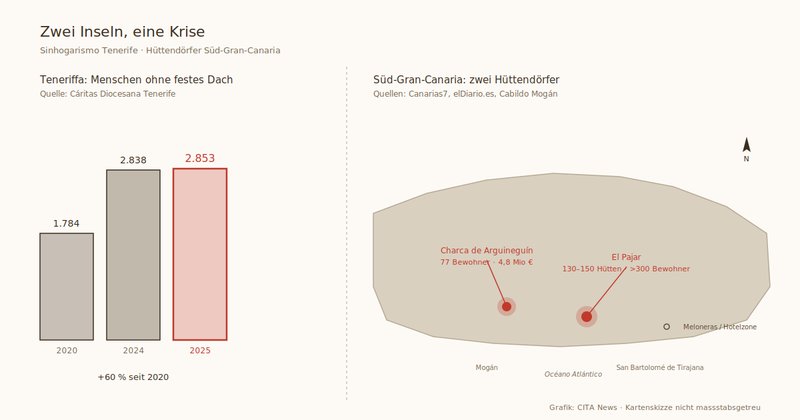
Two islands, one crisis. Graphic: CITA News.
Gran Canaria: a slum 300 metres from the beach
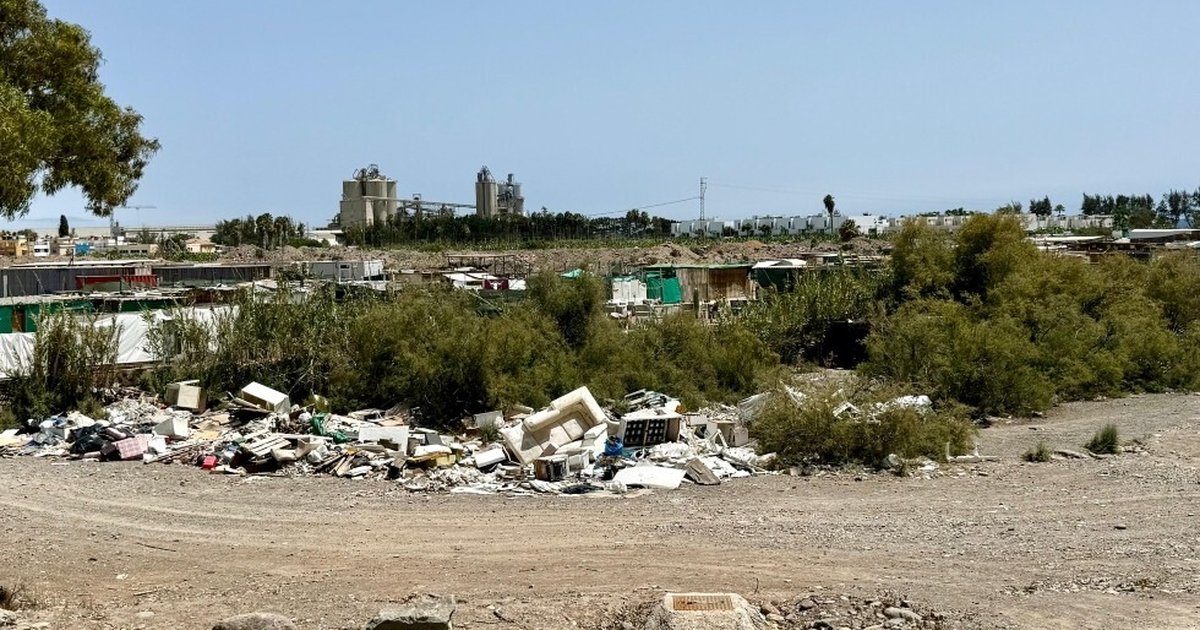
In southern Gran Canaria, on the boundary between the municipalities of San Bartolomé de Tirajana and Mogán, what the administration labels the «El Pajar settlement» is a corrugated-iron quarter of 130 to 150 huts, with a population the town hall estimates at «several hundred». There is no water, no electricity, no street lighting. Paths are marked with stacked pallets, and some residents have laid out a small square with plastic flowers and wooden benches. On one side stand banana plantations, on the other Mogán begins, and within sight of the coast a string of five-star resorts.
Juan, 53 years old, has lived in El Pajar for nearly a decade. He works as a lifeguard at a hotel and earns about 1,000 euros a month. «If you earn 1,000 euros and you pay 600 or 700 in rent, you have to beg to eat for the rest of the month», he told elDiario.es. Other residents include Reda, who arrived years ago by patera; Aroa, 21, whose parents lost their home; Hazmani, 53, who reduces his reasons for staying to one sentence: «You have to survive. You don't want to sleep on the streets. You build yourself a hut and that's it.» The San Bartolomé town hall has commissioned drone footage and is studying whether to open a procedure to restore urban-planning legality. The land is private — two families of the Del Castillo lineage own the two plots — and since April 2024 an eviction proceeding has been pending, which requires a vulnerability certificate from the town halls.
Charca de Arguineguín and Pino Seco — a 4.8 million euro programme
A few kilometres west of El Pajar, within the Mogán municipality, sits a second shanty quarter: La Charca de Arguineguín and the Barranco de Pino Seco. Here, the legal team of two landowners has identified 77 residents; the Asociación de Vecinos Las Lomas de Arguineguín, led by volunteer Jeni, has distributed food to the same constituency for 15 years. «There are families who have lived in these shacks for 60 or 70 years and aren't allowed to register their address there», she told Cope Canarias.
On 28 January 2026, Cabildo vice-president Augusto Hidalgo together with Mogán mayor Onalia Bueno signed the addendum to the «Programa para la Erradicación de Zonas Degradadas, del Chabolismo y la Infravivienda» — a four-administration agreement between Spain's Ministry of Transport (€1,874,370), the Canary Islands government, the Gran Canaria Cabildo (€1 million) and the Mogán town hall. Total budget: €4,794,191. A building with 23 new social-housing units (VPO) is planned, between Gazmira and Damasco streets, for around twenty families currently living in tin shacks. The tender for the works is planned in the coming weeks, Bueno said at the signing.
What connects them
Behind the different forms — street homelessness on Tenerife, shantytown on Gran Canaria — lies the same economic mechanism. The Canary Islands rank fifth in Spain by share of population at risk of poverty or exclusion (AROPE), at 31.2 percent, behind Andalusia, Castilla-La Mancha, Extremadura and Murcia. The EAPN 2025 report, based on INE data, simultaneously shows the highest income inequality in Spain by Gini index: it rose to 31.6 points in 2024 because income gains concentrated in the upper brackets. The three municipalities with the most tourism overnight stays in the Canary Islands — San Bartolomé de Tirajana, Adeje and Arona — are among the fifteen most unequal in Spain.
Cáritas Tenerife cites «tourism and migration management» as one of the structural factors driving rising homelessness. The 5th report (October 2025) put it plainly: rising hotel demand and the influx of new residents — overwhelmingly from the Americas and Europe — are pushing the rental market beyond the reach of islanders. On Gran Canaria the phenomenon takes its most visible form: the nearby Lopesan resorts in Meloneras are staffed by the very service workers, some of whom live in El Pajar.
What comes next
On Tenerife, Cáritas calls for a strategy based on the «Marco Estratégico para la Inclusión Social y Comunitaria de las Personas en Situación de Sinhogarismo», coordinated by the Cabildo's IASS. Concrete demands: expansion of the social-housing stock, simplification of the «empadronamiento» registration procedures, bridge teams between street and health services. On Gran Canaria, the Erradicación programme in Mogán moves into the tendering phase; in San Bartolomé de Tirajana the El Pajar case remains legally stuck — as long as an eviction depends on vulnerability certificates from both town halls, nothing happens in practice. Las Palmas de Gran Canaria laid the foundations for a Municipal Network of Care for Homeless Persons in December 2025; a second plan is announced for 2026.
The EU's 2021 Lisbon Declaration commits member states to ensuring that no one sleeps rough by 2030. In the Canary Islands the number has risen for five straight years.
Frequently asked questions
- How many people live without a stable roof on Tenerife?
- The sixth Cáritas report counts 2,853 people in extreme residential exclusion in 2025. In 2024 it was 2,838, in 2020 just 1,784 — a rise of roughly 60 percent in five years.
- What is El Pajar on Gran Canaria?
- A shantytown on the boundary between San Bartolomé de Tirajana and Mogán, 300 metres from the beach. Estimates speak of 130 to 150 huts and over 300 residents. There is no water or electricity.
- Who lives in El Pajar?
- Some are weekend-only residents, the rest live there full time — many work in tourism, on wages around 1,000 euros that don't cover rents in San Fernando or Arguineguín.
- Will El Pajar be cleared?
- An eviction proceeding has been pending since 2024 by the two private landowner families. Before a court ruling, the town halls must issue vulnerability certificates — the process is open.
- What's happening in Charca de Arguineguín?
- On 28 January 2026 the Cabildo and Mogán town hall signed an addendum worth €4.79 million. A building with 23 new social-housing units is planned for around twenty families currently living in tin shacks.
- How high is the Canary Islands' poverty risk?
- 31.2 percent of the population — around 695,000 people — live at risk of poverty or exclusion, according to INE 2024 data. The Canary Islands have the highest Gini index in Spain.