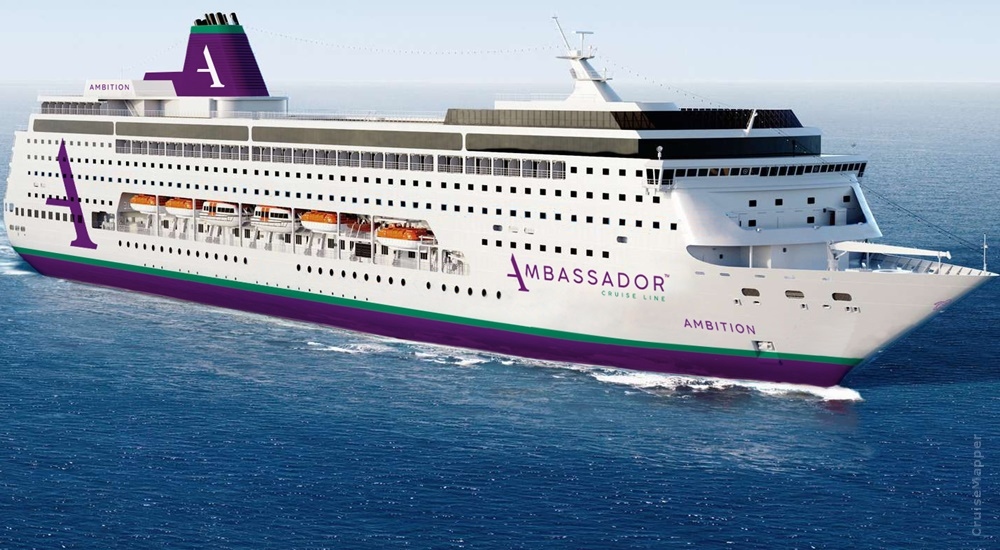
The ship nobody wanted to take
Imagine you have been stuck on a cruise ship for a week. You are 72 years old, you booked the cruise in Tilbury at the Thames estuary, you wanted «Winter Sunshine Escape» — sun-flight to the Atlantic — and instead you are stuck in Bordeaux. Confined. Because half the passengers have stomach cramps and you do not know if you are next.
This week that was the reality of 1,750 Britons and Irish on the MS Ambition. A British mid-range ship, built in 1999 in Saint-Nazaire, of the modest sort: «premium value», industry jargon for a target audience aged 50+, Atlantic crossings starting at £1,200 (around €1,430 or US$1,530), cabins large enough not to feel claustrophobic.
But norovirus doesn't care about cabin size.
Seven days after Hondius
A week ago it was a different ship. A different virus. A different port.
The research vessel Hondius — much smaller than the Ambition — came from the Falklands. Three dead passengers, a hantavirus outbreak of the rare Andes strain, transmissible human to human. Canary Islands politicians argued for days whether the ship should even be allowed to dock. The Tenerife Cabildo, Clavijo's regional government, Granadilla port, Madrid — all quarrelling simultaneously. Ten days ago that was the archipelago's main story.
Then on Wednesday a turn. WHO Director-General Tedros Adhanom Ghebreyesus, who had been in Granadilla in person, wrote an open letter to the people of Tenerife: «We live in a time when it is easy to close doors, to turn inward, to let fear become hostility. Tenerife chose something else. You have left a mark on how humanity responds to crises.»
He called it «moral courage». He called the Spanish coordination «impeccably precise». He thanked, «from the bottom of his heart», the 950,000 Tenerife residents who did not turn away a ship nobody else wanted.
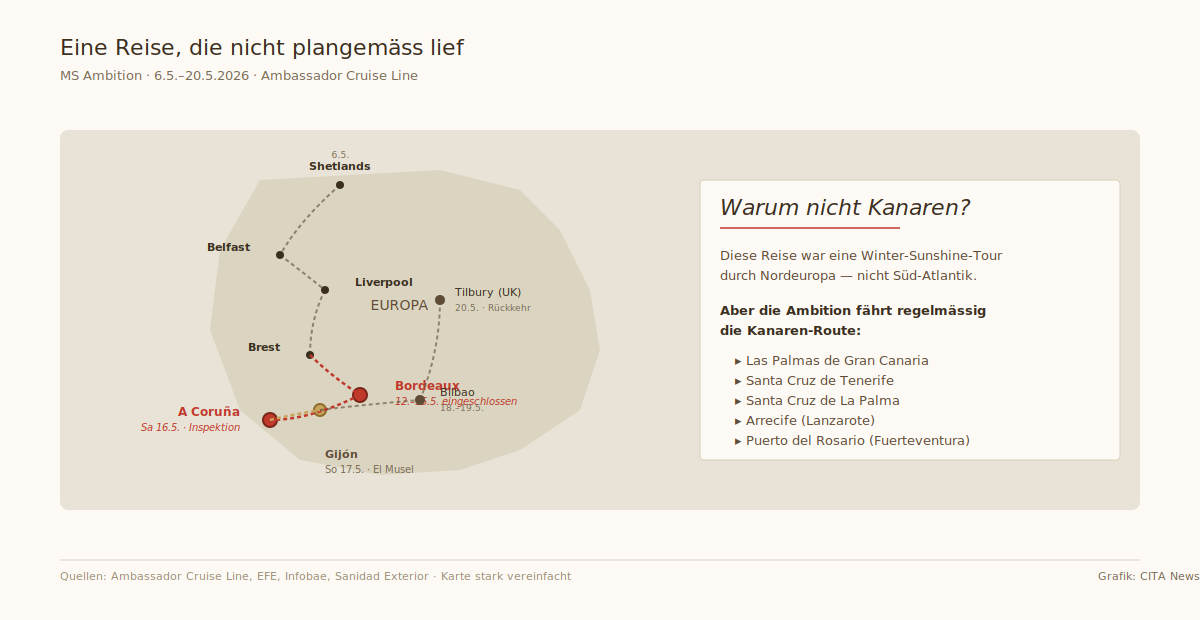
A Northern European tour, no Canary Islands stop — this time. Graphic: CITA News.
What changed this week
This Saturday at 9:30 in the morning the Ambition docked at the Muelle de Trasatlánticos in A Coruña. No quarrel. No political debate. No demonstrations at the port. Sanidad Exterior — Spain's border health authority — went on board, took an hour, gave the green light.
The 21 sick stayed isolated. The other 1,729 passengers were allowed ashore between 10:30 and 18:00. Some walked through A Coruña, others booked excursions to Betanzos or Santiago de Compostela, where Ascensión holidays are being celebrated.
A passenger told an EFE reporter on disembarking something that summed up the whole situation: «The Hondius theatre has meant we're getting more attention here than we deserve.» Translation: We have a stomach bug, they had hantavirus, leave us alone.
The man has a point. Norovirus is not hantavirus. Norovirus is what many call winter flu — with the academic precision only epidemiologists can stomach, Pedro Arcos of the University of Oviedo says: «It's the most common pathogen of acute gastroenteritis worldwide, with over 365 million cases a year.» Last year there were 30 norovirus outbreaks on cruise ships alone. When 1,700 people eat from a shared kitchen, the maths is no secret.
Hantavirus, by contrast, kills 30 to 40 percent of cases in the Andes variant.
What this means for the Canary Islands
The Ambition is not going to Las Palmas this time. But it could. The cruise line's route plans include Gran Canaria several times — the line shuttles between British ports, Madeira and the Canary Islands. When the season picks up again in autumn, ships like the Ambition will be back.
And that is the point: what Spain did this week in A Coruña — quick, calm, professional, no political theatre — is exactly what Tenerife did last week under strife. The difference: Hondius was a first, Ambition is routine. Routine gets practised through firsts.
Tedros' letter is not a courtesy. It is a curriculum. The Canary Islands tourism industry — which finances a good part of its winter season from cruise day-trippers — cannot afford to treat every ship with an illness as a national crisis. It needs stable protocols. A Coruña showed this week how it's done.
What remains: 21 Britons are throwing up on the way to Gijón. Three Hondius dead are being buried in three countries. A WHO chief says thank you. And a 1,700-person ship sails into El Musel at seven on Sunday morning, with a city expecting a normal Sunday in May.
That is actually how it should be.
Frequently asked questions
- Did the Ambition ever reach the Canary Islands?
- Not on this trip. The route ran Shetlands → Belfast → Liverpool → Brest → Bordeaux → A Coruña → Gijón → Bilbao back to Tilbury. But the ship regularly serves Canary Islands routes — typically with stops in Las Palmas, Santa Cruz de Tenerife and Arrecife.
- What's the difference between norovirus and hantavirus?
- Norovirus: highly contagious, mild course, passes within 2-3 days, more than 365 million cases worldwide a year. Hantavirus: significantly rarer, with higher mortality (30-40% for the Andes variant), usually transmitted by rodents, in rare cases human to human.
- Who decides whether a crisis ship can dock?
- In Spanish ports, Sanidad Exterior — the Ministry of Health's border health authority. They board the ship, check health and protocols. If a population risk exists, they can refuse docking.
- What did Tedros' letter actually achieve?
- Politically, it cools down the dispute over Hondius. Practically, it confirms WHO standards were upheld in Tenerife. Symbolically, it shifts the Canary self-perception — from «why must we do this» to «we did something important».
- Will more crisis ships come?
- Yes. About 35 million people cruise worldwide a year. Statistically, roughly every two weeks somewhere a ship faces a major outbreak. Spain will have to manage more — not fewer — such situations.