
What happened
Air Transat — Canada's largest leisure airline and named «Best Leisure Airline of the World» at the 2025 Skytrax Awards — announced on 7 May 2026 something Gran Canaria has not seen since the early 1970s: a regular direct flight to North America.
From Saturday 12 December 2026 the aircraft will depart Montreal-Trudeau. The following day, the Toronto Pearson connection begins. Until now, travellers had to transit through Madrid, Barcelona, occasionally Paris. Four hours of Atlantic less, less stress for a family, more sun on the same holiday.
Seasonal — until 4 April 2027. The aircraft will be the Airbus A321LR, the long-range member of the narrow-body family. Around 200 seats, two classes, subject to outstanding slot allocations and regulatory clearances.
Why this matters now
This is not just a flight. It is a turning point.
Tenerife — the Canaries' larger sister island by visitor numbers — gets the full programme too. Air Canada opens two weekly Toronto routes and one from Montreal from 25 October 2026. AirBaltic is setting up a seasonal base at Tenerife South. Iberia, TAP and Air France are reinforcing frequencies.
For the Canary Islands as a whole, that means market diversification. Until now, the islands have depended on British, German and Nordic winter tourism. The British keep coming — even though, as of February 2026, the electronic ETA authorisation costs £16 (around €18, or roughly US$20). The Germans are tapering off, as we analysed on Tuesday — minus 16 percent. The Italians partially make up for it.
What is still missing: North Americans. Until now, transit travellers through Madrid. From December: direct bookings.
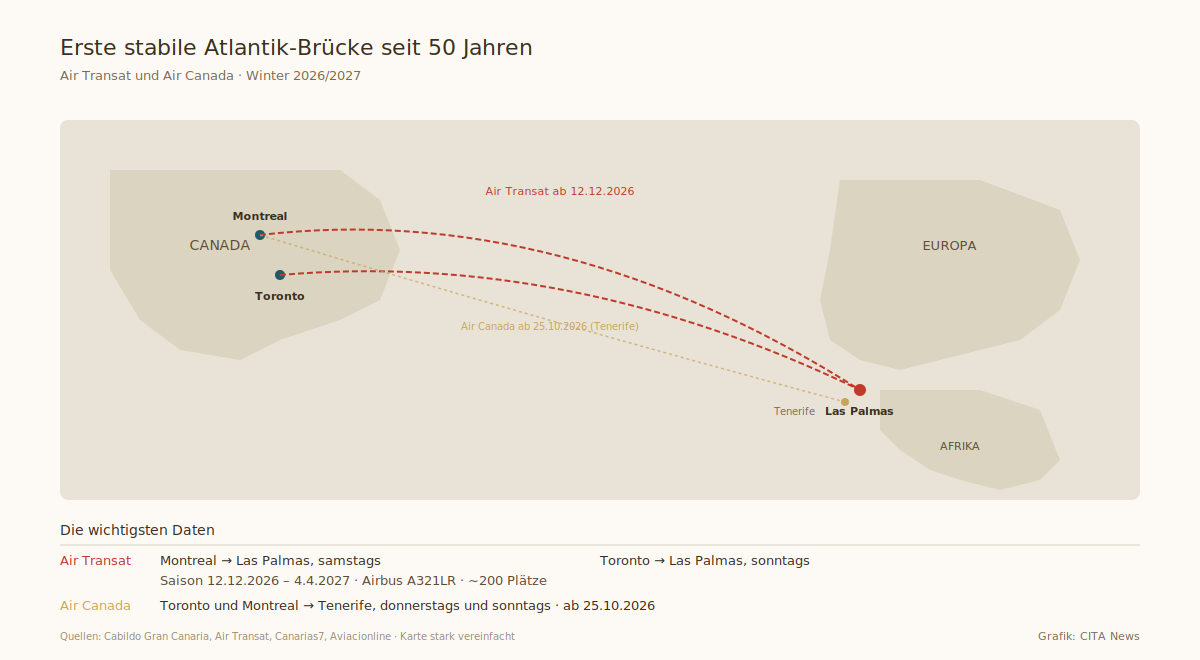
Two airlines, two islands. Graphic: CITA News.
What it means for the island
Sebastian Ponce, Chief Revenue Officer of Transat, puts it in PR language: «Las Palmas offers the best of both worlds — the sunshine and mild climate of the Canary Islands combined with the charm and cultural richness of Europe. With an ideal climate year-round, spectacular beaches and a vibrant gastronomy scene, it's a destination that perfectly fits travellers looking for something new.»
Behind the marketing language sits a solid calculation. Average winter temperatures in Las Palmas, December to February, are 18 to 22 degrees Celsius (64 to 72 Fahrenheit). In Toronto: minus three. In Montreal: minus nine. The market for direct winter sun is large, and until now it was closed to Gran Canaria.
The other direction will be interesting too. For the first time in generations, residents of Gran Canaria can fly to Canada without transiting through Madrid — family visits, business, studies. A 200-seat aircraft per week is not a mass market. But it is a door opening.
What it means for European tourists
For German, Italian, Spanish and British holidaymakers: two effects. First, Gran Canaria gets busier in winter — Canadians arrive in peak season, December to April, when the island is already in high gear. Second, the tourist mix changes. North Americans book different hotels, different beaches, different restaurants than Central Europeans. English will become more audible on the island — it already is, thanks to the British in Maspalomas and Playa del Inglés.
Third, an indirect consequence: hotel prices. If Air Transat and Air Canada together bring around 30,000 additional seats per island per season, demand for premium accommodation will rise. Rents in Las Palmas have already become expensive. The Canadians won't ease that pressure.
But: for European travellers who want to cross the Atlantic once, from December 2026 the reverse route also exists. Las Palmas → Toronto, direct, on Mondays. What is a Spanish island in winter becomes, in summer, a bridge to North America.
Bookings are open. Slots remain subject to clearance.
Frequently asked questions
- When does the flight actually start?
- 12 December 2026, Saturdays from Montreal. Sundays from Toronto. Last flight of the season: 4 April 2027.
- How long is the flight?
- Estimated 7 to 7.5 hours net flying time from Montreal, 8 to 8.5 hours from Toronto, depending on wind conditions. Exact schedules will follow slot confirmation.
- Which airport codes?
- YUL (Montreal Trudeau) to LPA (Aeropuerto Gran Canaria, Gando). YYZ (Toronto Pearson) to LPA.
- Is the flight year-round?
- No, seasonal only, December to April. Air Canada's Tenerife service runs longer (from 25 October 2026).
- Do Canadians need a visa for Spain?
- No, but probably from Q4 2026 they will need the EU's electronic ETIAS travel authorisation. Cost: €20 (about US$22), valid three years.