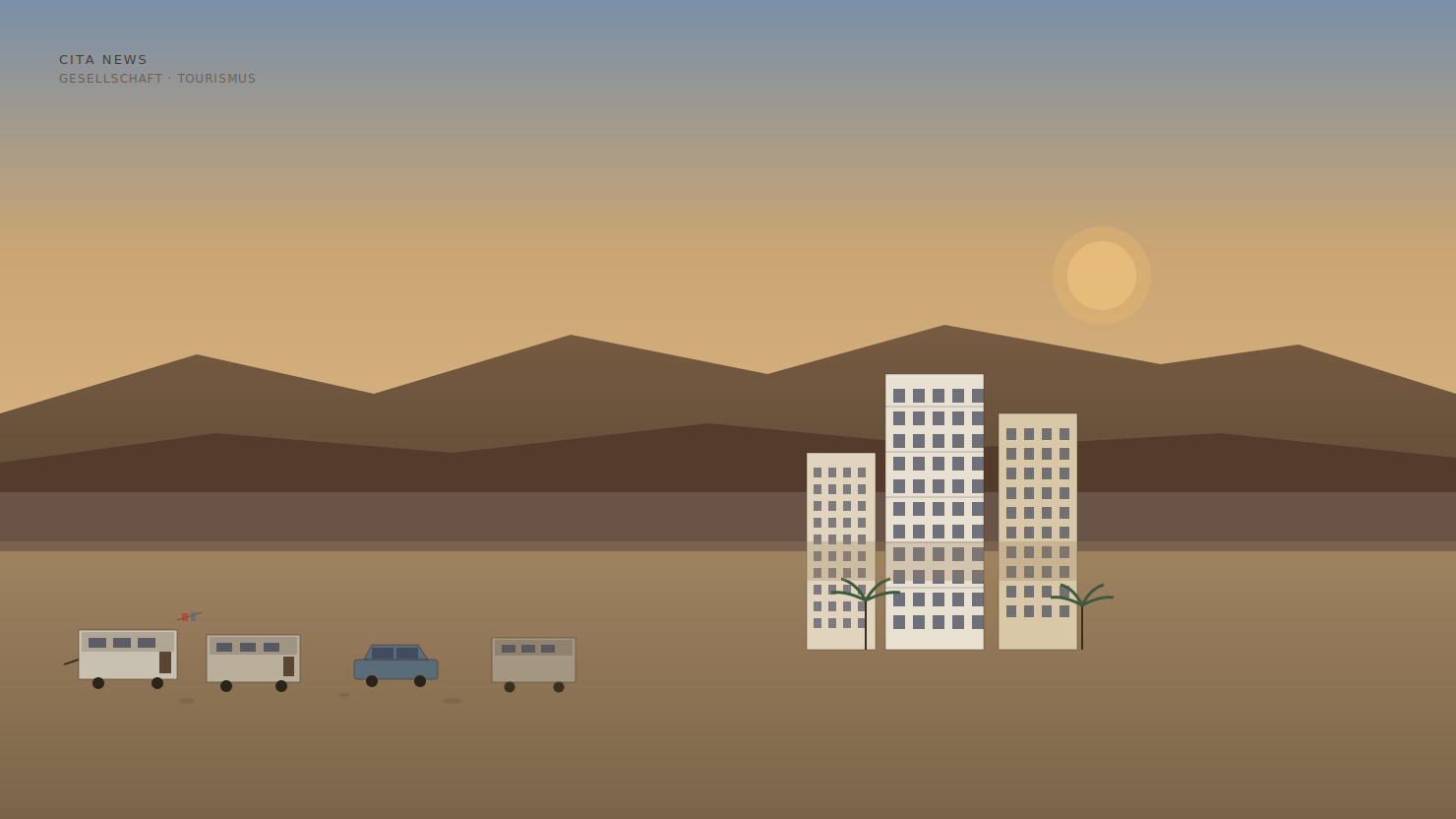
Kaat's caravan
If on a normal day in May you come out of Tenerife Sur airport and drive north — towards Granadilla de Abona, past Montaña Roja, the rust-red volcanic cone — you will see on the right, just behind the rental-car lot, a line of caravans. Some have been there for over a year.
In one of them lives Kaat. A Belgian woman in her mid-forties, currently pouring water for her dog. She told the broadcaster Cope her story in October 2024. «Rents are so high that it is practically impossible to find a place to live», she said. «There are people who lost their homes after the volcanic eruption on La Palma and still have nowhere to go. They live here while they wait for a solution.»
A year and a half later, they are still waiting. The caravans have multiplied.
Why your hotel pool shields you
Anyone holidaying in Tenerife follows a fairly specific choreography. Arrival Tenerife Sur. Transfer to Costa Adeje, Los Cristianos, Playa de las Américas — or Maspalomas on Gran Canaria. Hotel with a pool. Beach. Maybe Teide or the Maspalomas dunes as a day trip. Flight home.
This choreography is very well designed to make sure you do not see the other Tenerife.
You do not see the hotel worker who drives an hour every morning at five from La Esperanza down to Adeje because she can no longer afford a flat near her workplace. You do not see the waitress sharing a single bedroom with two colleagues. You do not see the teacher in Arona wondering whether to move back to the mainland, because he cannot keep working here without going broke.
And you do not see that the flat next to your hotel — which five years ago housed a family from Adeje — is now on Airbnb at 180 euros a night.
The number that explains everything
In Arona, a 65-square-metre flat currently costs 1,400 euros a month. The local outlet El Burgado ran the numbers in April 2026 using data from Idealista, Indomio and ISTAC.
The average net salary in the Canaries is around 1,500 euros a month.
The OECD rule of thumb says that no more than 30 percent of income should go on housing. Spanish housing law knows this rule too. It is in the text of the law. At a median salary of 1,500 euros net, that would mean a maximum of 450 euros in rent.
In Arona, Adeje, Granadilla, Guía de Isora and Santiago del Teide, 450-euro flats simply do not exist any more. Not in luxury locations. In standard residential 65-square-metre flats.
In La Laguna — university city, World Heritage Site — the housing burden is 63 percent of income. In Santa Cruz de Tenerife, 70 percent. In Los Gigantes, 73 percent. In Arona, around 93 percent.
Spanish housing law allows municipalities to declare «zonas tensionadas» in such cases. Rents are then capped, large landlords have to freeze prices. As of April 2026, the number of Canarian municipalities that have used this option is exactly zero.
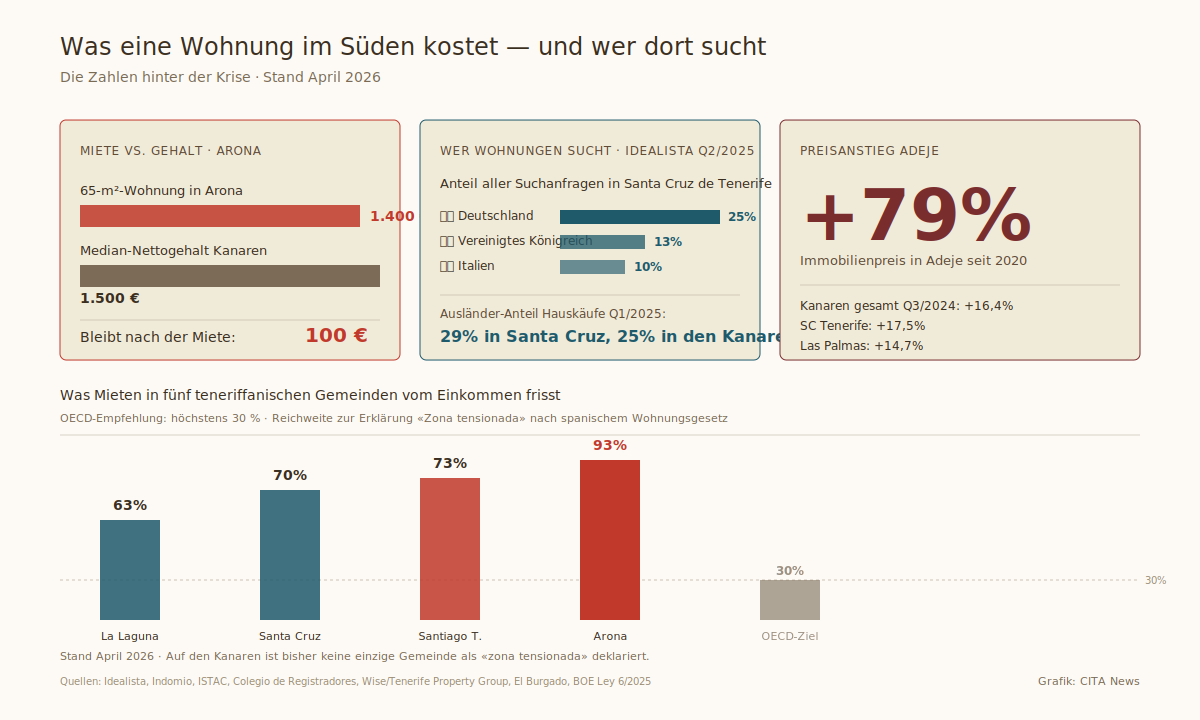
The numbers behind the crisis. Graphic: CITA News.
Who is actually buying here
When someone buys a flat in Adeje, almost one in three is a foreigner. That is not polemic, it is the statistic of the Colegio de Registradores for the first quarter of 2025: 29 percent of house sales in the province of Santa Cruz de Tenerife went to foreigners. In the Canaries as a whole, 24.6 percent — the third most important Spanish region for foreign buyers, after the Balearics and Valencia.
The Idealista search data for the second quarter of 2025 shows the same picture even more clearly. 25 percent of all housing searches in Santa Cruz de Tenerife come from Germany. 24 percent in Las Palmas. In second and third place: British and Italians, between 10 and 14 percent.
What do they buy? Adeje, Costa Adeje, Los Cristianos in southern Tenerife. Maspalomas and Playa del Inglés on Gran Canaria. Precisely the zones where Canarian workers work.
In Adeje, property prices have risen by 79 percent since 2020. That is not the rent — it is the purchase price. Four-fifths more expensive in five years.
Buyers are often buying as a second home or as a holiday-rental investment. Until the end of 2025 this was a pure yield business: with a return of 5 to 7 percent gross, a holiday rental beats almost any bond.
The Canarian government estimates that 200,000 flats on the islands are registered as holiday rentals. For comparison: regulated hotel and apartment-hotel beds total 325,000. The ratio is closer to 1:1 than any tourist imagines.
What is changing right now
On 10 December 2025, the Spanish parliament passed something remarkable. The Ley 6/2025, de Ordenación Sostenible del Uso Turístico de Viviendas — the Law on the Sustainable Regulation of the Tourist Use of Housing.
What it actually means:
Municipalities can no longer issue new holiday-rental licences automatically — they need their own urban-planning rules that prescribe where it is even allowed. New builds may not be rented as holiday lets until ten years after completion — so that gaps in the housing market are not immediately sold back to tourists.
Social housing may not be used for tourist purposes at all. Existing licences remain — but they can no longer be transferred to buyers or heirs. That cuts the resale value of some holiday rentals by an estimated 15 to 20 percent.
In parallel, the Spanish state has adopted the Plan Estatal de Vivienda 2026-2030. 371 million euros from it flow into the Canaries — for social housing, refurbishment, transitional aid. That is substantial. Measured against the need, however, it is closer to a drop meant to cool a hot stone.
Meanwhile, at residents' meetings, what lawyers in Costa del Silencio and El Médano call «blindar el residencial» is happening — shielding the residential area. The residents vote on whether holiday rentals are allowed in their block at all. Often: no.
What you as a visitor can do — and what does not help
No one is saying don't come. The Canary Islands live from tourism. Around 35 percent of GDP, roughly one in three jobs — that is real and not trivial. The Canarian government also defends the model — what it rejects is the holiday rental in the residential block, not the tourist in the hotel.
What can be done differently:
Book a registered hotel or apartment-hotel instead of an individual Airbnb. The difference is real: hotel tourism mobilises employees, logistics, catering, several supply chains. Airbnb tourism, by contrast, removes one unit from the local housing market. If you filter on Booking.com for «registered apartment» or «vivienda vacacional con licencia», you only get licensed accommodation — regulated by the new law and likely to shrink in numbers over the coming years.
Eat in guachinches, small family-run restaurants in the inland villages, rather than at the resort. They often have no sign, that is part of the concept. Upside: the money stays on the island. Downside: harder to reach with the hotel shuttle.
What does not help: feeling guilty and not coming at all. That only displaces the problem. What helps is looking more carefully at where your money lands.
What no one talks about: the expats who are already here
One thing has to be said because it is rarely said honestly: foreign buyers are not uniformly «tourists» or «investors». A growing share are Germans, British, Dutch and Italians who live here permanently — or want to. Retirees from Munich. IT professionals from Amsterdam on a digital-nomad visa. British people who took the post-Brexit leap.
This group is in a peculiar position. It is part of the same statistical wave that drives Canarian residents out of the market. But it is also affected itself: anyone moving from Germany to Adeje in 2025 or 2026 pays that 79-percent premium themselves.
That makes the situation paradoxical. Many newly arrived expats say privately that they bought just in time — and agree at the same time that the model cannot continue this way. They are in a similar boat to Canarians, without always noticing it.
Alongside this, there are concrete structures meant to help at least younger Canarians. The Hipoteca Joven Canarias guarantees up to 95 percent of the purchase price for buyers under 40 — comparable to an ICO guarantee. That helps those who already have a job. It does not help those living in caravans.
Sebastián Franquis, socialist member of the Parlamento Canario, said in February 2026 about the budget agreed by CC and PP: «This is another twist of the screw in the renting-to-die process.» The government replies by pointing to the 371 million and to the holiday-rental law.
Both are right. And both are not enough.
Next time you come out of Tenerife Sur, just drive slowly towards Granadilla. Look right, by the rental car lot. Kaat's caravan is still there.
Frequently asked questions
- Should I avoid the Canaries as a tourist in 2026?
- No. The Canarian government and all the protest movements emphasise that tourism is welcome — the criticism is aimed at the model, not at visitors. What can be done differently: registered accommodation instead of unlicensed Airbnb, local restaurants instead of the resort bar.
- How can I tell if my holiday rental is legal?
- Every legal holiday rental on the Canaries has an official registration number («Vivienda Vacacional» with V.V. or NRUA reference). It must appear on Booking.com, Airbnb and in the rental contract. If it is missing, the rental is not legal under the law of 10 December 2025 — and can be shut down by the town hall at any time.
- What will happen with rents in 2026?
- Most forecasts — Fotocasa, Idealista, the property advisers Fimax — expect further increases of 5 to 8 percent over the year. The new holiday-rental law has a long-term dampening effect; short term, the continued international buying pressure dominates.
- Can I still buy a property as a German, British or Italian citizen?
- Yes, without restrictions. Non-resident buyers also have full ownership rights. The Spanish Golden Visa scheme — which used to grant residency through property purchase — was abolished in 2024. Anyone wanting to live here permanently needs a separate visa (Digital Nomad, Non-Lucrative). NIE number and Spanish bank account are mandatory in any case.
- Which islands are most affected?
- Southern Tenerife (Adeje, Arona, Granadilla) and southern Gran Canaria (Maspalomas, Playa del Inglés). La Laguna in northern Tenerife is also affected through students. On Lanzarote and Fuerteventura the problem is structurally similar but smaller; on La Gomera, El Hierro and La Palma the dynamics are different.
- What does the Canarian government say?
- It points to the new law (December 2025), the Plan Estatal de Vivienda (371 million €), the Hipoteca Joven Canarias and social-housing programmes. Critics say it is too little, too late. The government replies that the holiday-rental law is the strongest intervention ever decided — and needs time to work.
- Why are the Canaries on Fodor's No List 2026?
- Fodor's Travel Guide placed the islands on the list in January 2026 because of overtourism, the housing crisis, water emergency and social tensions. It is not a travel warning — more a call for more conscious travel. Other destinations on the list: Mexico City, Antarctica, Montmartre.