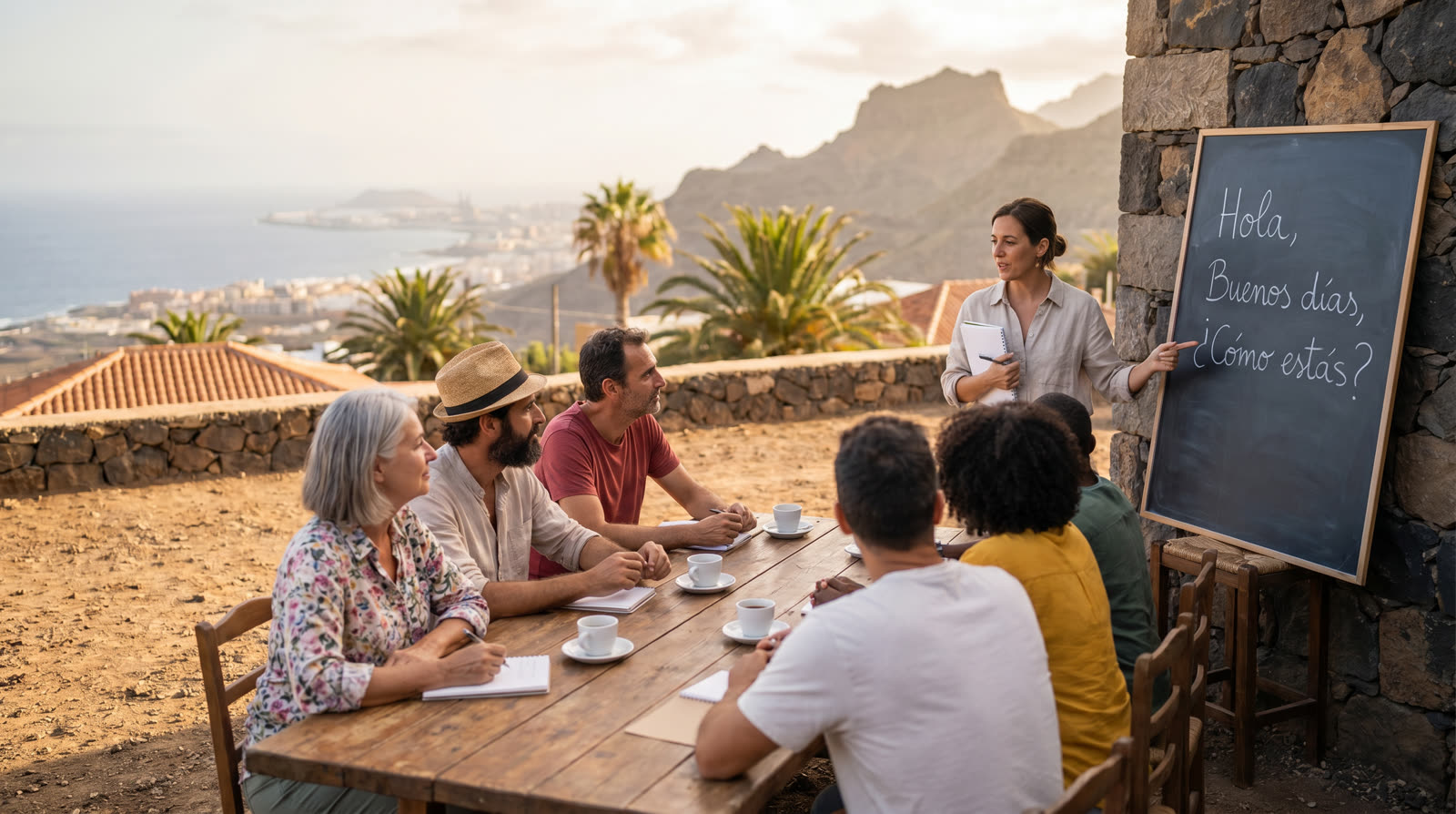
The Public Option: Escuela Oficial de Idiomas (EOI)
The Escuela Oficial de Idiomas is the best-kept secret of the Spanish education system — at least for foreigners. The EOI is a state institution offering language courses from A1 to C2, with officially recognised qualifications, at fees that are absurdly low compared to private language schools.
The Canaries have EOI locations on all major islands. Las Palmas de Gran Canaria even has two: EOI Guanarteme (C/ Fernando Guanarteme 51) and EOI Siete Palmas (C/ Hoya del Enamorado 133). Tenerife has locations in Santa Cruz and La Laguna. Lanzarote, Fuerteventura and La Palma each have one.
What it offers: Spanish for Foreigners (Español para Extranjeros) in in-person, blended and distance formats. Four weekly hours plus optional Friday sessions. Academic year October to June. Three levels (básico, intermedio, avanzado), two course years per level. Official exam with CEFR certificate at the end of each level.
Cost: Fees vary slightly by Comunidad Autónoma but typically sit at 50–120 euros per academic year. Canary Islands residents may qualify for reductions. For comparison: one week of intensive course at a private school costs 200–400 euros.
The catch: Registration runs through the Gobierno de Canarias and is bureaucratic. Pre-registration opens between March and May, formal enrolment follows in June. Miss the deadline and you can ask about remaining places in autumn. You will need a NIE or proof of Empadronamiento.
Still: For anyone living in the Canaries for more than a year who wants to learn systematically, the EOI is by far the best deal. No private provider comes close.
Private Language Schools in the Canaries
If you need more speed, flexibility or intensity — or cannot get a place at the EOI — Gran Canaria and Tenerife have a handful of established private language schools. On the smaller islands, options are thin.
Gran Canaria (Las Palmas)
| School | Profile | Price from (week) |
|---|---|---|
| Gran Canaria School of Languages | Since 1964, three buildings near Las Canteras, max. 12 per group, DELE exam centre, recognised for German Bildungsurlaub in 8 federal states | ~€125/wk standard |
| Academia El Capitán | Triana quarter, small groups, strong cultural programme (guachinches, market visits, outdoor classes) | ~€200/wk intensive |
| Language Campus | Younger academy, SIELE exam centre, exams every Friday, afternoon courses for children aged 3–16 | on request |
| ELE USAL Gran Canaria | University of Salamanca extension, academic approach, excursion programme (banana plantation, Arucas) | ~€200/wk |
Tenerife
| School | Profile | Price from (week) |
|---|---|---|
| Don Quijote / Enforex | Puerto de la Cruz, colonial Canarian building with courtyard, max. 8 per group (Premium), Cervantes-accredited | ~€200/wk intensive |
| FU International Academy | Puerto de la Cruz, DELE and SIELE exam centre, student visa support | ~€170/wk |
| SMS Spanish Experience | Puerto de la Cruz and Costa Adeje (south!), Cervantes-accredited, communicative approach, surf combos | ~€170/wk |
| Canarias Cultural | Santa Cruz, since 2001, outdoor activities, excursions, library | ~€150/wk |
Smaller Islands
Lanzarote, Fuerteventura, La Palma, La Gomera and El Hierro have no established private language schools for Spanish as a foreign language. Options: EOI (where available), private tutors (€15–30/hour, word of mouth or milanuncios.com), or online classes.
Bildungsurlaub: Learning Spanish on the Boss's Tab
Employees in Germany have the right to Bildungsurlaub — paid educational leave — in 14 of 16 federal states: five days per year, in many states stackable to ten days every two years. Bavaria and Saxony have no regulation.
And yes: Spanish courses in the Canary Islands are recognised as Bildungsurlaub. The requirement is an intensive course of at least 30 weekly lessons of 45 minutes each. Several schools on Gran Canaria and Tenerife hold the necessary accreditation.
Indicative cost (Gran Canaria, 2 weeks): Intensive course €400–600, host family accommodation €500–700, return flight Germany–LPA €200–400, materials €35–50. Total: roughly €1,100–1,750. The employer continues paying your salary without deducting holiday days.
Apps: What They Can Do — and Where They Stop
Language apps are not a replacement for a course. But they are a useful supplement, and for the first three months before moving to the Canaries, they are the best preparation you can get from your own sofa.
Babbel — Structured, everyday dialogues, solid grammar explanations, offline mode. No gamification. €9–18/month depending on commitment. Includes Business Spanish courses.
Duolingo — Free (with ads), gamified, 3-minute lessons. But: grammar is nearly ignored, no clear thread, unreliable speech recognition. Good as a daily dose, not as a main course.
Busuu — Full A1–C1 learning path accessible for free, community feature (native speakers correct your writing), more structured than Duolingo. Premium subscription (~€7/month) adds travel courses and grammar exercises.
SpanishDict — Not a course but a dictionary-grammar-trainer hybrid. 90 lessons from Present Progressive to the Subjunctive. Free.
DELE and SIELE: Official Exams That Count
DELE
The gold standard. Issued by the Instituto Cervantes. Six levels (A1–C2). In the Canaries you can sit it at ULPGC and FU International Academy (Puerto de la Cruz). Seven exam sessions in 2026. Cost: €118 (A1) to €228 (C2). Validity: indefinite. For Spanish citizenship the DELE A2 is required (registration with NIE mandatory).
SIELE
The digital, adaptive alternative. A single test covering A1–C1, results in three weeks, valid for five years. Less institutional weight than DELE but accepted by many universities and companies. Language Campus in Las Palmas offers weekly SIELE exams.
Canarian Spanish: What They Don't Teach You in Class
The Spanish you learn in school is standard Castellano. Nobody in the Canaries talks like that. The S at the end of words is aspirated or swallowed ("lah cosah" instead of "las cosas"). There is no ceceo — people say "sinco", not "thinco" for cinco. And there are words that simply do not exist on the mainland: "guagua" for bus, "papa" for potato, "baifo" for baby goat.
It is not a defect. It is the language of the islands. And when after a few months you start to understand it and drop in the occasional Canarismo, you notice that the guy at the guachinche looks at you with a bit more warmth.
Common Mistakes and Costs
Questions and Answers
What is the cheapest way to learn Spanish in the Canary Islands?
The Escuela Oficial de Idiomas (EOI) offers Spanish courses for 50–120 euros per academic year — state-run, with officially recognised qualifications following the CEFR. Locations exist on all major islands. Registration runs through the Gobierno de Canarias, typically between March and May.
Which language schools in the Canaries are recognised for Bildungsurlaub?
On Gran Canaria, the Gran Canaria School of Languages (since 1964, recognised in eight federal states) and Academia El Capitán among others. On Tenerife, FU International Academy, Don Quijote/Enforex and SMS Spanish Experience. The requirement is an intensive course of at least 30 weekly lessons of 45 minutes.
What is the difference between DELE and SIELE?
DELE is the classic globally recognised Spanish qualification issued by the Instituto Cervantes. It tests a fixed level (A1–C2) and is valid indefinitely. SIELE is the digital alternative — an adaptive test that determines your level, with results in three weeks, but valid only for five years. Spanish citizenship requires the DELE A2.
Which app is best for learning Spanish before the move?
Babbel offers the most structured approach with everyday dialogues but costs 9–18 EUR per month. Busuu is free with a complete learning path to C1 and community corrections. Duolingo is free and good for daily routine but weak on grammar. No app replaces a course with real speaking situations.
Do Canarians understand the Spanish taught in language schools?
Yes. Language schools teach standard Castellano, which is understood throughout Spain and Latin America. Canarian Spanish differs — aspirated S, seseo instead of ceceo, local vocabulary (guagua, papa, baifo) — but communication works perfectly in both directions.