Working from the island: what really matters
Photos of laptops on the beach look great. The reality is different: patchy café Wi-Fi, sand in the keyboard, a video call with the sun behind you. Anyone working from Gran Canaria long-term needs two things: a stable line at home and a place outside the house where real focus is possible. As of April 2026, both are readily available on the island — if you know where to look.
Internet at home: fibre almost everywhere
The Canary Islands are among the best fibre-covered regions in Spain. According to the Observatorio Canario de las Telecomunicaciones, coverage now sits at around 92 percent — five points above the Spanish average. In Las Palmas de Gran Canaria, along the tourist south between San Agustín and Meloneras, and along the GC-1 motorway, there are essentially no coverage gaps. It gets trickier inland — in Tejeda, Artenara, or on isolated fincas, fibre may be missing, and a 4G/5G router becomes the only option.
The four big providers
Movistar is the market leader with the technically best infrastructure. Plans start at around 20 euros per month for 300 Mbps, and the new 10-Gbps plans in Las Palmas and Santa Lucía de Tirajana cost around 22 euros (compared to 25 euros on the mainland — a small IGIC advantage). Active rollout in Playa del Inglés and Maspalomas since 2024.
Orange also offers 10 Gbps in Las Palmas, Tirajana, and Santa Cruz de Tenerife. Plans from around 30 euros, cheaper when bundled with mobile.
Vodafone bundles fibre, mobile, and TV in packages from around 30 euros. Solid technically, though customer service reviews are mixed.
Digi is the price breaker — a Romanian provider gaining market share rapidly in Spain. Currently: 500 Mbps for 10 euros per month, 1 Gbps for around 17 euros. Since April 2026, also 10 Gbps on Gran Canaria for 22.11 euros. One caveat: Digi uses CG-NAT, meaning no public IP — fine for normal browsing, streaming, and video calls, but a hassle for home servers or certain VPN setups.
What to watch for in the contract
The maximum legal contract length in Spain is 24 months. Twelve months is standard, and some providers (Movistar, O2, Pepephone) also offer plans with no minimum commitment — at a slightly higher price. If you're unsure how long you'll stay, avoid exactly that: a two-year contract. Number portability for landlines is guaranteed by law and free.
To sign a contract you need a NIE and a Spanish bank account. Without both, no provider will sign you up. If you have neither yet, bridge the gap with prepaid routers (Movistar, Vodafone) or mobile data.
Coworking: two worlds, two philosophies
The island's coworking landscape splits geographically into two zones. In the north, in Las Palmas, the digital nomad community has grown over years and is professionally organised. In the south, between Playa del Inglés and Maspalomas, the offer is smaller but specifically designed for longer stays.
Las Palmas: the capital of remote work
Las Palmas is regularly ranked among Europe's top digital nomad cities. Across the neighbourhoods of Guanarteme, La Isleta, and the centre, there are around 50 coworking spaces. A selection of established addresses:
White Forest — Guanarteme, generously sized, bright architecture, regular events with international speakers. Meeting rooms, phone booths, event space. Day passes, flex memberships, and dedicated desks.
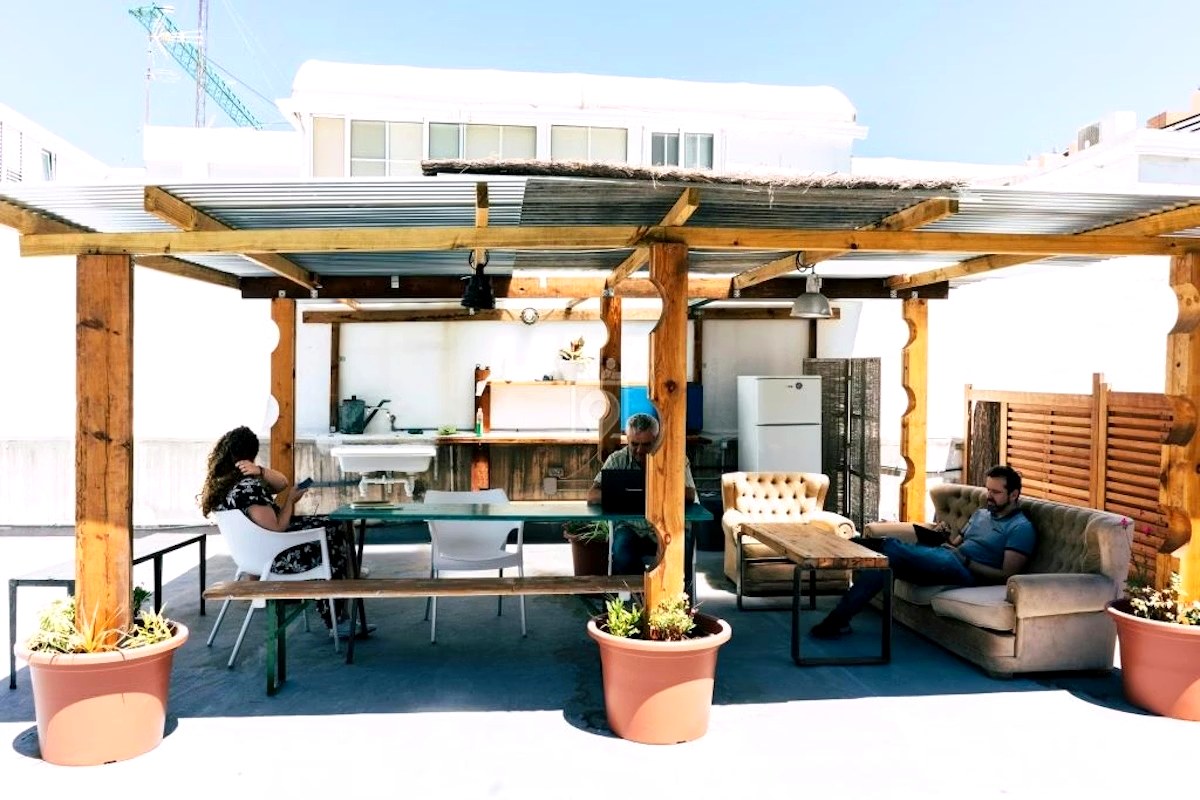
Sky Coworking — central location, sixth floor with rooftop terrace, private call booths, standing desks. Members have 24/7 access; new enquiries Mon–Fri 10 am to 12 noon.
Talleres Palermo — also Guanarteme, industrial-creative atmosphere, more informal.
Fico Coworking — La Isleta, with its own coffee roastery attached. Smaller, quieter, neighbourhood feel.
Soppa de Azul — La Isleta, creative environment, popular with designers and artists.
Prices in Las Palmas typically range from 15 to 25 euros per day, 80 to 120 euros per week, and 150 to 250 euros per month for a flex desk. Dedicated desks run higher, between 200 and 300 euros.
South: Maspalomas, Playa del Inglés, San Agustín
The south has less choice but offerings specifically tailored to the mix of tourism and long-term stays.
Coworking Neptuno (Mur Hotels, Maspalomas) — air-conditioned, 24/7 access, meeting room, printer, parking right outside. 20 euros per day, 120 euros per week, 200 euros per month for a dedicated desk.
BEAC Coworking — Avenida de Tirajana, Maspalomas. Fully furnished office, professional environment. 200 euros per month for a fixed station, 100 euros per week flexible.
Coworking Maspalomas — Avenida de Tejeda. Smaller setup, popular with solo entrepreneurs.
In Playa del Inglés itself the offer is thinner — many digital nomads rent in Meloneras or San Agustín and commute the few kilometres to coworking in Maspalomas instead.
Coliving as an alternative
If you want work, accommodation, and community in one package, Gran Canaria has one of Europe's largest coliving scenes. Nomad City and Coworksurf run several houses in Las Palmas with high-speed internet, shared workspaces, and regular events (barbecues, hikes, surf sessions, yoga). Prices vary widely by season and room: roughly 800 to 1,800 euros per month including workspace, electricity, and internet.
Café as workspace — possible, but limited
Las Palmas has a mature café scene with functional Wi-Fi. In the south, options are thinner and Wi-Fi quality often patchy. Anyone with regular video calls should not rely on it. What works: mornings for writing, emails, focused solo work. What doesn't: an important client meeting with stable 1080p video.
Checklist: work infrastructure in your first two weeks
If you're new to the island, in this order:
First, a Spanish SIM card with generous data — Digi, O2, or Lowi offer plans from 10 euros with 30+ GB. That keeps you functional anywhere until the home line is up. In parallel, apply for your NIE and open a Spanish bank account (see Relocate parts 2 and 4 in this series); without both, no internet contract. Then sign up for fibre — installation typically takes 2 to 15 working days. In the meantime, buy a day pass at a coworking space of your choice — in Las Palmas try White Forest or Sky, in the south Neptuno. After two or three days you'll know whether you prefer working near your flat or commuting daily into the city. That decides whether a monthly membership pays off.
Bottom line
The infrastructure on Gran Canaria is better than many expect. 10-Gbps fibre for 22 euros in the capital almost reads like a typo — but it's real. The coworking network is dense and internationally flavoured in the north, smaller but solid in the south. Anyone working remotely and professionally finds functional structures here. If you're only staying six months, a 4G router plus day passes is enough. If you're staying longer, home fibre plus a monthly coworking membership is the move — and will cost you substantially less than equivalent setups in Germany or the UK.