What the Cabildo Wants
On 13 April 2026, a broad alliance — Cabildo, Clúster Marítimo de Canarias, unions, business associations, research centres — signed a joint letter to Energy Minister Sara Aagesen. The demand: Spain's first offshore wind auction should take place off Gran Canaria. Not in a few years. Now.
Cabildo President Antonio Morales was unequivocal: "Gran Canaria has done its homework. We are ready. We do not need to wait until other regions of Spain catch up."
The numbers being put on the table:
250 MW for the first floating offshore wind farm — enough electricity for hundreds of thousands of households. A long-term potential of 500 MW.
80–120 €/MWh is the cost of offshore wind power according to a 2025 study by the Universidad Pontificia Comillas. Sounds expensive — until you compare: the diesel and heavy fuel oil electricity that the Canaries still depend on today costs 120–200 €/MWh. Offshore wind would actually be cheaper than the fossil alternative.
Up to 8,000 jobs per year (equivalent) and billions in investment, according to proponents. Gran Canaria will present itself as a location at the WindEurope fair in Madrid (21–23 April 2026).
2027 could see the first floating park operational — if the auction is called now.
Why the Canaries Want Offshore Wind
The argument makes sense at first glance. The Canary Islands have no mainland grid. Each island generates its own electricity. And over 80 per cent of that electricity comes from fossil fuels — diesel, heavy fuel oil, imported by sea. That makes the Canaries expensive, vulnerable and a climate laggard.
There is plenty of wind. The trade winds blow constantly. Offshore — kilometres from shore — the wind is even stronger and more consistent than on land. Floating turbines (as opposed to fixed) work in deep waters, like those around the Canaries.
And the proponents' star argument: offshore wind farms are barely visible from land. They stand far out at sea. They do not destroy mountains, valleys or coastlines.
So much for the theory.
Drive to Vecindario — and See the Practice
Before getting excited about floating wind farms on the Atlantic, it is worth seeing what the existing onshore wind power has done to Gran Canaria.
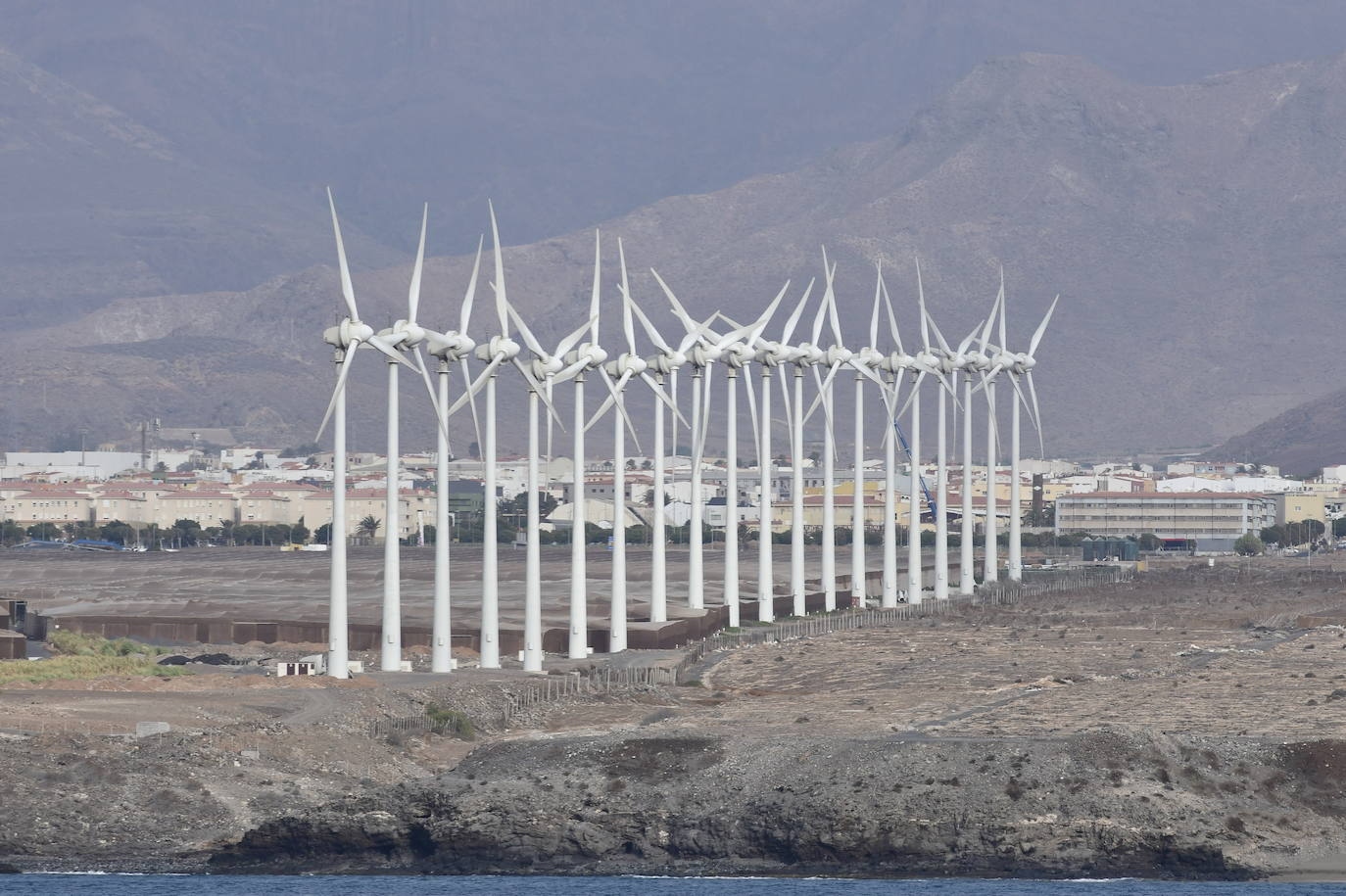
Take the GC-1 heading south, take the Vecindario/Arinaga exit. Look left. Look right. What you see: a landscape that looks like an industrial zone with nature as an alibi. Enormous turbines on the hills, in the barrancos, along the coast. Access roads gouged into the ground. Pylons, substations, fences.
Arinaga was once a quiet fishing village with views of untouched hills. Today one wind farm stands next to another. The Canary Islands' own environmental authority issued a negative environmental report for the Parque Eólico Puerto de Arinaga — citing "significant and negative landscape impact," bird collision risk and insufficient mitigation measures. And yet the turbines are still there.
At Camino la Pasadilla, near the Barranco de Guayadeque — one of the island's most beautiful natural monuments — a wind farm project was rejected because the environmental authority found: "The zone has high visibility with very wide visual basins" and the installation "would create a precedent that would accelerate the degradation of agricultural land as a natural resource."
Gran Canaria today has 216 wind farms (onshore, existing or in the permitting process). Every single one was sold as "green" and "necessary." The cumulative result is a landscape that in some areas is unrecognisable.
The Promise That "Offshore Is Different"
Offshore advocates say: that is exactly why we want to go to sea. No more turbines on mountains. No more destroyed landscapes. The floating platforms stand 15, 20, 30 kilometres offshore — invisible from the beach.
Sounds good. But questions remain:
Who guarantees the distance? Auction conditions set how far from shore construction is allowed. If economic pressure increases, do the distances shrink? In other countries, that is exactly what happened.
What about the cables? The electricity has to reach land. That requires subsea cables, landing points, substations on the coast. Those are construction sites — on beaches, in ports, in natural areas.
What about the seabed? Floating turbines are anchored with chains or cables to the ocean floor. The impact on marine ecosystems is poorly understood, especially in the rich waters around the Canaries.
Who dismantles the old onshore parks? If offshore wind is the future — what happens to the 216 onshore parks? Will they be removed? Or will they remain as ruins of the first energy transition while the second is already underway?
How unstable is wind power? The Canaries have no interconnected grid. When the wind does not blow — and yes, even trade winds have calms — backup is needed. Batteries, pumped storage, or diesel again. The storage question is unresolved.
The 8,000-Jobs Calculation
The number sounds impressive. But it comes from a study calculating the entire life cycle of a 500 MW park — planning, construction, operation, over decades. "8,000 equivalent annual jobs" does not mean 8,000 people will have permanent employment. It means that over the entire lifespan, that many person-years of work will accumulate.
How many of those jobs are actually created on Gran Canaria — and how many at international corporations in Norway, Denmark or Bilbao — is another matter entirely.
What Nobody Asks
The debate about offshore wind on Gran Canaria is currently told as a pure success story. Cabildo, businesses, unions, science — all in favour. Not a single critical voice in the entire coverage.
But the questions that need asking:
Has the population ever been consulted on whether they want to give up their coastline for wind farms — even if they are 20 kilometres away?
Who benefits economically? The islanders — or the international energy corporations that win the auction?
What about tourism? Gran Canaria lives from the sea. If visitors look out of the plane window and see a forest of turbines off the coast — is that the image the island wants to sell?
And the most fundamental question: is it wise to build the next generation of energy infrastructure at sea before cleaning up the chaos on land?
Where the Debate Should Be
Offshore wind may make economic and ecological sense for the Canaries. The cost figures are convincing, at least on paper. And the dependence on imported diesel is a real problem that needs solving.
But the way this debate is being conducted — as an inevitable progress narrative, with no room for criticism, no public participation, no honest assessment of existing onshore wind — is reminiscent of other large projects in the Canaries that were sold as a blessing and ended up as a burden.
Anyone who wants to can drive to Vecindario and see what "green energy" looks like when it meets a landscape.