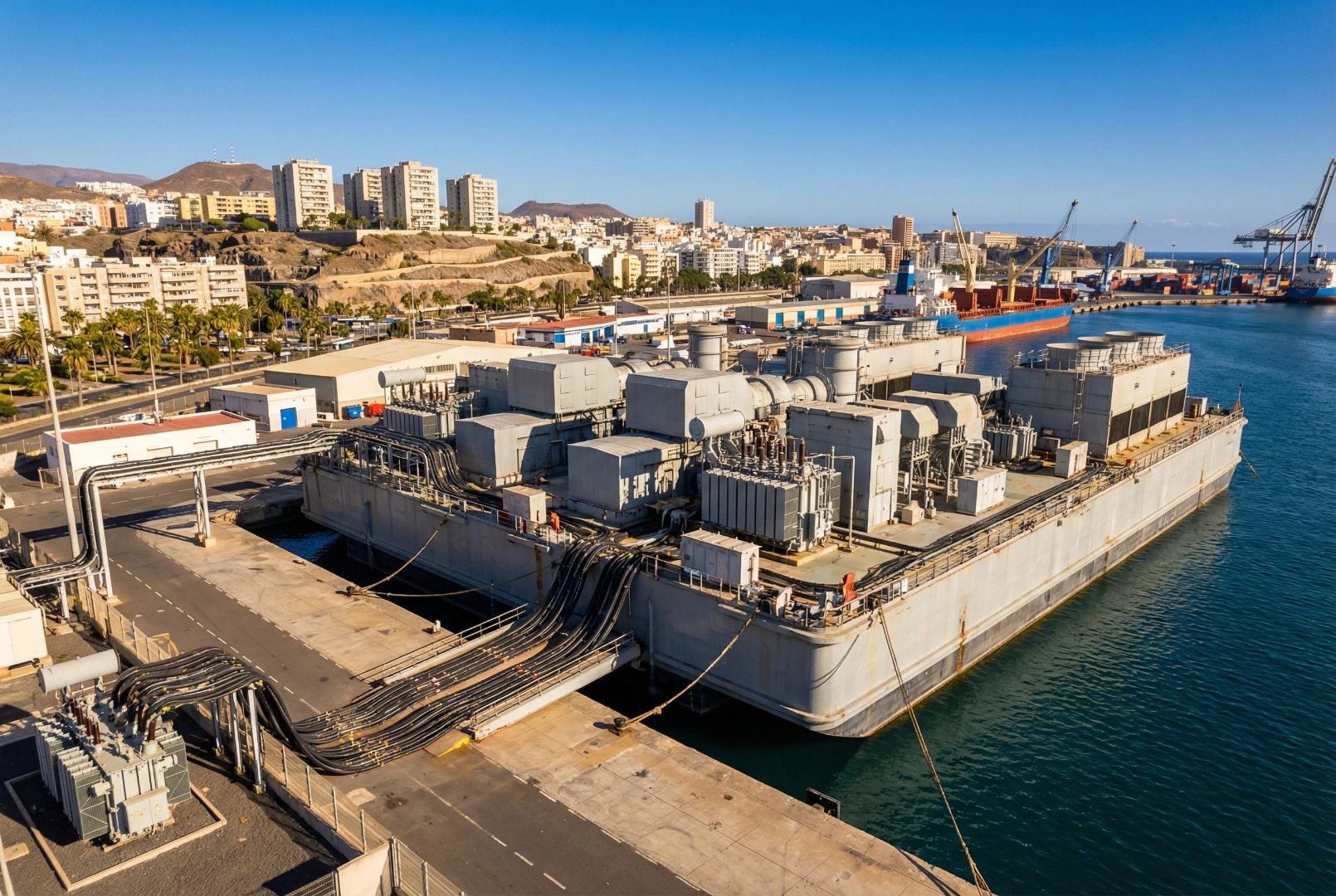
138 Megawatts Missing — Power Could Fail at Any Moment
The numbers are stark. In March 2025, Red Eléctrica de España, the grid operator, stated in its annual coverage report that Gran Canaria lacks 138 megawatts of generation capacity to guarantee supply security. Tenerife's deficit stands at 80 MW. Peak demand on Gran Canaria reaches 550 MW — against a total capacity that should ideally be double but is not.
In a parliamentary committee on 9 April 2026, energy minister Mariano Hernández Zapata was blunt: the risk of a so-called "zero energy scenario" — a complete blackout — is real. In the worst case, restoring the power supply would take 15 to 20 days.
The Powership: 100 MW on Water
Zapata's solution: a floating power plant, a Shark-class powership, to dock at the Puerto de La Luz in Las Palmas. The facility would deliver 100 of the missing 138 megawatts. Six engines in combined cycle, running on low-sulphur fuel oil or marine diesel.
The minister compared the situation to a shipwreck: the powership is the lifeboat — a temporary measure while the main vessel takes on water. The goal remains decarbonisation through renewables, but in the short term, supply must be secured.
The Energy Gap in Numbers
- Gran Canaria deficit: 138 MW (Red Eléctrica, March 2025)
- Tenerife deficit: 80 MW
- Powership capacity: 100 MW (Shark class, 6 engines)
- Emergency plants Telde: 2 facilities at 35 MW (Ayagaures + Disa), propane-powered
- New renewables authorised: 311.59 MW (71 wind and solar parks)
- Blackout recovery: 15–20 days worst case
Opposition: Port, Residents, Politicians
The plan is controversial. The Autoridad Portuaria de Las Palmas under president Beatriz Calzada has not publicly taken a position — a sign that the project is not universally welcomed at the port. The powership would occupy around 200 metres of quay length otherwise used for commercial traffic.
There is also the pollution issue. A recently rejected regasification plant was turned down partly over air quality concerns in the urban zone — Las Palmas has little room for additional industrial emissions given the port's proximity to the city centre. A plant burning fossil fuels would exacerbate this problem.
From the opposition, Yoné Caraballo of Nueva Canarias voiced criticism. He called the powership a "whim" and warned: an isolated island system depending on a ship that itself depends on fuel tanker deliveries creates new vulnerabilities — especially in times of international conflict.
The Emergency Plants in Telde
Alongside the powership plan, two further emergency projects are underway in Telde. In El Goro, two flexible generation facilities are to be built: one operated by Ayagaures, the other by Disa, together providing around 35 MW. Both run on propane and are designed for a maximum of three years.
Carlos Medina, dean of the Colegio de Ingenieros Industriales de Canarias, criticised this solution as insufficient. Even with the 35 MW, a deficit of over 100 MW remains. He called the fast-track procurement process a "botch job" without proper legal basis — plants designed to operate only in emergencies could end up running continuously.
The Nuclear Alternative: A Reactor in the Port?
Even more radical is a proposal from the Universidad de las Hespérides. Its Centro Peter Huber published a study in February 2026 suggesting a floating nuclear reactor in the Puerto de La Luz as a long-term alternative — modelled on Russia's Akademik Lomonosov, which has been generating 70 MW in the Arctic since 2020.
The authors argue: a nuclear reactor would operate for decades without fuel resupply, produce no emissions and eliminate the dependency on tanker deliveries. The study is explicitly critical of the powership plan, which it says reinforces fossil dependency without solving the structural problem.
Whether the nuclear option would ever be politically feasible is another matter entirely. But it illustrates how deeply Gran Canaria's energy crisis is perceived — even in academic circles.
What Happens Next
The decision on the powership now lies with the port authority. Minister Zapata emphasised their willingness to examine the project. At the same time, he urged the state to urgently launch a new tender for the renewal of thermal power plants in the Canaries — the actual solution to the problem.
Zapata also pointed to 311.59 MW of new wind and solar capacity already authorised, plus 125.5 million euros in EU Next Generation funds for the islands' energy self-sufficiency. Long-term, the archipelago is to be decarbonised. Short-term, Gran Canaria faces the question: how do you bridge the next two to three years without the lights going out?