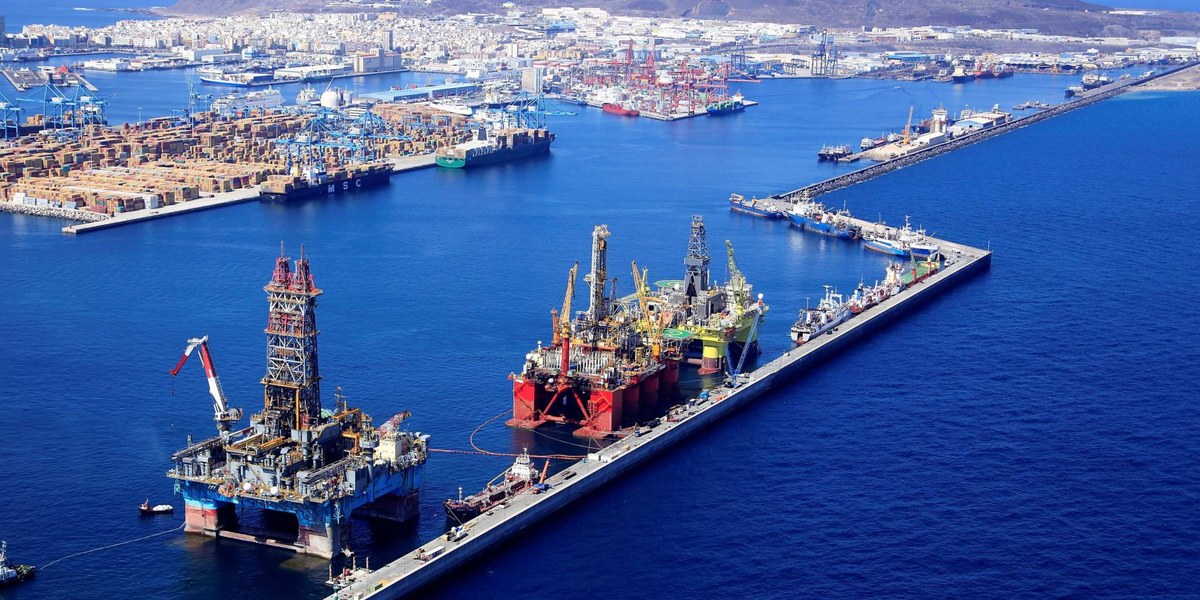
The figure that explains it all is 1.54 million. That is how many standard containers (TEU) the port of Las Palmas handled in 2025 — a rise of 16.1 percent on the year before.
By comparison, Spain's heavyweights grew far more slowly or even shrank. Valencia, clearly number one with 5.66 million TEU, gained 3.4 percent; Algeciras 0.5 percent; Barcelona lost 4.1 percent.
Las Palmas grew fastest in percentage terms among the big ports by some distance.
The reason lies at the Suez Canal
Why precisely now? The answer has to do with a crisis that seemingly has nothing to do with the Canaries.
Since cargo ships on the Asia–Europe route have been avoiding the Suez Canal and the Red Sea for security reasons, they sail the long way round the southern tip of Africa — round the Cape of Good Hope. And that route passes right by the Atlantic archipelago.
The Canaries thus become a natural stopover for bunkering, transhipment and supplies. This is exactly the key: so-called transit cargo — containers that are merely transhipped, not imported — rose around 20 percent in Las Palmas, while at mainland rivals Algeciras, Barcelona and Valencia it fell, in part by double digits.
In the first quarter of 2025 the province of Las Palmas, led by La Luz, posted a 12.1 percent rise in total throughput — the best result of all Spain's big ports. The port authority APLP, under its president Beatriz Calzada, confidently took this as grounds to formally demand promotion to the "top tier" of Spanish ports — a status so far held only by Valencia, Barcelona, Algeciras and Bilbao.
More than just tourism
For a region that in public perception is associated almost solely with tourism, this is an important reminder: the port is a second economic pillar. It creates skilled jobs — the stevedoring firms recently expanded their workforce to cope with the growth — and connects the islands with West Africa, Latin America and the world's trade routes.
Other segments also ran well: container loading rose 4.1 percent in 2026 to May, cruise traffic by almost 16 percent, frozen-fish handling by over 60 percent.
Frequently asked questions
- How much did the port grow in 2025?
- Container throughput rose 16.1 percent to 1.54 million TEU — the strongest percentage growth among Spain's big ports.
- Why is container traffic booming?
- Because, due to the Suez Canal crisis, freighters sail round the Cape of Good Hope and use the Canaries as a stopover. Transit cargo rose around 20 percent.
- Is Las Palmas bigger than Valencia or Algeciras?
- No. Valencia (5.66m TEU) and Algeciras (4.73m) are far bigger in absolute terms. But Las Palmas (1.54m) grew fastest in percentage terms and is seeking promotion to the "top tier".
- Why do the 2026 figures call for caution?
- The port authority had to revise its statistics from +1.2% to −0.96% total traffic after a counting error. Growth also depends heavily on the Suez exception.
- What does this mean for the island?
- The port is a second economic pillar alongside tourism, creating skilled jobs and connecting the Canaries with the world's trade routes.
Read on
- Gran Canaria: 6 bids for €45.3m Las Palmas port quayGran Canaria · 19 November
- Las Palmas port drone Tritón searches for cars at 200 mGran Canaria · 17 November
- Canary Islands pardelas: what to do in NovemberGran Canaria · 9 November
- Gran Canaria ARC 2026: start 22 November, 124 yachtsGran Canaria · 20 November
- Las Palmas taxi fares 2026: among Spain's cheapest citiesGran Canaria · 20 November
- All events on Gran Canaria →
As of 30/06/2026. Sources include Puertos del Estado, the Autoridad Portuaria de Las Palmas (APLP), Atlántico Hoy and Diario del Puerto. TEU = Twenty-foot Equivalent Unit. Traffic figures refer to the stated periods and may change through subsequent statistical revisions. This article is general context. Illustration.