What's at stake
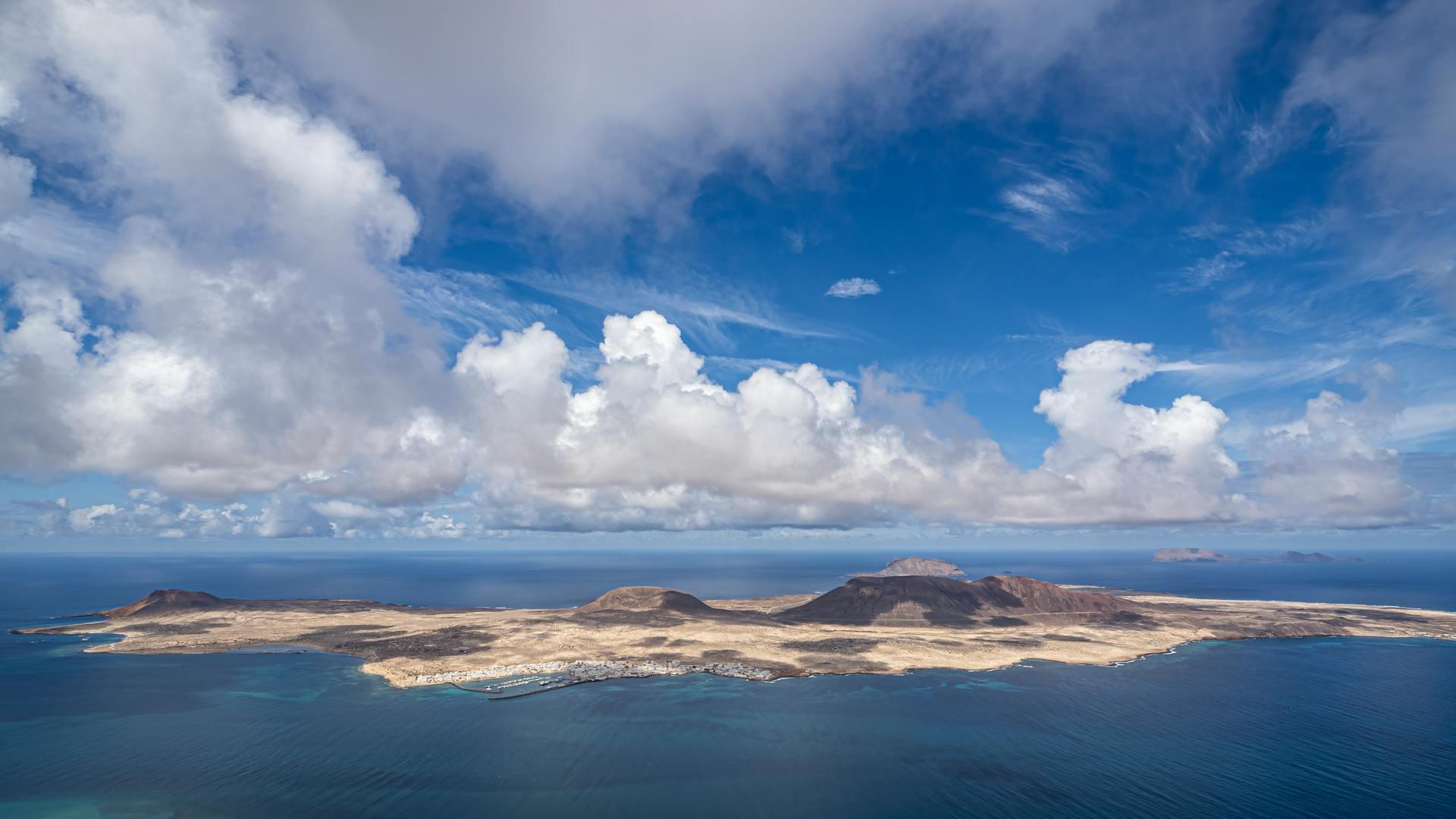
On La Graciosa, the eighth and smallest inhabited island of the Canary archipelago, the testing phase of a solar-powered seawater desalination plant begins in 2026.
It is the first of its kind in Europe to be built and operated for an island community exclusively with locally generated solar energy.
The plant is being built as part of the EU project ICONIC, a three-island pioneer programme with 7 million euros of Brussels funding. The partners are Inis Mór in the Irish Aran Islands and Berchidda on Sardinia.
Behind the project stands a concrete commitment: by 2030, La Graciosa is to be supplied 100 percent with locally generated renewable energy and locally desalinated water. It would be the first 100-percent autarky island in Spain.
The umbilical cord that breaks too often
La Graciosa has obtained its drinking water since the early 1990s through an undersea line from Lanzarote — a pipe, a power cable, an «umbilical cord», as the activist and spokesperson of the El Sol de La Graciosa energy community, Ginés Díaz Pallares, calls it.
It is fragile. In 2022 the line broke six times; each time the island sat without water for days. The island has no freshwater sources of its own, no aquifers, no significant rainwater storage.
An old desalination plant from the 1980s still exists — as an industrial ruin. It was shut down when the Lanzarote line came online in the early 1990s. The new plans foresee converting its building into a cultural and community space.
The new plant is being built right next to it — solar-powered, with no connection to the power grid.
The ICONIC project: 7 M euros for three islands
The EU project ICONIC was approved by Brussels in December 2024 and began in May 2025. Budget: 7 million euros for three years, divided between the three pilot islands.
The programme is coordinated by María Ruiz Díaz-Reixa, a specialist at the Madrid consultancy R2M Spain. «With the non-potable water from the desalination plant», Ruiz says, «we can make ice for the fishermen's guild or irrigate the plants.» Circular economy as design principle.
The project consortium includes Boreal Light GmbH (Berlin), GeoAI Analytics, Traza, the University of Galway (Ireland) and the Canary Islands government.
The second pillar alongside water desalination: a local energy market. Citizens are to be able to trade surplus solar energy among each other. Third: a mobility plan for an island without paved roads.
Wind energy is not allowed on La Graciosa — the island lies inside the Chinijo Archipelago Nature Park, and turbines would endanger migratory birds. Hence the commitment to pure photovoltaics.
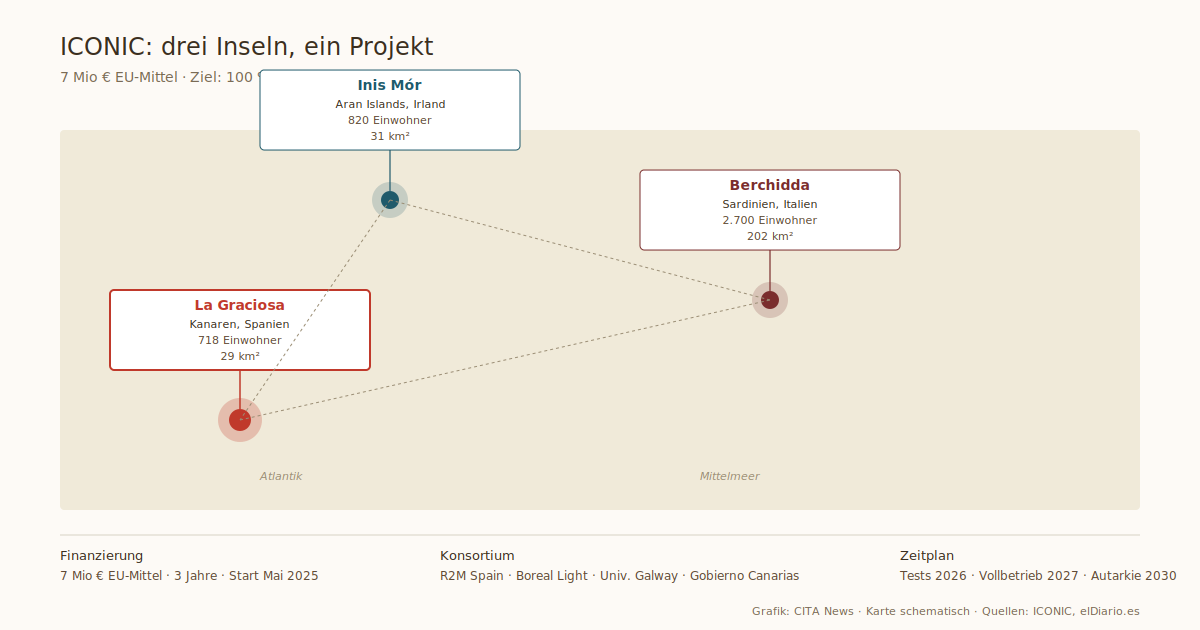
The three ICONIC pilot islands compared. Graphic: CITA News.
Boreal Light: the Berlin solar specialists
The construction of the desalination plant is being undertaken by the Berlin firm Boreal Light GmbH. The company specialises in solar-powered water treatment in rural and island regions of Africa and Europe.
The licensing procedure is currently underway with three Canary administrative levels: the Canary Islands government, the Cabildo of Lanzarote and the municipality of Teguise (to which La Graciosa formally belongs).
Ginés Díaz describes the state of play: «We are in constant contact with technicians from the Canary Islands government, the Cabildo of Lanzarote and the municipality of Teguise. The dialogue is fluid — so that 2027 becomes a reality.»
If successful on La Graciosa, the model could be transferable to other small Canary islands and comparable sites in Europe — especially through the EU «Clean Energy for EU Islands» programme, which aims to support 30 European islands on the path to energy autarky.
718 residents, 575,000 visitors
La Graciosa has 718 permanent residents. Each year around 575,000 tourists visit the island — 800 times the population.
This asymmetry makes water supply the core question. While locals feel the high-season pressure on the Lanzarote pipeline, tourists arrive with plastic bottles — and produce waste that La Graciosa neither can dispose of itself nor efficiently ship out during the high summer.
The ICONIC project counts on that: «The desalination plant must work like the village fountain», Díaz says. «Also for tourists — so they fill their aluminium bottles and end the plastic consumption.»
This anti-plastic strategy is part of the sustainable island strategy that the energy community El Sol de La Graciosa, founded in May 2023 with twenty initiators under president Nahúm Cabrera, has pursued for three years.
What comes next
The plant's test runs begin in 2026; full operation is planned for 2027. Until then, three administrative levels must grant the remaining permits.
In parallel, training programmes are running for the local population in photovoltaic installation, water hygiene and energy management.
In the background, the European-level «Clean Energy for EU Islands» programme aims to support 30 European small islands on the path to energy autarky. La Graciosa applied in October 2023 — and has been a pilot site ever since.
The reference point: 2030. By then, all three ICONIC islands are to be 100 percent renewable and water-autarkic. For La Graciosa, that means breaking with a 35-year dependence on Lanzarote.
Frequently asked questions
- What is the solar desalination plant on La Graciosa?
- A seawater desalination plant operated exclusively with locally generated solar energy. It is the first of its kind in Europe for an inhabited island.
- When does it start?
- The test runs begin in 2026. Full operation is planned for 2027.
- Who is building the plant?
- The Berlin firm Boreal Light GmbH, which specialises in solar-powered water treatment. Construction is part of the EU ICONIC project.
- Who is financing the project?
- The European Union, with 7 million euros over three years. The budget is divided between the three pilot islands: La Graciosa (Canary Islands), Inis Mór (Ireland) and Berchidda (Sardinia).
- How many people live on La Graciosa?
- 718 inhabitants. Each year around 575,000 tourists visit the island — 800 times the population.
- Why no wind energy?
- La Graciosa lies inside the Chinijo Archipelago Nature Park. Wind turbines would endanger migratory birds, so they are not permitted. Hence the commitment to photovoltaics.