This is Part 4 of our Relocate series. If you haven't read the earlier steps: Part 1 — The First 48 Hours, Part 2 — Applying for a NIE, Part 3 — Empadronamiento.
Why you need a Spanish account
In theory, you can live in Spain with a German, British or other European IBAN — SEPA makes it possible. In practice, it falls apart quickly: many landlords only accept Spanish account numbers for rent. Electricity providers like Endesa or Iberdrola require a Spanish IBAN for domiciliación (direct debit). And the social security system simply does not work without a Spanish account.
| Bank | Resident Account | Non-resident Account | English Service | Online Banking |
|---|---|---|---|---|
| CaixaBank | Yes | Yes | Partial | Yes |
| BBVA | Yes | Yes | Partial | Yes |
| Santander | Yes | Yes | Partial | Yes |
| Bankinter | Yes | Limited | No | Yes |
| Revolut / Wise | N/A (e-money) | N/A | Yes | Yes (app-only) |
The four main banks for expats
CaixaBank is the top choice for most foreigners in the Canaries in 2026. Through its "HolaBank" programme, it offers account opening for non-residents, support in over 20 languages, and a fully online process. With more than 11,000 ATMs across Spain, its network is the largest. Account opening works with NIE or passport, including fully digital.
BBVA allows account opening both online and in-branch. EU citizens need their CUE (EU citizen registration certificate) plus passport or ID card. Non-EU citizens need their TIE (residence card). The app is good, the online banking solid. BBVA has numerous branches on Gran Canaria, including Las Palmas and the south.
Banco Sabadell offers the "Key Account" specifically for international clients. The process can be partly online, partly in-branch. Sabadell is particularly popular among British expats.
N26 / Revolut — the digital alternatives. Both allow account opening with just a passport, fully online, in minutes. Downside: no Spanish IBAN (N26 has German, Revolut Lithuanian). Useful for the transition period, but limited for permanent use in Spain — direct debits and government payments don't always work.
Which documents do you need?
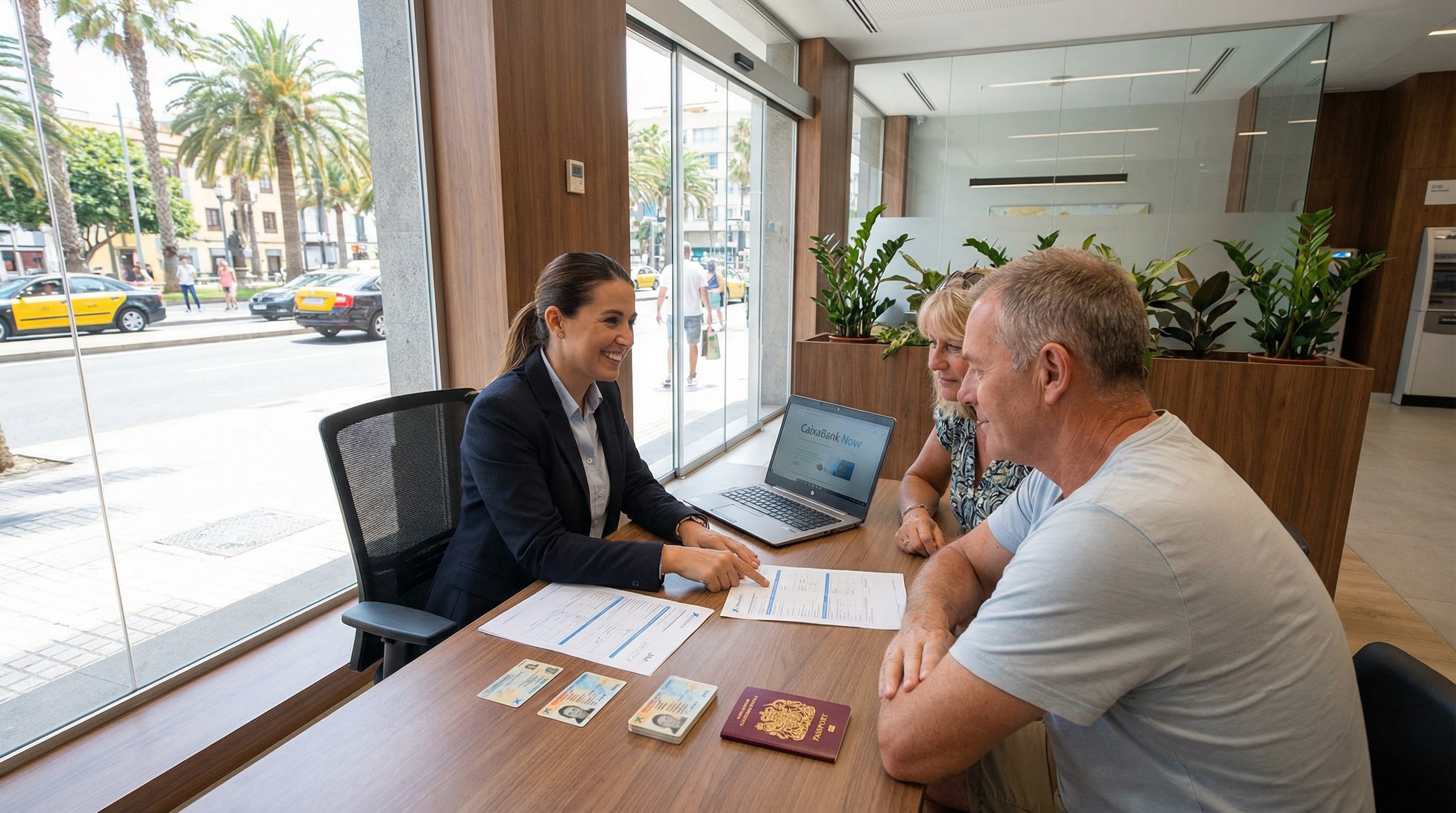
Requirements vary by bank and residency status. For EU citizens residing in Spain, the basics are: passport or ID card, NIE or CUE (EU registration certificate), and optionally the Padrón (residence certificate) or a rental contract as proof of address. Some banks also ask for proof of income — employment contract, pension statement or proof of self-employment.
For non-EU citizens, the TIE (Tarjeta de Identidad de Extranjero) is additionally required. Without a NIE, options are limited — CaixaBank and BBVA allow opening in some cases with passport plus a Certificado de No Residente (available from the Policía Nacional).
Online or branch?
CaixaBank and BBVA offer both. The online process at CaixaBank takes about 10 minutes — smartphone, camera and documents are enough. BBVA starts online but often completes in-branch. Sabadell is mainly branch-based. For in-person opening, booking an appointment through the respective app or website is recommended — walking in works but may mean queuing.
If you don't speak Spanish, CaixaBank (HolaBank) is your best bet — support runs in over 20 languages including English and German. BBVA has English-speaking advisors in larger branches. Sabadell has occasional English-language service on the Canaries.
Fee overview
Common mistakes
Going to a branch without a NIE and asking for a resident account — this almost always fails. Forgetting the Padrón — some banks need it as proof of address. Relying on N26 or Revolut as your main account — fine for daily spending, but not for rent, utilities and government payments. And: refusing to sign the DAE (Declaración de Actividad Económica) — this is a mandatory form for every account opening in Spain under the 2010 anti-money-laundering law.
Account opening checklist:
1. Apply for NIE (see Part 2)
2. Complete Empadronamiento (see Part 3)
3. Gather documents: passport/ID + NIE/CUE + proof of address
4. Choose a bank: CaixaBank (online, 20+ languages), BBVA (solid app), Sabadell (EN service)
5. Book appointment or open online
6. Sign DAE form (mandatory)
7. Activate Spanish IBAN — set up direct debits for rent, electricity, social security
Next in the Relocate series: Health insurance and the healthcare system in the Canary Islands.