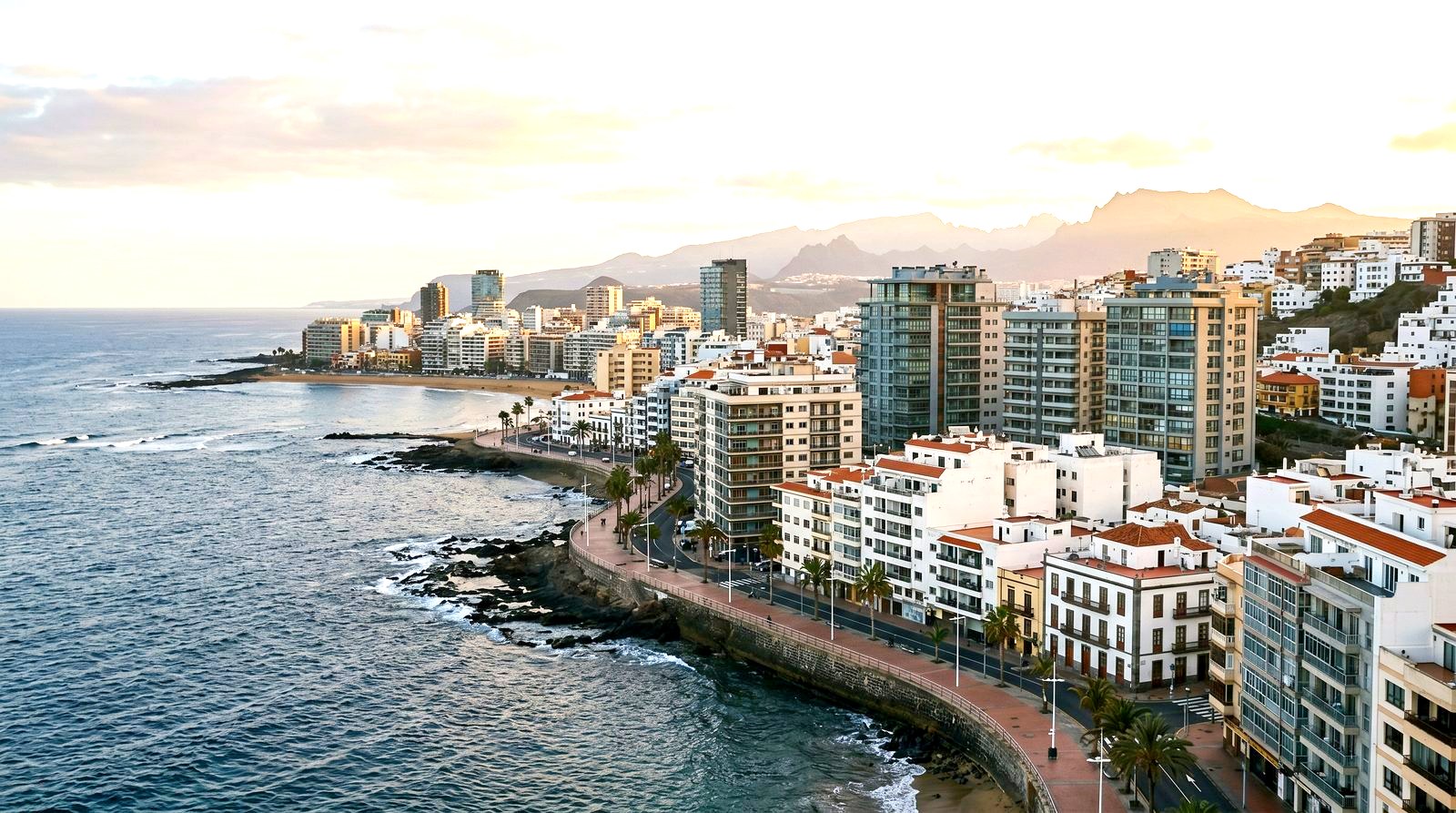
Market Snapshot 2025/2026
In Q4 2025, the assessed average value for free-market housing across the Canary Islands stood at 2,146.1 €/m² — that is 13.48 % more than in Q4 2024, according to ISTAC / Gobierno de Canarias (Gobierno de Canarias) (published 04.03.2026). For the province of Las Palmas, which covers Gran Canaria, the assessed value came to 2,151.1 €/m² (+12.7 % YoY). These are appraisal values; portal asking prices run considerably higher.
| Property Type | Transaction Tax | Rate | Paid By |
|---|---|---|---|
| New build (from developer) | IGIC (Canarian VAT) | 7% | Buyer |
| New build (from developer) | Stamp Duty (AJD) | ~1% | Buyer |
| Second-hand property | Transfer Tax (ITP) | 6.5% | Buyer |
| All properties (annual) | IBI (municipal tax) | Varies by cadastral value | Owner |
| Non-resident owners (annual) | IRNR (imputed income) | 19% (EU) / 24% (non-EU) | Owner |
Prices in the capital and the south
In Las Palmas de Gran Canaria, Idealista reported asking prices of 2,594 €/m² in February 2026 (+8.2 % vs. February 2025), a historical high. Fotocasa put the figure at 3,283 €/m² for April 2026, with an average property value of 311,216 €. The Notariado records a mean transaction price of 2,177 €/m² for Gran Canaria in 2025, at an average purchase price of 212,962 € and an average floor area of 98 m².
Prices vary sharply by location. The premium district of Isleta–Puerto–Guanarteme was commanding 4,159 €/m² on average in April 2026 (Fotocasa); Las Canteras waterfront typically fetches 3,600–3,700 €/m². The historic Vegueta–Triana quarter recorded year-on-year price growth of roughly 19 %, reaching approximately 2,700 €/m² according to CB Tu Hogar. The more affordable Tamaraceite district was priced at 1,500–1,600 €/m², while the innermost Carretera del Centro–Cono Sur zone sat at around 1,300 €/m².
For many foreign buyers, the real target is the south. In the municipio of San Bartolomé de Tirajana — encompassing Maspalomas, Playa del Inglés, and Meloneras — the average price reached 4,677 €/m² in H1 2025, up 9.1 % versus H1 2024, according to Cárdenas Inmobiliaria. Maspalomas–Meloneras was asking 5,343 €/m² in April 2025 (+14.2 % YoY); Playa del Inglés 5,016 €/m² (+9.3 % YoY). The municipio of Mogán stood at 4,147 €/m² (+5.98 % H1).
Transaction volumes and foreign buyers
Across the Canary Islands, 25,924 purchase contracts were signed in 2025, according to the Portal Estadístico del Notariado (AtlánticoHoy). Foreign buyers accounted for 35.17 % of those — the second-highest share of any Spanish region, behind the Balearic Islands (39.1 %). By nationality, Italians led with 18.31 %, followed by Germans (16.6 %) and British buyers (8.57 %). In January 2026, transactions in the Canaries fell 22.7 % year-on-year — the sharpest regional decline in Spain — according to Idealista/News / Colegio de Registradores (Idealista).
Rental market
Long-term rents in Las Palmas average 16 €/m²/month and a mean monthly rent of roughly 1,283 € (Fotocasa, April 2026). In the south, asking prices reached up to 21.3 €/m²/month in Playa del Inglés and 21.0 €/m²/month in Maspalomas–Meloneras as of June 2024. Inland areas such as Telde were priced at around 9.9 €/m²/month. For current asking prices by municipio, see the CITA Property-Prices Tool.
The Buying Process and Ancillary Costs
Buying property in Gran Canaria follows a structured multi-step process. Foreign buyers need a NIE (Número de Identificación de Extranjero) without exception — no contract, bank account, or mortgage is possible without one. Applications go to the Spanish consulate in the buyer's home country (form EX-15, fee under Modelo 790 Code 012: approximately 12 €) or at a Spanish police station after prior appointment; processing takes 2–6 weeks.
From reserva to escritura
Once the NIE is in hand, a brief reservation of the property is made with a deposit of typically 3,000–6,000 €. This is followed by the Contrato de Arras — almost always as arras penitenciales under Art. 1454 of the Código Civil: the buyer forfeits the deposit on withdrawal; the seller must repay double. The typical deposit is 10 % of the purchase price. The period until the notarial deed (escritura) is usually 30–90 days, though 3–6 months is common in practice.
Before the escritura, a Nota Simple from the Registro de la Propiedad is essential (cost: 9.02 €). It discloses mortgages, attachments, easements, unpaid IBI, and community debts. Notary fees amount to 0.2–0.5 % of the purchase price, typically 600–875 € for a standard residential property. Taxes must be filed within 30 working days of signing. Land registry inscription costs 400–650 € and takes 1–3 months.
Purchase tax
Total ancillary costs sum to 10–12 % of the purchase price according to Hipoteca-Radar (November 2025). The main item is tax:
- Resale property (ITP): General rate in the Canaries 6.5 %. Reduced to 5 % for primary residence purchases up to 200,000 € (raised from 150,000 € on 01.01.2026 by Ley 9/2025). Further reduced to 4 % for buyers under 40 (Ley 9/2025 raised the age limit from 35 to 40). Special rate of 1 % for large families, single parents, persons with disability ≥65 %, and those under 40 with income up to 46,455 €. Social housing (VPO) as primary residence: 0 %.
- New build (IGIC + AJD): IGIC general rate 7 % (vs. 10 % VAT on the Spanish mainland — a saving of 3 percentage points). AJD 0.75 %, one of the lowest in Spain. For primary residence: IGIC 5 % (general) or 3 % (within income thresholds). On a new-build purchase at 400,000 €, taxes amount to approximately 29,000 € (IGIC 26,000 € + AJD ~3,000 €) according to Casilla de Costa.
Additional costs: notary fees (600–875 €), land registry (400–650 €), gestoría (300–500 €), and for mortgage-financed purchases, an independent property valuation (tasación: 250–500 €). Solicitor fees run at roughly 1–2 % of the purchase price — not legally required but strongly advised for foreign buyers.
New Build or Resale
Supply of new-build property in the Canaries is structurally thin. According to Fotocasa Research, only 2 % of Canarian property owners listed their home for sale in 2025 — down one percentage point from 2024 — while 14 % of residents said they wanted to buy. This supply gap is pushing prices in both segments.
Taxes, prices and guarantees
New builds and resale properties differ significantly in tax treatment and payment structure. Nationally, new builds averaged 2,445 €/m² in 2025 and resale properties 2,240 €/m² (Colegio de Registradores). In the Canaries, properties under five years old stood at 2,300 €/m² in Q3 2025 (+13.4 % YoY), older properties at 2,063 €/m² (+12.5 % YoY). In the province of Las Palmas, the average new-build price in 2025 was 426,658 €/unit, with offers starting from 76,500 € for smaller units.
The tax difference is more significant here than elsewhere in Spain: instead of 10 % VAT, new-build buyers on the Canaries pay only 7 % IGIC. On a 400,000 € flat, that is a saving of roughly 12,000 € compared with a purchase on the mainland.
Payment structure for off-plan (sobre plano)
Off-plan purchases proceed in stages. First a reserva of 3,000–6,000 €, then on planning approval 10 % of the purchase price. During the construction phase (20–24 months) a further 10 % is paid in monthly instalments. All advance payments must be secured by a bank guarantee (aval bancario) or held in escrow — a statutory requirement. On handover, 80 % of the price plus taxes falls due. The mortgage application should be submitted 2–3 months before the anticipated completion date.
Statutory warranties on new builds
Spain's Building Regulations Act (Ley 38/1999) sets three warranty tiers: 10 years for structural defects (the mandatory Seguro Decenal), 3 years for latent defects in building components and installations, and 1 year for surface defects. Limitation periods run from the date of construction acceptance (Recepción de la Obra). The period to bring a claim after damage appears is 2 years.
For resale properties, these statutory warranties do not apply. Due diligence on condition, planning permissions, and encumbrances becomes critical, as does verifying the currency of the energy certificate and the Cédula de Habitabilidad.
Mortgage as a Non-Resident
Foreign buyers without Spanish tax residence can obtain a mortgage in Spain — but on different terms to residents. The critical parameter is LTV (loan-to-value): non-residents receive a maximum of 60–70 % of the purchase price or appraised value (whichever is lower), according to Bravos Estate and TEKCE. Residents can finance up to 80 %.
Capital requirements and interest rates
For a property at 400,000 €, a non-resident buyer needs a deposit of 120,000–160,000 € plus approximately 32,000–52,000 € in purchase costs — total cash requirement roughly 152,000–212,000 € (Granfield Estate, March 2026). Fixed rates for non-residents stood at 2.8–3.5 % (lower LTV) to 3.2–4.5 % (higher LTV) in 2026. Variable rates are priced at Euribor plus 1.5–2.5 %. The 12-month Euribor stood at 2.565 % in March 2026 (Futur Finances, April 2026).
Typical loan term is 20–25 years, maximum 30 years; repayment must be completed before the borrower turns 75. For loans above approximately 500,000 €, banks increasingly require variable rather than fixed pricing.
Documents and lenders
Santander, CaixaBank, Sabadell, Bankinter, BBVA, and ABANCA all operate active international mortgage desks. The debt-to-income ceiling is 30–40 % of net income; minimum monthly net income is typically 2,000–2,500 €.
Required documentation: NIE and passport, last 3–6 payslips (apostilled, certified translation), employment contract, 1–2 tax returns from the home country, bank statements for the last 6–12 months, proof of own funds, credit report (Schufa, Experian, Equifax etc.), proof of marital status, certificate of tax residence, Nota Simple of the property, and the signed arras agreement. All non-Spanish documents must be apostilled and accompanied by a certified translation into Spanish.
Process and timeline
In practice, non-resident mortgage applications take longer to process than resident ones. Collecting binding pre-offers (ofertas vinculantes) from two or three lenders before signing the arras agreement is a sound approach. Once all documents are in order, expect 4–8 weeks for a formal credit decision.
Legal Checks: Cédula, ITE, Energy Certificate
Three documents should be verified before purchasing any resale property on Gran Canaria: the Cédula de Habitabilidad, the ITE inspection record for older buildings, and the energy performance certificate.
Cédula de Habitabilidad
The cédula is the official habitation certificate — required for sale, for rental, and for registering new utility connections. The competent authority is the local Ayuntamiento, which acts on the report of a licensed architect or building technician. Validity depends on the year of issue: cédulas issued before 2004 are valid for 10 years, those issued between 2004 and 2012 for 15 years, and those issued after 2012 for up to 25 years (depending on the municipality). Costs: technician's fee 90–180 €, administrative fees 15–50 €.
For holiday rental properties, Ley 6/2025 (in force since 12.12.2025) introduced stricter requirements: minimum usable floor area of 35 m² (previously 25 m²) and ceiling height of at least 2.5 m.
ITE — Building Inspection
In the Canaries, the mandatory Inspección Técnica de Edificios (ITE) applies to buildings aged 80 years or more (Ley del Suelo de Canarias). Once carried out, the ITE is valid for 20 years — longer than the 10-year standard in most other Spanish regions. Costs range from 300–600 € for buildings of up to 10 units, 500–900 € for 10–30 units.
Energy certificate and Nota Simple
The Certificado de Eficiencia Energética is mandatory for every sale and rental, must appear in property listings and contracts, and is valid for 10 years. The scale runs from A (best) to G (worst). For new holiday-rental registrations under Ley 6/2025: buildings constructed on or before 31.12.2007 need at least energy class F; those built after that date need at least class D.
The Nota Simple from the Registro de la Propiedad (cost: 9.02 €) lists the owners, floor area, boundaries, and registered encumbrances. Before the escritura, the following documents should be in place: Nota Simple (not older than 30 days), valid Cédula de Habitabilidad, valid energy certificate, IBI receipts for the last 2 years, community of owners debt clearance certificate, Certificado de Deuda Cero from the mortgagee, and for new builds, Licencia de Primera Ocupación and Seguro Decenal proof.
Vivienda Vacacional: the Short-Term Rental Minefield
Short-term letting on Gran Canaria was already regulated before 2025 — since Ley 6/2025 it has become considerably more complicated. The island sits in a region where tourism and housing affordability compete directly, and the legislature has tightened the rules.
Tribunal Supremo: three landmark rulings
The Tribunal Supremo handed down three landmark judgments on holiday lets in owners' communities within two years. In October 2024, rulings 1232/2024 and 1233/2024 (03.10.2024) established that a community of owners can prohibit tourist lettings entirely with a three-fifths majority — an outright ban is lawful, not merely a restriction. Existing licences are protected; there is no retroactive effect. In February 2025, ruling 264/2025 (18.02.2025) clarified that a community cannot prohibit holiday letting if its statutes contain no express ban — a general residential-purpose clause is insufficient. In September 2025, ruling 1025/2025 (02.09.2025) confirmed the October 2024 doctrine and referenced Ley Orgánica 1/2025 (02.01.2025).
Ley 6/2025: the new Canarian framework from December 2025
Ley 6/2025 (BOC No. 246, 12.12.2025) has been in force since 12 December 2025 and fundamentally alters the basis for short-term letting in the Canaries. The core: holiday letting is no longer classified as residential use but as an economic activity governed by tourism planning law. Municipalities may designate zones where holiday lets are permissible and may restrict or prohibit them altogether.
Key requirements: a maximum of 10 % of a building's dwellings may operate as holiday rentals (for the "Green Islands" — El Hierro, La Gomera, La Palma — the limit is 20 %). New dwellings may not be used for tourist letting for at least 10 years after construction completion. The minimum floor area is 35 m². More than 4 beds requires at least 2 full bathrooms. Authorisation is granted by the Cabildo Insular. Operating without authorisation: fines of 15,000–150,000 €.
Tax and registration
Since 01.07.2025, all short-term rental listings on digital platforms (Airbnb, Booking, VRBO etc.) require a NRA (Número de Registro de Alquiler) — listings without one are removed.
For EU/EEA residents (e.g. Germans), IRNR is levied at 19 % on net rental income (after deducting IBI, community fees, insurance, mortgage interest, depreciation at 3 % of building value, and platform charges). Non-EU residents (e.g. British nationals post-Brexit) pay 24 % on gross receipts with no cost deductions — though the Audiencia Nacional ruled on 28.07.2025 that non-EU residents may also deduct costs; the appeal process is ongoing. Returns are filed on Modelo 210; since 01.01.2024 an annual grouping is permitted.
Running Taxes: IBI, IRNR, Wealth Tax
After purchase, three recurring taxes are relevant: IBI, IRNR, and — above certain asset thresholds — wealth tax.
IBI — local property tax
IBI (Impuesto sobre Bienes Inmuebles) is a municipal tax on the cadastral value of the property, payable annually. Las Palmas de Gran Canaria reduced its rate to 0.62 % in 2025 (down from 0.67 %, a reduction of 5 basis points), benefiting 98.9 % of all properties in the city and delivering an average saving of 7.5 % according to the city council. In practice, IBI for a typical urban flat in Las Palmas amounts to 200–500 €/year. Municipal refuse charges (100–300 €/year) and community fees (50–200 €/month) come on top.
IRNR — imputed rental income
Non-residents who own property in Spain without renting it out owe IRNR on a deemed rental return. The calculation basis: 1.1 % of the cadastral value if it has been updated within the last 10 years; otherwise 2 %. The tax rate is 19 % for EU/EEA residents and 24 % for all others. Example: a German owner with a cadastral value of 100,000 € (updated) pays deemed income of 1,100 € × 19 % = 209 €/year. Return filed on Modelo 210, deadline 31 December of the following year.
Wealth tax
Wealth tax (Impuesto sobre el Patrimonio) applies to Spanish-sited assets of non-residents. Personal allowance: 700,000 €, plus 300,000 € for the main residence — but the main-residence allowance only applies where the property genuinely serves as the primary residence in Spain. The scale starts at 0.2 % on the first 167,129 € and rises progressively to 3.5 % above 10.7 million €. A return must be filed even where no tax is due if gross assets exceed 2,000,000 €.
Other ongoing costs in summary
Beyond the main taxes, several recurring costs deserve attention. Community fees (Comunidad de Propietarios) vary widely: 50–200 €/month is typical in Las Palmas; resort complexes in the south can run to 300–500 €/month. As a realistic baseline: fixed annual running costs of 800–2,500 €/year for a mid-sized flat in Las Palmas, excluding financing. In the south, especially in guarded resort developments, costs run higher.
Foreign Buyers and the 2026 EU Debate
On 14 January 2026, the Spanish Ministry of Territorial Policy (Minister Ángel Víctor Torres) filed a formal request with the European Commission: the Canary Islands should be empowered to restrict property purchases for non-primary-residence use. The legal basis is Art. 349 TFEU, which allows special measures for the EU's "outermost regions" (RUP).
Content and rationale
The request is explicitly not framed by nationality — that would plainly breach the EU's free movement of capital. The proposed restriction targets the purpose of use: a ban on acquiring property that will not serve as the buyer's primary residence. Torres cited the Canaries' price trajectory over the last 10 years (+50 %) and a foreign-buyer share the government puts at "one in four transactions" — the Notariado records 35.17 % of all Canarian purchases as foreign.
Legal assessment and timeline
BBVA Research economist Miguel Cardoso describes the proposal as "de dudosa legalidad" (of dubious legality) and doubts it would solve the housing problem. Spanish Property Insight considers an EU approval "very unlikely" and reads the request as a political signal rather than a serious legislative initiative. A decision from Brussels is expected in Q3 2026; until then the legal framework remains unchanged.
What this means for buyers today
There is currently no purchase ban, no new obligations, and no additional taxes for foreign buyers on Gran Canaria. All existing purchase rules remain in force. The more realistic alternatives under discussion: a tax on secondary-home purchases (no nationality discrimination), prioritising social housing waiting lists for those with at least 10 years' residence (already enacted by the Canarian government), and tighter short-term rental regulation (already implemented through Ley 6/2025).
Gran Canaria remains in 2026 a functioning but expensive property market with a multi-layered legal framework and meaningful political risk in the foreign-buyer segment. Further detail guides in the CITA Relocate series and on the property landing page.