There's a guy. Three years on Gran Canaria, knows his landlord, a clerk at the immigration office and the man at the cheese counter in Hiperdino. Nobody else. He says the island is friendly but «hard to make connections». It's not the island.
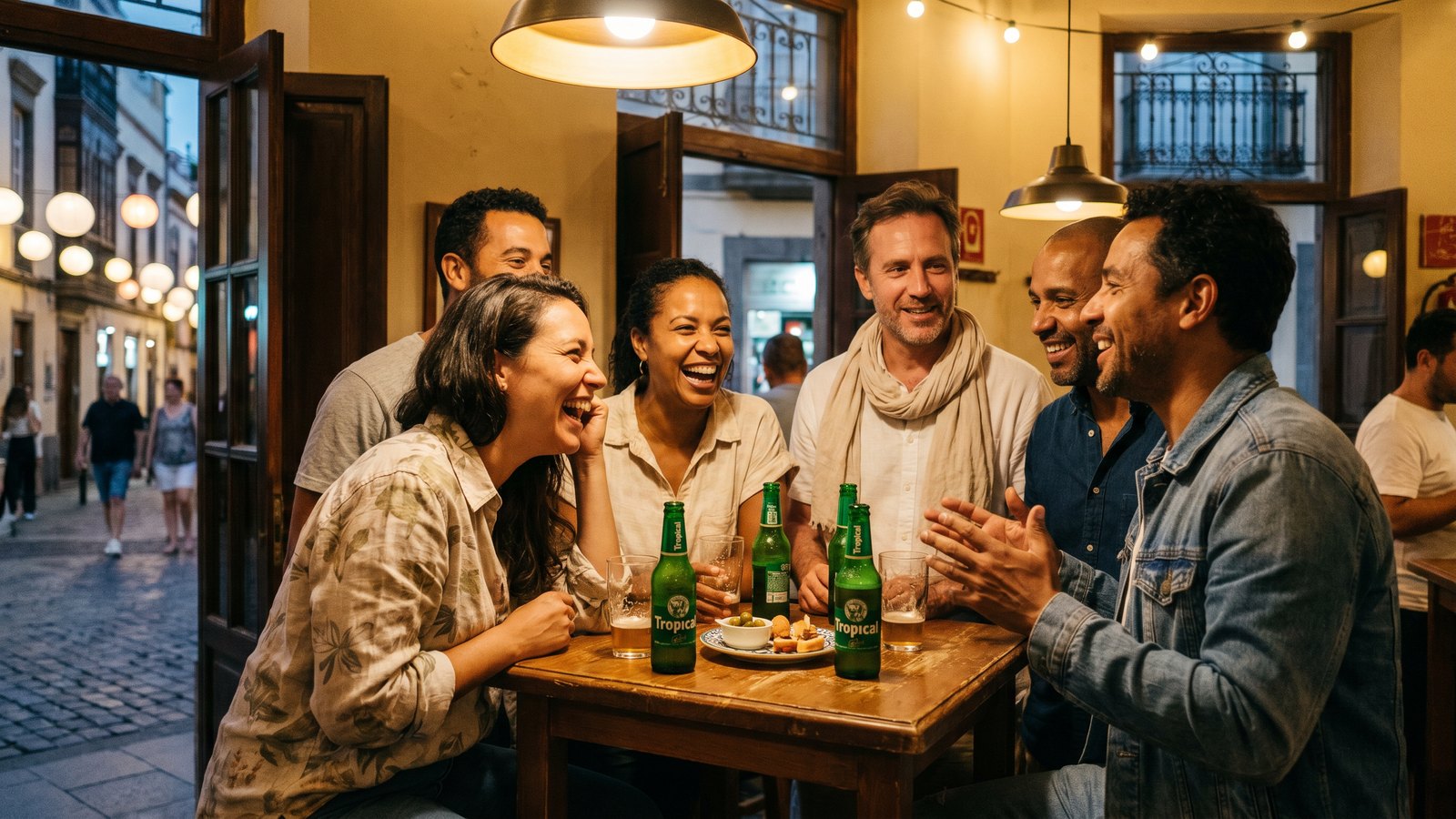
Anyone in Las Palmas who's been here two weeks and wants to grab a beer has two options. Sit alone in the hostel — or show up Tuesday at half seven at Bar San Remo, one street up from Sky Coworking, and find themselves among fifty to seventy people doing the exact same thing. That's the weekly nomad meetup. It has been running for years. Nobody has to sign up, nobody introduces you, you order a Tropical and ask the next table what they're doing here. In an hour you have three contacts.
The connection problem on the Canaries isn't the islands. It's the information. People who know where the others gather are inside the network within three weeks. Those who don't, sit alone for three years.
The platforms — where life actually happens
The central address is Live It Up Las Palmas, founded by a woman called Nelly. A Slack group with more than ten thousand members, sorted thematically into channels: restaurant tips, housing market, bureaucracy help, second-hand marketplace, sport organising. A Canadian nomad wrote in a public review that it's «the best organised thing she had seen so far». Moderation is firm, advertising gets pulled, insults too. Sign-up runs through the website, takes ten minutes, costs nothing.
Alongside Slack there are dozens of WhatsApp groups, sorted by topic: Surf & Skate, beach volleyball, techno movement, queer, board games, coworking buddies, tech meetups. The links aren't publicly searchable — you get them through Slack or at your first in-person meetup. That's deliberate: keeps trolls and spammers out.
On Facebook, «Gran Canaria Expat Community» is the largest English-language hub, alongside specialised groups for families, retirees, dog owners. Meetup.com Las Palmas lists active groups, including an international excursion group that runs hikes plus a guachinche meal every few weeks. Travel-mate seekers find each other through the GAFFL app.
The weekly fixed points
Three dates worth memorising.
Tuesday — the nomad meetup at Bar San Remo. Starts around 19:30, runs until midnight. Mix of remote workers, sabbatical types, recent arrivals, a few locals from the neighbourhood. Nobody asks what you do for a living until you bring it up.
Thursday — Tapas Thursday in the old town. Bars in Vegueta and Triana offer small tapas with wine for one to two euros on Thursday evenings. One glass, one tapa, move on. Local format, not a tourist event. The Spaniards are there, the island is there. This is the non-tourist version of Las Palmas.
Weekend — Mercado del Puerto. Indoor market, meeting point between local cuisine and an international crowd. Sunday lunchtime is peak. Anyone asking there if someone has tips for an affordable flat in Vegueta gets three answers.
Sport as the door opener
The fastest route to contacts on the Canaries isn't the language. It's sport.
Beach volleyball at Playa de Las Alcaravaneras has six courts — three for tenis playa, three for vóley and futvoley. Regulated access, free on Sundays and public holidays. Show up with a ball, ask politely, you're in a game within half an hour. The ULPGC (Universidad de Las Palmas) runs tournaments through the year, the Trofeo Rector is open to students and residents.
Surfing at Playa de Las Canteras, the La Cícer sector at the south end, suits beginners. Several schools, most with day packages from 25 euros. People who stay longer drop the school for a club.
Pádel is booming on the Canaries at a pace that doesn't really match European benchmarks. The Federación Canaria de Pádel lists dozens of clubs, most with open slots for guests. Anyone who plays pádel has a steady four within a week.
Hiking. The Slack groups run regular routes into the Cumbre, up to Roque Nublo, into the Barranco de Guayadeque. Meetup has an international group that gathers every two or three weeks, with food afterwards in a guachinche.
Diving. The Club Actividades Subacuáticas Nautilus at Alcaravaneras and the Club Tritón are the two long-standing addresses. Water sits between 18 and 23 degrees year round, visibility usually past fifteen metres.
Sailing runs through the Real Club Náutico de Gran Canaria or the Club Marítimo Varadero — both offer taster courses and rent boats.
Lucha canaria is the traditional Canarian wrestling. The Federación Insular has clubs in several municipalities. Not the fastest route to contacts, but those who take it become the only foreigner in the club and get taken seriously accordingly.
Ciudad Deportiva Gran Canaria at Paseo Blas Cabrera Felipe is the island's central sports complex: basketball, handball, volleyball, futsal, swimming, triathlon, table tennis, aerobics, gymnastics. The Cabildo organises access through the IID (Instituto Insular de Deportes). Over thirty federations are linked in, from chess to waterpolo.
Coworking as community
Anyone working remotely should not see coworking as just a desk. Sky Coworking in La Isleta is the older, more established address — its own Slack channel, community events, Thursday breakfasts, regular talks. Alongside it Mola Mola, ReStation, Coworking C, each with its own profile. Day pass usually 15 to 20 euros, monthly pass between 150 and 250 depending on provider.
A coworking is more than a chair. Anyone who powers through a full week there walks away with twelve to fifteen new faces, half of whom will stay longer than you do.
Associations and federations — the Spanish way
What Germans and Brits often underestimate: Spaniards organise their social life through associations. From the bola canaria club to the chess club, there are structures open to newcomers as soon as the language allows. Anyone who moves to the Canaries and after a year still has no association contact has chosen the slowest route.
The Cabildos of each island maintain federation directories. On Gran Canaria there are more than thirty, on Tenerife similar. Membership fees usually run between 30 and 100 euros a year. The entry path is an email to the association, a trial training, done.
What runs differently on Tenerife
Tenerife has an expat scene of similar size, but less centralised than Gran Canaria. There's no umbrella community comparable to Live It Up. The scene splits between the north — Santa Cruz, La Laguna — and the south — Costa Adeje, Los Cristianos, Las Américas. Anyone living in Costa Adeje rarely drives up to Santa Cruz for a meetup.
In practice that means on Tenerife you need to look more carefully at where you live. Anyone after social contact tends to land in La Laguna or Puerto de la Cruz, both with active international scenes. Costa Adeje is more touristic, less community-driven, more resort atmosphere. The Facebook groups «Tenerife Expats» and «Tenerife Forum» have tens of thousands of members each, but lighter moderation than Live It Up.
On the smaller islands — La Palma, El Hierro, La Gomera, Lanzarote, Fuerteventura — the whole thing works differently again. Lanzarote has a growing digital nomad scene with a coworking hub in Costa Teguise. On Fuerteventura social life concentrates around Corralejo and El Cotillo, both surf spots. La Palma and El Hierro are smaller, quieter, more personal — anyone moving there knows almost all the other newcomers within three months simply because there aren't that many.
The most common mistakes
Too many apps, not enough showing up. Slack, WhatsApp, Facebook, Meetup, GAFFL — all of it costs attention. One platform is enough. Showing up at the Tuesday meetup beats any online discussion.
Getting stuck on English. The international scene runs in English, but that's not the whole life. Anyone speaking only English never gets to know the islands. Spanish goes in parallel — see Relocate #16.
Overrating the first impression. A Slack group looks in the first month like a mix of influencer posts and help requests. It improves once you meet the people in person. Three weeks of patience.
Seeing sport as effort instead of access. Anyone refusing to play beach volleyball because they aren't good enough has missed the point. Nobody plays on the beach to win. Same goes for pádel beginners.
Living in the south and looking for contacts in the north. On Gran Canaria that means: anyone living in Maspalomas shouldn't be surprised if the Las Palmas scene stays distant. One hour by car, one way. Anyone wanting connection lives in Las Palmas or accepts that the south is dominated by tourist structures.
Q&A
I just arrived — what first?
Sign up to the Live It Up Las Palmas Slack. Pencil in the next Tuesday at Bar San Remo. Identify one sport hobby you want to continue. That covers the first two weeks.
Does this work without Spanish?
For the first months yes. The Slack community runs in English, so do the coworkings. Anyone staying longer eventually needs Spanish — especially for associations, authorities, neighbours.
I'm in my early fifties — do I fit into the nomad scene?
The mix at the Tuesday meetup runs from early twenties to late sixties. Nobody clocks the age. Anyone after connection finds it across age groups — sport associations often work even better for over-forties than the pure expat scene.
I have a family with kids — does this all apply to us?
Partly. The nomad meetups are more for singles and couples without children. Families have their own structures: German and British schools with active parent communities, playgroups, family hiking groups via Meetup. On Facebook groups like «Familias en Gran Canaria» work well. Sport clubs for children are cheap (often 15 to 30 euros a month) and integrate the parents automatically.
What does a social life on the Canaries roughly cost?
Slack is free. Meetup is free. The nomad meetup costs a beer. Coworking day pass 15 to 20 euros, monthly pass 150 to 250. Sport associations 30 to 100 euros a year. Pádel court per hour 8 to 16 euros for a group of four. Anyone budgeting thirty to fifty euros a week for social activities won't have a free evening left after a month.
---
Sources linked in the text: Live It Up Las Palmas, Sky Coworking, Meetup Las Palmas, GAFFL.
Previous part: Relocate #16: Learning Spanish on the Canaries
---
Manus note: Q&A section visible above — please mirror as FAQPage JSON-LD in `
` as well, content-identical (Bing penalises mismatches).