The Spanish school system in three minutes
Spain has compulsory schooling from age 6 to 16. The stages:
| School Type | Language | Cost | Curriculum | Typical Ages |
|---|---|---|---|---|
| State school (público) | Spanish | Free | Spanish national | 3–16 |
| Semi-private (concertado) | Spanish (bilingual options) | Low fees | Spanish national | 3–16 |
| International (British) | English | €5,000–€15,000/yr | British/IGCSE/A-Level | 3–18 |
| German school | German/Spanish | Moderate fees | German + Spanish | 3–18 |
- Educación Infantil — kindergarten, ages 0–6, voluntary but usually attended from age 3
- Educación Primaria — primary school, ages 6–12, six year-groups
- Educación Secundaria (ESO) — lower secondary, ages 12–16, four year-groups, compulsory
- Bachillerato — upper secondary, ages 16–18, two years, optional, required for university
- Formación Profesional (FP) — vocational training, alternative to Bachillerato
In Gran Canaria, as everywhere in Spain, there are three kinds of schools:
Public (público) — state-funded, free. Enrolment through the Canary Islands education ministry. Instruction in Spanish. Wide quality range — there are excellent public schools and weaker ones.
Concertado (subsidised private) — half-private. State-subsidised but independently run (often religious). The core teaching is free but voluntary contributions, materials and activities come on top — usually 50 to 200 euros per month. Enrolment similar to public schools.
Private (privado) — fully private, no state subsidy. Mostly international schools with their own curricula (British, German, American, IB). Fees between 4,000 and 15,000 euros per year. Direct enrolment at the school.
Public schools: what to expect
Gran Canaria has hundreds of public schools across the island. The system works by school districts — your home address decides which catchment area gives you priority.
What works well:
- Free. Really. No tuition, no enrolment fee
- Everywhere available. Even in small municipalities
- Lunch usually subsidised at 2–4 euros per day
- Full Spanish immersion — if you want your child to learn fluent Spanish, this is the direct path
What works less well:
- Class sizes — often 25 children per class, more in popular schools
- Language support for non-Spanish speakers exists but varies widely by school
- English teaching at very different levels
Schools with bilingual programmes (Spanish-English) have grown stronger in recent years, including in the public system. The Canary Islands have an official programme called AICLE/CLIL through which more and more public schools become bilingual.
*Tip: The Canary Islands government portal gobiernodecanarias.org/educacion lists all public schools with their language programmes and opening hours.*
Concertado schools: the middle way
Colegios concertados are Spain's particular hybrid: privately run, state-funded. Usually with religious backing (Catholic, though some are secular).
Advantages:
- Typically 50 to 200 euros per month, often less than a private school
- Smaller classes than the public system in some cases
- More stable teaching staff
- Extracurricular offers, full-day care
Disadvantages:
- Sometimes religiously oriented. If you don't want that, you need to specifically look for secular options (some offer religion as an elective)
- Waiting lists for popular schools
- The "voluntary" contributions are often effectively compulsory
Well-known concertado schools in Gran Canaria: Colegio San Ignacio de Loyola (Jesuits) and Colegio Los Ángeles in Las Palmas, Colegio Norte in Guanarteme — all established for decades.
International private schools: if your child shouldn't speak Spanish
These are the schools expat families most often choose — with curricula from the UK, Germany, the US, or International Baccalaureate.
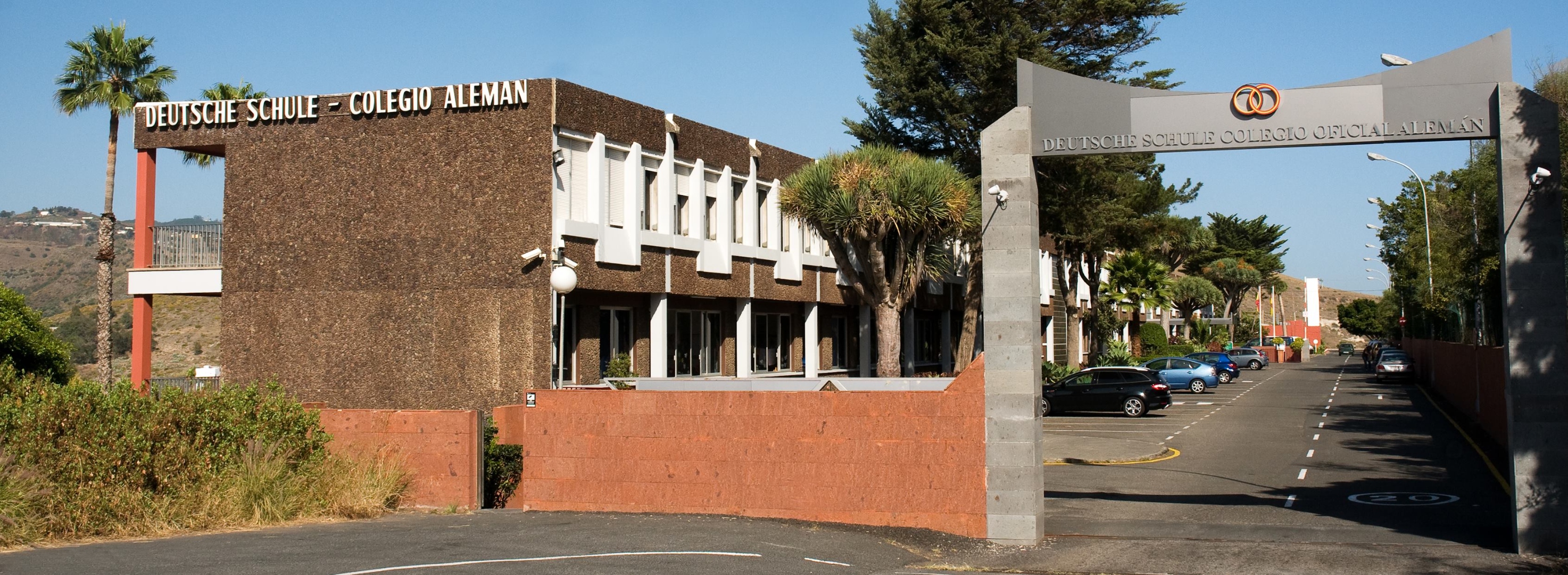
Deutsche Schule Las Palmas (DSLPA)
In Tafira, north of Las Palmas. German curriculum, instruction in German, accredited by the German Central Office for Schools Abroad. Children from 3 to 18. Final qualification: German Abitur.
Fees 2025/2026: 4,560 to 5,980 euros per year depending on stage. Plus enrolment fees, materials, lunch.
Ideal for: German-speaking families staying for a few years who want to keep connection with the German school system.
British School of Gran Canaria (BSGC)
In Tafira. UK curriculum, instruction in English, COBIS-accredited. Children from 3 to 18. Final qualification: A-Levels, leading to British and international universities.
Fees are not publicly listed — interested families must inquire directly. Expect 7,000 to 12,000 euros per year depending on stage.
Oakley College
Also British curriculum, Las Palmas. Smaller classes, family atmosphere. International teachers, instruction primarily in English. Repeatedly recognised as one of Spain's top schools.
The American School of Las Palmas
Private, American curriculum, bilingual Spanish-English. Accredited by the US Department of Education. Children from 3 to 18.
Colegio Heidelberg
Trilingual — Spanish, German, English. International Baccalaureate from secondary. Children from 2 to 18. Interesting for families who want to develop several languages in parallel.
Canterbury School
In Maspalomas-San Agustín (south) and a second campus in Las Palmas. British curriculum, instruction in English with strong Spanish component. Especially relevant for families in the south — one of the few international school locations south of Las Palmas.
San Antonio International School
Bilingual Spanish-English with UK influences. Modern campus, focus on holistic education.
*Note: Fee figures are for school year 2025/2026 and may change. Enrolment fees (matrícula), uniform, school bus, materials and lunch usually come on top — budget 20–40% more.*
Enrolment: the bureaucratic path
Public and concertado
Enrolment for the next school year is typically March to April. You need:
- Empadronamiento — town hall registration. Nothing happens without it
- NIE for parents and children
- Copies of passports
- Vaccination book (cartilla de vacunación) or proof of vaccinations
- Children's birth certificate (translated and apostilled if from abroad)
- Previous school records (for transfers)
- Enrolment form from the Canary Islands education authority
Enrolment runs online through the Canary Islands government portal or directly at the preferred school. You usually list three preferences. The system allocates by a points system: catchment area, siblings at the school, income, disabilities.
Important: Children who arrive mid-year can be enrolled outside the regular enrolment window. The education authority will assign a place — not always at the preferred school.
Private schools
Direct contact with the school. Often with admission tests, interviews, waiting lists. For German and British schools the enrolment process often starts a year in advance. Arriving mid-year still gives you a chance — but popular stages (Primaria, Secundaria) are usually full.
The most important question: where should you live?
The school location helps decide where to live:
- Las Palmas (Tafira, Siete Palmas, Guanarteme) — this is where almost all international schools are. If your child is going to Deutsche Schule, BSGC, Oakley or Heidelberg, living in the catchment area makes sense. School buses usually run, but the journeys are long.
- San Agustín / Maspalomas (south) — Canterbury School is the main anchor for expat children in the south. Otherwise public and concertado schools.
- Telde — Brains International School and several public options. Cheaper to live than Las Palmas, good bus connections.
- Gáldar, Arucas, north — mostly public schools, mostly in Spanish. If you want to live up in the mountains, you should accept that the children will immerse in the Spanish school day.
What to do in the first weeks
Checklist for families who have just arrived:
- Empadronamiento — at the town hall (ayuntamiento) of your municipality. You need NIE or passport, rental contract or proof of ownership
- Include children on the NIE — done together with the parents' application
- Visit schools — even outside the enrolment period, most schools take appointments. Public, concertado, international — look at all three before you commit
- Health card (Tarjeta Sanitaria) for the children — important for school medicine, vaccinations
- Get the vaccination book checked — Spanish schools require certain vaccinations. Hepatitis B, meningococcus, HPV, measles. Missing vaccinations must be caught up
- Translate and apostille documents — birth certificates, school records. Done through a notary or official translators
- Extracurriculares research — sports clubs, music schools, language schools. The right activities make integration easier
Integration reality: what actually happens
Most expat children in public or concertado schools speak fluent Spanish within six to twelve months. Children under ten integrate almost playfully. Teenagers between 12 and 16 have a harder time — both linguistically and socially.
Children in international schools learn Spanish as a subject, but their daily life stays English- or German-dominated. Those who want to stay locally in the job market later benefit from the public system. Those visiting the islands for a few years and wanting to keep connection with the home country are better off in an international school.
Mixed model: Some families start at an international school (orientation, language learning, friendships) and later switch to the public system once the children have enough Spanish. That works but needs planning.
Special education and inclusion
Children with special needs have a legal right to support in Spain. Public schools offer:
- Apoyo escolar — extra pedagogical support
- Speech therapists, psychologists in larger districts
- Aulas Enclave — classes for children with severe disabilities
- Programmes for gifted children (alta capacidad)
International schools have their own learning-support programmes, but not all accept children with significant learning needs. Clarify in advance.
Context: what makes the islands distinctive
The Canary Islands have features you won't find on the mainland:
- The school year starts early to mid September, ends mid June. Summer holidays are long
- Christmas break almost three weeks
- Semana Santa (Easter week) a whole week off
- Canarian holidays — Día de Canarias (30 May), island-specific days
- Weather enables much outdoor learning — swimming from April in the pool, year-round breaks outside
The holidays have advantages: long summer breaks are ideal for grandparent visits or trips home. Disadvantages: summer childcare is expensive and must be booked early — summer camps (campamentos de verano) on Gran Canaria are plentiful, but the good ones fill up fast.
Bottom line
Gran Canaria offers expat families three real options: a solid public system for full Spanish integration, a concertado middle way, and several excellent international schools for families who want to keep connection with the home country.
The most important advice: start early. Both with the paperwork (Empadronamiento, NIE, apostilles) and the school search. Arriving in August with two kids and no school place means a difficult September.
The second key recommendation: visit the schools in person. Websites tell you little, and the on-site impression decides. Talk to teachers, other parents, and if possible older students. That decides more than a fee table.
Your children will settle in. Experience shows that happens on Gran Canaria faster than in many big cities — schools are smaller, communities tighter, and the island's culture around kids is warm and inclusive.
---
*As of April 2026. Fees, enrolment processes and school offers can change. For current information see school websites or the Canary Islands education ministry (gobiernodecanarias.org/educacion).*
*This article is part of the CITA News Relocate series. Previous parts: [Internet and Co-Working](/en/internet-coworking-gran-canaria-relocation-guide.html) · [Buying or renting a car](/en/buying-renting-car-gran-canaria-relocation-guide.html). Next part: Health and insurance.*