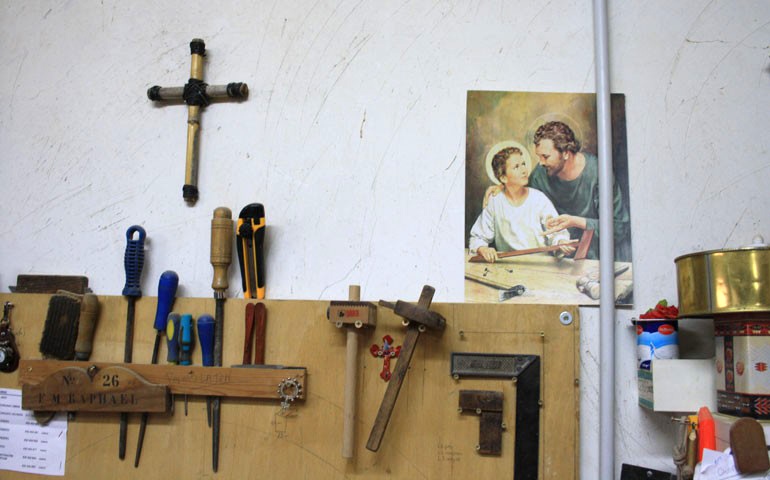
The carpentry workshop at the entrance to Vecindario, where Carlos González has been making custom furniture for three decades, closes at the end of 2026. Carlos is 64. His son is a teacher on Tenerife and has no desire to return to the tools.
Carlos has placed no advertisement. He has simply told three regular clients that it's over in December. That's how the gaps form that appear in the national statistics as a generational handover deficit — quietly, without headline, workshop by workshop.
Across Spain a demographic shift is taking shape in the self-employed segment that will reshape the islands' economic fabric in the coming years. In the Canary Islands 32,755 self-employed between 56 and 65 are close to retirement.
Against them stand only 19,750 self-employed between 26 and 35, plus 4,314 under 26. Even if all the younger ones took over — which they won't — 8,700 successors would still be missing.
What the national ATA figures show
The Federación Nacional de Asociaciones de Trabajadores Autónomos (ATA) presented its 2025 balance in February 2026. As industry medium Distrito Emprendedores summarises the figures (Distrito Emprendedores), 73.1 percent of the entire self-employed growth in Spain in 2025 came from people over 56.
Within this group, those over 65 made up 35.2 percent of net growth. Self-employed over 46 explained 84.5 percent of total RETA growth.
ATA president Lorenzo Amor frames the situation with unusual sharpness: "Despite the global growth, we are not in a position to ring the bells.
2025 was a very complicated year for the small self-employed." In Lawandtrends, Amor sums up the mood at the end of 2025: 30 percent of the self-employed closed the year with losses, as the magazine reported in December 2025 (Lawandtrends).
While natural-person self-employed in Spain fell by 21,406 in 2025 and collaborating family members by 7,732, corporate self-employed grew by 66,674. Translated: the classic family business is disappearing, the corporate structure is growing.
Which Canarian sectors are hit hardest
Three areas stand out. Construction and trades — carpenters, masons, electricians, plumbers — have been family businesses for generations. When a 62-year-old maestro stops, a 32-year-old maestro rarely follows.
Hospitality and small retail — bars, tienditas, fruterías — find no successors; the younger generation doesn't want to stand 70 hours behind the counter. Agriculture and livestock — cabreros, small farmers, cheesemakers — lose the generation that still knew how to ripen a Queso de Flor or how to plant a banana without damaging it.
The consequences are already visible in daily life. Anyone in the south of Gran Canaria who has tried on a Friday afternoon to reach a plumber for an urgent problem knows the waiting times.
Certain services — from chimney sweep to shoemaker — are slowly disappearing on many islands. Repair becomes more expensive than buying new, because fewer professionals are available.
What the market opens for buyers
Anyone who wants to take over an existing business has a better negotiating position today than five years ago. Sellers are often motivated: better a sensible handover to a committed person than closing without an heir.
That applies with particular sharpness to family businesses in which the next generation either is missing or has gone other ways.
Anyone toying with the idea of taking over an existing business in the Canary Islands should clarify above all the legal form. A takeover as autónomo is a different constellation than a takeover as Sociedad Limitada. Both have implications for IGIC, IRPF, RETA and liability.
An initial consultation with a gestor or economic lawyer specialised in the Canaries is mandatory. The Gobierno de Canarias maintains subsidies for taking up self-employment, including explicitly the possibility of taking over a family business after the death, illness or retirement of the previous holder.
More important than the form is the relationship. A family business is more than its balance sheet. Customers know the maestro by first name.
Whoever takes over also takes over a trust relationship — and must cultivate or lose it. A six-month handover period, in which the departing owner personally introduces customers to the new owner, is worth gold.
Why the gap will not close itself
Spanish Social Security has since April 2026 revalued "Jubilación Activa" for self-employed. Anyone combining the pension with a running business now gets 55 percent instead of 45 percent of the calculation base (El Confidencial Digital), if at least one employee is permanently contracted.
This is meant to encourage the self-employed to continue longer. The effect: retirement is delayed, the gap is not closed.
At national level ATA and the Social Security Ministry have been talking for years about tax incentives for taking over existing businesses. Concrete measures are missing.
As long as the policy gap is not closed, generational handover remains a private matter between retiring maestros, their children with other plans, and isolated buyers who dare to ask. Carlos González in Vecindario is one of those who close in December without anyone asking. Anyone who would ask could get the workshop cheaply.
Martin Kosinski writes for CITA News about business, tourism and service topics. More about the author