After the drive from Las Palmas to Guía, you come across a petrol station just past the entrance to the village. Convenient, if you need fuel — but also for refuelling body and soul.
Inside the cafeteria stands Paula behind the counter, smiling, reading from your eyes that you need a lift, and making a double espresso without your having to ask.

She slides the cup across the wooden counter with a small turn of the wrist, laughs briefly, talks fast, and the coffee really does wake the soul and the tired mind. She didn't want to be photographed.
But the next time I drive up to Guía — and there will be a next time — I'm stopping at her counter first.
The road from Las Palmas through Arucas up to Guía is, by experience, light on traffic this Sunday morning, as Sundays tend to be. The landscape grows greener with every kilometre. Nothing up here resembles the beach hotels of the south.
If you live in a city in the south, where things are busier, and think you know Gran Canaria, you don't know the island, not by a long stretch.
On the way to the Plaza
From the parking spot up to the historic centre, it's a ten-minute walk through narrow lanes. Uneven cobblestones — flat shoes are mandatory.
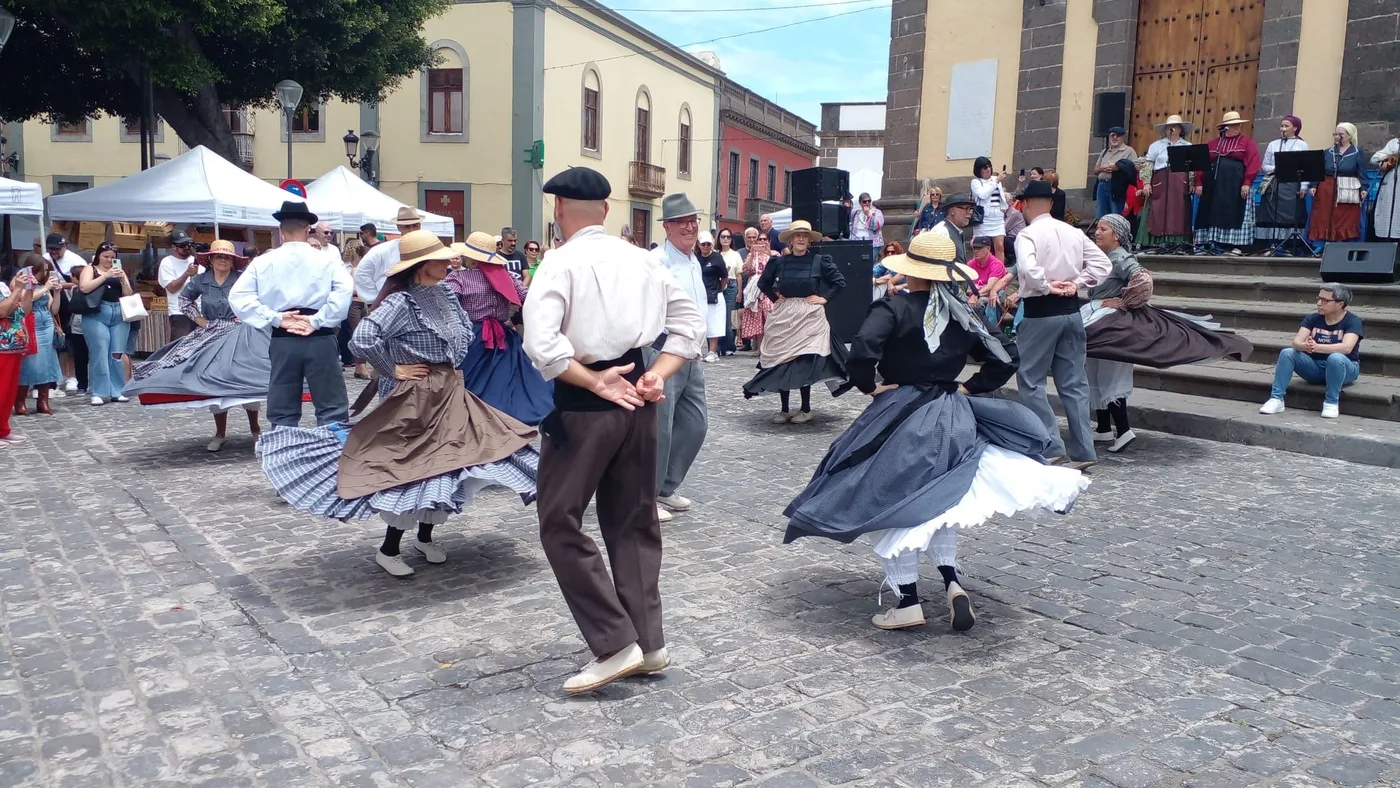
Halfway up I cross paths with Francesco, in full traditional dress, white shirt, dark waistcoat, the rest of the folklore group already further uphill. We talk briefly. He has been dancing for years; the performance is about to start at the Iglesia Matriz.
He smiles warmly, shakes my hand, walks on. First observation of the day: the warmth with which strangers look at you here is not tourist-courtesy. It is the normal register.
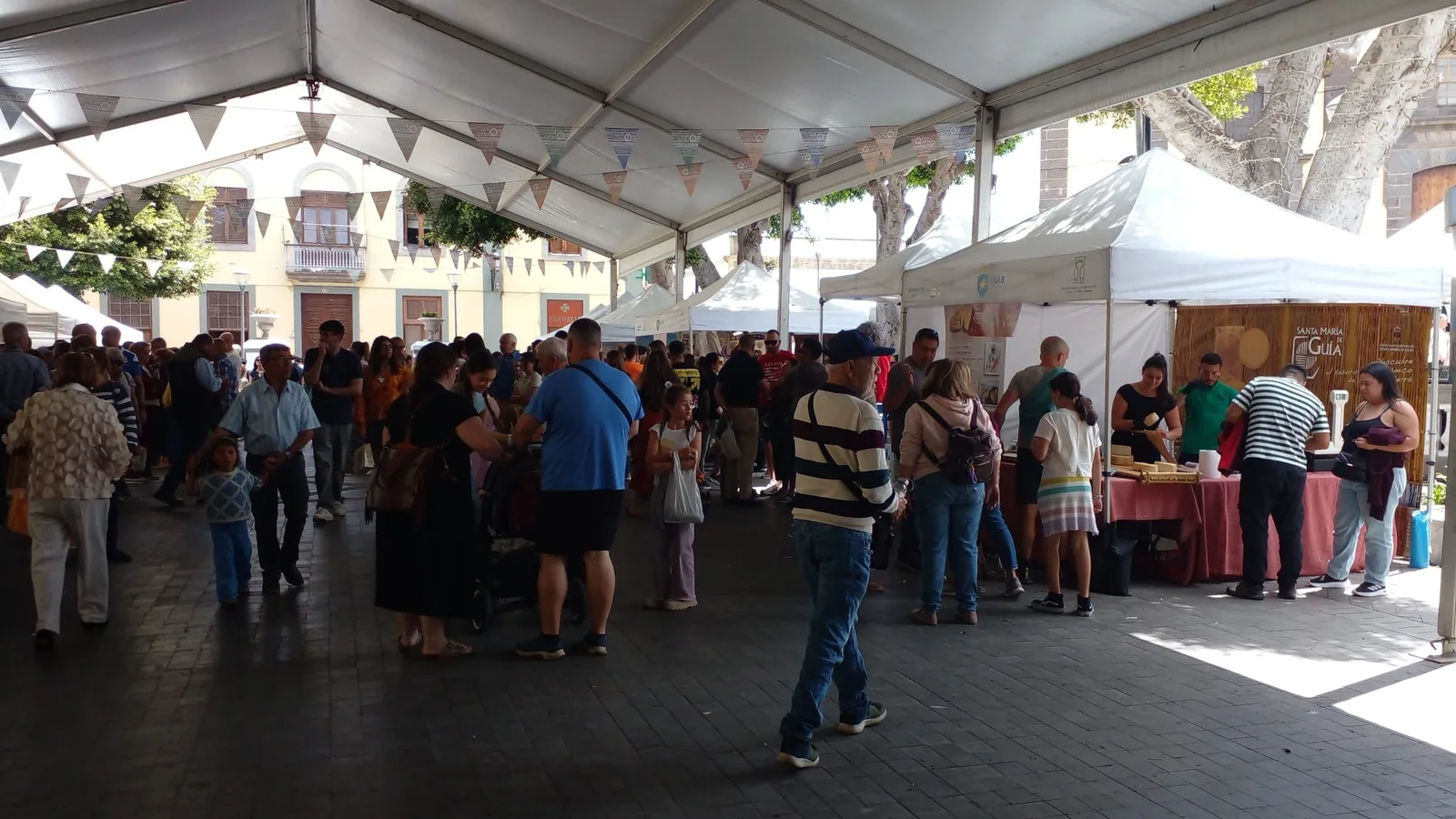
Up at the Plaza Grande the crowd is bigger than I expected. The organisers had announced 12 cheese stands, 24 craft stands and 13 stalls of regional food, spread across the Plaza Grande, the smaller Plaza Luján Pérez, the Calle Marqués del Muni and the church forecourt.
It feels like more.
The festival has carried the seal of „Fiesta de Interés Turístico de Canarias" for years, but here you don't notice it as a label, you notice it as atmosphere: families with dogs, older couples on canes, children between adult legs, someone apologising for a bump that was barely a bump. Disculpe.
Three generations on a square barely big enough for one.
What is sold here, smells here, tastes here
The cheese this is all about is the Queso de Flor de Guía, with Protected Designation of Origin. Its rennet is not animal but vegetable: dried flower petals from the wild cardoon thistle (Cynara cardunculus). That makes it one of the rarest of its kind worldwide.
On the stalls, wheels lie at every stage of ripeness — from soft ivory to brittle bronze. The cheesemakers barely have time for long conversations. Demand is too high; selling, weighing, wrapping is what the morning is for.
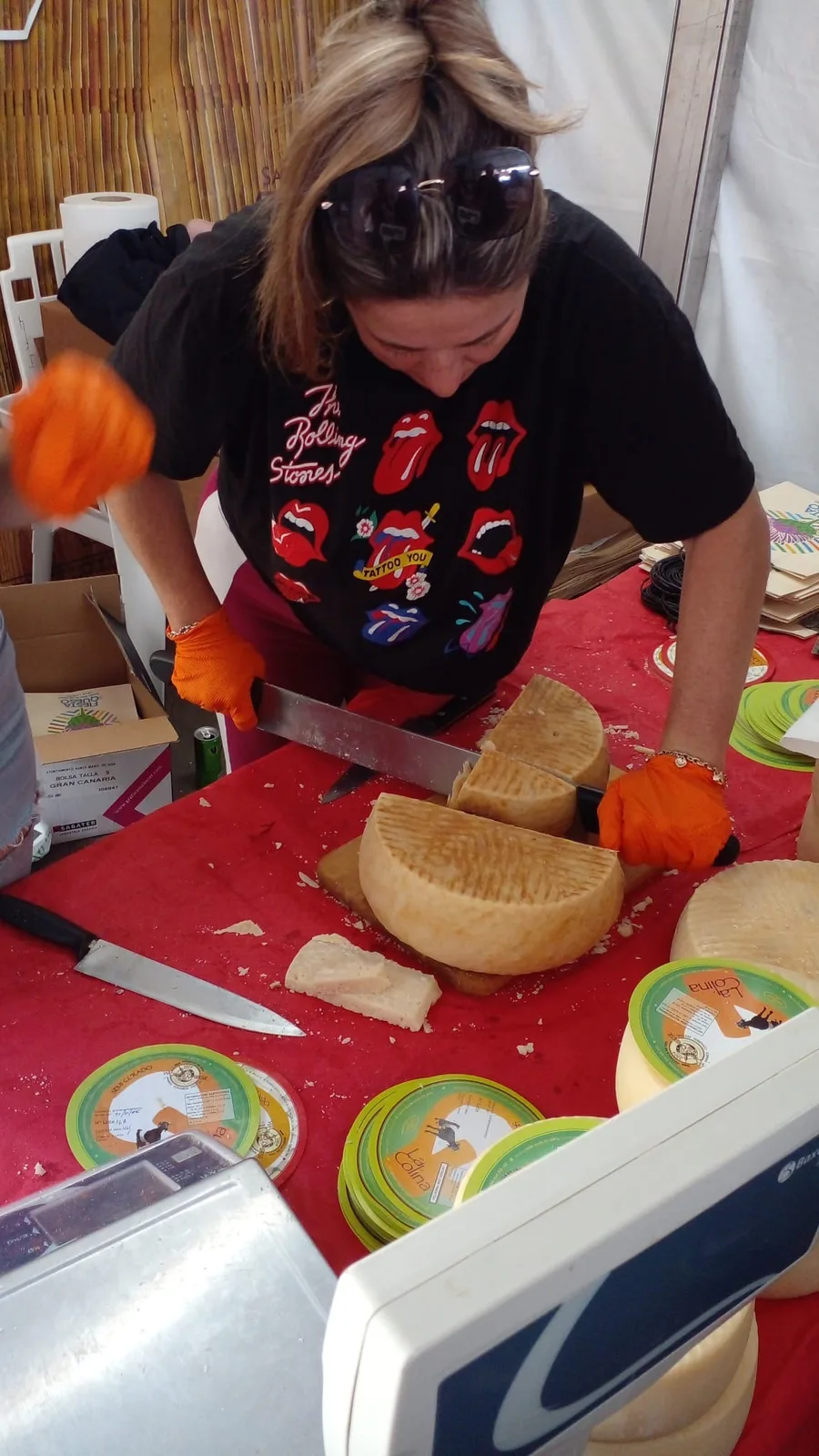
I stop and watch a middle-aged woman cut a wheel — not without looking, but with the routine of someone who has been doing it for over twenty years. On her T-shirt, the logo of a rock band. Good choice, señora.
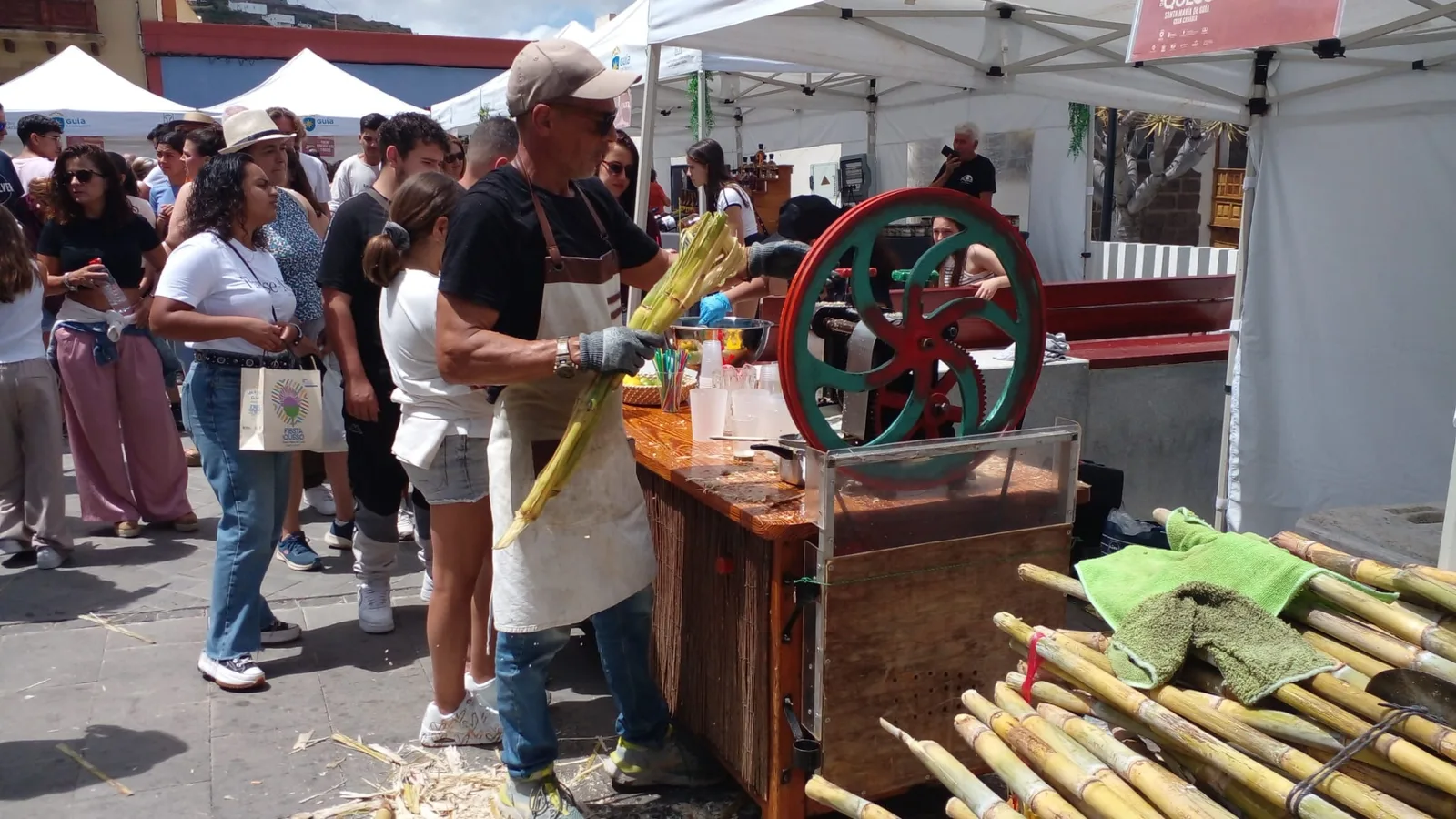
Right next to the cheese stalls there is a machine I first take for an old caipirinha press.
It's a caña de azúcar press: the man at the flywheel feeds fresh cane between the rollers, cranks with both hands, and below the juice runs into a bowl, then mixed with water, lime, and — if you ask — a shot of rum. The queue in front of it is the longest on the square.
The people who come back with a cup grin broadly and say nothing more than muy bueno. With rum, I suspect, even better, although then someone else should drive.
Next to it, a stall of homemade liqueurs in coloured glass bottles, a jam stall, and a small wood-fired oven where two young men pull mini-pizzas out faster than the queue can shrink.
A few stalls further on, a stall of handmade traditional dresses — and two ladies wearing them who smile at me and explicitly ask to be photographed. They wear the dresses with the same matter-of-factness others wear a Sunday outfit. A beautiful sight.
The table with the bones
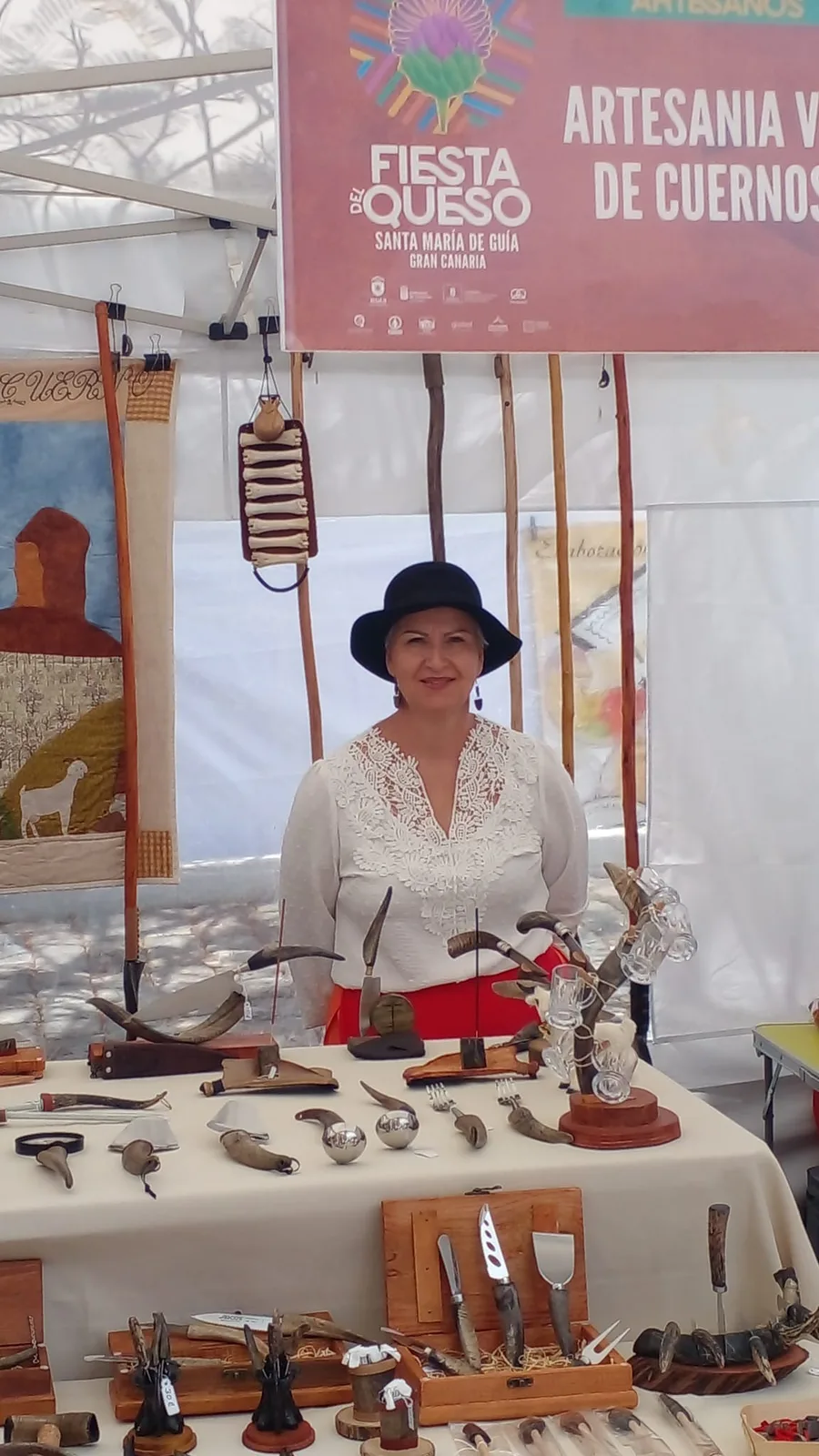
It takes me two looks to understand what is laid out on this one folding table. In front of me are bottle openers, pizza cutters, small kitchen utensils — and all of it, all of it, is made from bone. From horns.
From what is left of goat and sheep after slaughter, after the meat has been sold, the hide tanned and the milk turned into cheese. The sign above the stall says it plainly: Artesanía y cuernos. Crafts and horns.
The woman behind the table wears a wide-brimmed hat and a light blouse, and politely answers everything I ask, but the truly remarkable thing is the objects themselves.
What stands here is what Canarian farmers have meant for centuries by the word aprovechar — make use of everything from the animal. Not from ideology, but from scarcity. The tradition does not live in a museum or in the sustainability marketing of a tourism board.
It lives on this table, in Guía, on a Sunday morning.
Folklore at the church forecourt
At eleven, the folklore programme begins in front of the Iglesia Matriz. The organisers have lined up the A.F. Araza from Tenerife and the local A.C.R. Estrella y Guía; one of the two is Francesco's. About ten dances in an hour and a half, timple, drum, a voice that leads the song.
What surprises me: the audience doesn't only clap, but sways, hums along, and after three or four pieces the dancers pull passersby into the circle. An older lady, who a moment ago had her cane firmly in hand, suddenly dances along. Hand in hand.
A flicker of goose-bumps, on a Sunday at half past eleven, when nothing else extraordinary is happening. Francesco spots me at the edge and waves me over once more, para las fotos, and I take him up on it. They are the best pictures of the day.
An encounter in a side lane
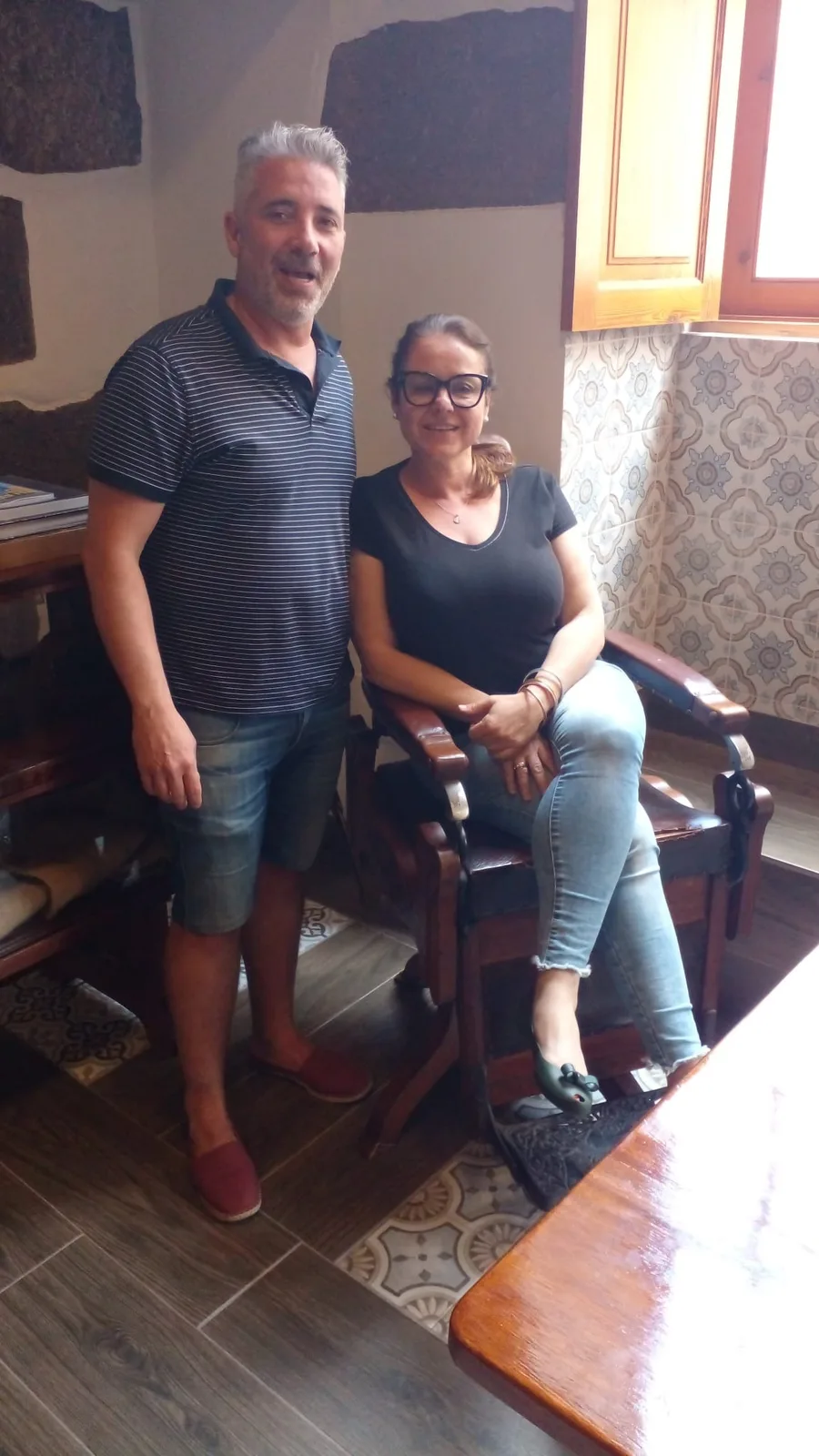
On the way back, with sore feet already, I turn into a narrow lane behind the Plaza. An open courtyard, a gate, a long wooden table, a few chairs, an old carafe. Tamara and Antonio, both from Guía, set their own little table on feast days — not as a restaurant, but for friends, neighbours and, occasionally, a reporter who happens to walk by.
They don't offer me coffee, they don't show me photos. They show me their villa, their interior, their favourite pieces — among them a dark leather armchair with curved armrests, an antique, on which they ask me to sit so they can take a picture.
„A dentist's chair would have been an idea too," Tamara says with a perfectly straight face, and the whole courtyard breaks out laughing. They have family in Germany, in a town I can't quite place, which doesn't matter to either side.
What stays is the complete warmth, the genuine interest, the openness — a hospitality that expects nothing and sells nothing. I hand out CITA News business cards, they scan the QR code, and Tamara nods, satisfied, as the page opens.
On the way back to the car I see two older gentlemen sitting on a bench. Fresh bread in one hand, a piece of bought cheese in the other, slowly, with relish. The smile on their faces says more than any press release about how worthwhile this day was for the people here.
The drive into the hills that quiets you
My last plan was the Casa del Queso in Montaña Alta, the cheese museum up in the hills, five kilometres past Guía.
The road up is well-signed and well-paved, but it asks for a different driving style than the GC-1 in the south. Tight bends, steep slopes on one side, walls of dark volcanic stone on the other.
Horses by the roadside, aloe in full bloom, the occasional Canarian casa rural with its roof barely reaching above the pines. The landscape is greener than the south will ever be, and it quiets you.
If you drive up here for the first time, pull over and stand still for a few minutes, instead of racing through the bends at fifty. It's worth it. Something of the Shire is in these hills.
I arrive at quarter past two. Closed. Open Sundays until two, a friendly gentleman at the car park tells me, and besides, the staff is down at the festival today.
Anyone who wants to see the museum should drive up next Sunday, 3 May — when the festival itself moves up to Montaña Alta, into the lanes around the church, with folklore groups, the prize-giving of the XXVII Cata Insular and an atmosphere that has consistently drawn around 8,000 visitors for years (Radio Faro).
Global runs a dedicated bus there too, the 107 from Gáldar, every fifteen minutes.
I drive back south. The double espresso is long gone. But the impressions that go to the heart and the soul stay with you for a long time: Tamara and Antonio's friendly laughter, the table of bones, the older lady who let go of her cane to dance, and the two gentlemen on the bench with bread and cheese.