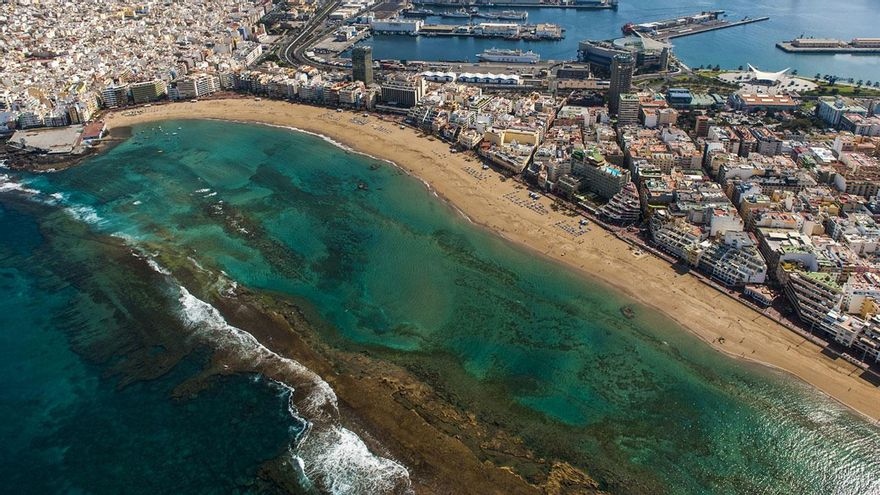
Las Palmas de Gran Canaria is among the ten best cities in the world for digital nomads. So says the Informe Nómadas Digitales Holafly 2026 (El Debate), released by the Spanish eSIM provider Holafly on 21 April 2026.
The Canarian capital lands in position 8 — making it one of only three Spanish cities in the top 10, alongside Valencia (3rd) and Seville (10th). Madrid and Barcelona are absent entirely.
How the report is built
Holafly is not a neutral academic publisher but a commercial eSIM provider whose target audience is digital nomads — the report therefore also serves its own marketing. Methodologically, however, it stands solidly.
The data base consists of a quantitative survey across ten countries (USA, UK, France, Spain, Germany, Brazil, Argentina, China, Japan, India) with 100 respondents each — a total of 1,000 digital nomads as the sample.
To this is added a systematic review of industry reports and data aggregator platforms such as Nomad List, which according to Holafly counts more than 40 million remote professionals worldwide.
Five main criteria were assessed: quality of life, coworking offer, administrative facilities such as digital nomad visas, internet reliability, and cost of living.
Las Palmas in detail
In the Holafly editorial reasoning on the Canarian capital, it is stated literally: Las Palmas is "a long-time favourite among remote workers" and combines "year-round mild climate with good connectivity and a mature 'work and surf' ecosystem".
As part of Spain, the city benefits from "favourable residence and visa regulations" and has a "developed coworking and coliving sector".
Concrete strengths from the data: well-developed fibre optic coverage in most neighbourhoods, an established international community in Vegueta, Triana and Puerto de la Luz.
more than two dozen coworking spaces in the city, the Spanish digital nomad visa (residence permit for remote workers with foreign income) and average living costs below the level of Madrid or Barcelona.
The complete top 10 — and what it shows
| Rank | City | Country | Region |
|---|---|---|---|
| 1 | Genoa | Italy | Western Europe |
| 2 | Bari | Italy | Southern Italy |
| 3 | Valencia | Spain | Mediterranean |
| 4 | Quebec City | Canada | North America |
| 5 | Catania | Italy | Sicily |
| 6 | Florence | Italy | Central Italy |
| 7 | Palermo | Italy | Sicily |
| 8 | Las Palmas de Gran Canaria | Spain | Canary Islands |
| 9 | Rome | Italy | Central Italy |
| 10 | Seville | Spain | Andalusia |
The ranking is clearly dominated by two countries: Italy holds seven of the ten places, Spain three. Quebec City is the only non-European city.
Reducing the list to the European area, Las Palmas thus sits at position 7 in Europe — and is the only representation of the Canary Islands. Madeira is also absent; Lisbon, Berlin, Amsterdam and Tallinn — all earlier digital nomad classics — are not in the ranking.
Why Madrid and Barcelona are missing — and what it means for Las Palmas
The Holafly editorial team justifies the absence of Spain's big cities with "high cost of living and urban saturation".
That is the other side of the Las Palmas position: the city is not in the top 10 because it is spectacularly cheap — but because it belongs to the category of "medium-sized cities" which, according to the report, currently set the trend.
Medium-sized cities with functioning infrastructure, Mediterranean climate, cultural profile and moderate prices — that is the Holafly formula 2026.
Las Palmas fits the profile. But the competition from Italy shows: seven Italian cities beat all other contenders. Genoa, Bari, Catania and Palermo all benefit, according to the report, from the Italian digital nomad visa, in force since April 2024, which admits lower-income emigrants than its Spanish counterpart.
Las Palmas thus does not compete against a single Italian location — but against a bundle of six places above and below it.
The weaknesses the report does not spell out
The Holafly report lists strengths but does not balance the weaknesses of each city. For Las Palmas, three points are relevant for remote workers that are usually missing from the promotional texts:
Rising rental prices. Residential rents in Las Palmas have risen sharply over the past year; Idealista data shows for San Bartolomé de Tirajana 21.6 euros per square metre (Idealista) — the highest value in the Canaries.
Las Palmas itself sits below that, but housing-market tension with local residents is real and is gladly omitted in tourism-oriented reports.
Central coworking spaces can be expensive and unreliable. Reviews on Nomads.com note repeated criticism: coworking spaces are in parts expensive, service not always reliable, internet in some spaces uneven.
Tensions with the local population. The influx of well-paid remote workers has led in recent years to open conflicts — displacement effects in the housing market, anti-tourist demonstrations in 2024 and 2025, a tense atmosphere in some neighbourhoods. This is not specific to Las Palmas, but relevant for a complete assessment.
What Las Palmas's position means for the island and the other Canaries
The inclusion of Las Palmas in the global top 10 is a marketing success for Gran Canaria. It confirms a development running since the pandemic: the Canaries have shifted from a pure mass-tourism destination to a mixed profile, with remote work, emigrants, lifestyle tourism and the established European resident community.
What is missing from the report are the smaller Canary islands. La Palma, La Gomera and El Hierro, with their quieter atmosphere and lower rent levels, would for a particular subgroup of digital nomads — self-employed, programmers, writers — possibly even be more interesting than Las Palmas.
But they don't have the critical mass of coworking infrastructure, direct flights and international communities that Holafly applies as evaluation criterion.
Las Palmas thus remains the one gateway through which digital nomads come to the Canaries — and anyone exploring the smaller islands from there will often find that the most interesting corners are not in the statistics.
Martin Kosinski writes for CITA News about business, tourism and service topics. More about the author