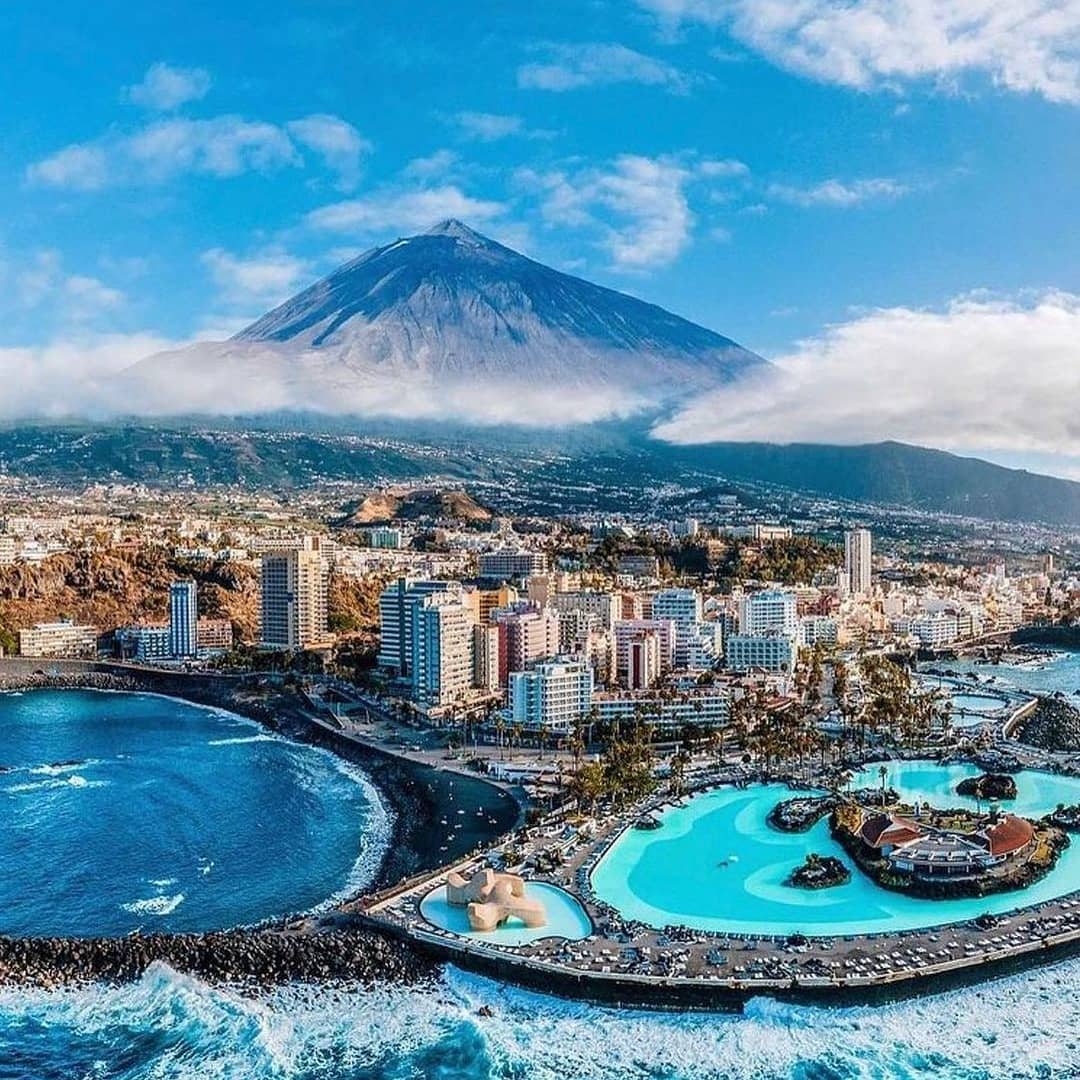
In Puerto de la Cruz the festival season starts in early May. Plaza del Charco, Muelle Pesquero, Jardines del Taoro: for four days dancers, musicians and acrobats take over the public space, and admission is free.
Anyone living in northern Tenerife — and especially the German resident community that has been at home there for decades — knows the phenomenon. What happens in the city between early May and mid-December 2026 is more than a loose programme: it is a cultural-political strategy that has received national recognition in recent months.
The Culture Department of the Town Hall presented the 2026 calendar on 23 April. The city itself speaks of a "Sistema Cultural Vivo" (Puerto de la Cruz) — a living cultural system rather than a string of isolated events. The result is a dense annual calendar with seven festivals.
The 2026 dates at a glance
MUECA — 24th International Street Art Festival, 7 to 10 May. Theatre, circus, music, dance in the historic centre, from Plaza del Charco to the Jardines del Taoro.
Australian company Circa opens with "Wolf/Lobo", a physically demanding choreography for ten acrobats. From Álava comes Zanguango Teatro with "El peor espectáculo del mundo, de momento" — theatre, circus, humour.
Up&Down — Jazz and World Music, 14 to 18 May. Immediately after Mueca. Concerts in historic spaces of the city; each venue is part of the musical experience.
Veranos del Taoro — 18 to 20 June. Theatre, dance and concerts in the open air at Taoro Park above the city.
Canarias Jazz & Más — 23, 24 and 25 July. One of Spain's most established jazz festivals. International acts, traditional, broad genre range.
Phe Festival — 4 and 5 September. Current music, urban trends, new cultural currents. Phe ranks according to the "Lo mejor de la Cultura" report by Fundación Contemporánea in second place in the 2025 Canary Islands ranking (Canal4) — alongside Mueca, which also appears among the top rated.
International Music Day — 2 and 3 October. Shared celebration in several Spanish cities.
Ritmos Handmade — 12 to 15 November. Concerts, masterclasses and workshops around percussion.
Puerto de la Cruz Bach Festival — November and December. Classical and choral music; concerts, education, exhibitions.
What lies behind the system
Mayor Leopoldo Afonso, who has led the Town Hall since summer 2024, formulated at the presentation on 23 April a claim that sums up the city's cultural shift: "This calendar reflects a way of understanding culture as an active part of the present and future of the city.
We are not talking about a sum of isolated events, but about a programme that projects identity, generates value for Puerto de la Cruz and reinforces its role as a meeting place for citizens and for those who visit us."
Culture Councillor Desiré Díaz added: "One of the strengths of this calendar is its capacity to unfold in dialogue with the city."
It is more than cultural marketing. Afonso spoke in an interview with Diario de Avisos in January 2026 (Diario de Avisos) about the city's situation: when he took office all major municipal contracts — waste, gardens, water cycle — had expired, plus an inherited debt of 4.1 million euros.
The reopening of Playa Jardín after a long closure was one of the first visible results. The festival strategy is part of this turnaround: Puerto is to become visible again as a cultural counterpoint to the mass tourism of southern Tenerife.
Why this matters to the German community
Northern Tenerife has one of the oldest and most stable German emigrant communities in the islands. While in the south — Costa Adeje, Los Cristianos — short-stay tourism dominates, around Puerto a resident layer has settled: pensioners, artists, restaurateurs, long-stay residents.
For them the festival season is a rare opportunity to experience their own city culturally — without having to open the German-language guidebook.
Most festivals are basically free. Anyone who has once stood in the Plaza del Charco on a Mueca evening knows why the concept holds: the audience mixes. Locals, resident foreigners, tourists — and the atmosphere carries itself. Restaurants in La Ranilla and around the Plaza often offer special menus during the festivals.
Practicalities for arrival and planning
Access from the south is about 90 minutes by car — TF-1 north, then TF-31. By TITSA bus considerably more.
Anyone wanting to experience several festival days in a row should think about staying overnight in the north — hotel capacity in Puerto is sufficient, and prices in April and November are more moderate than in summer.
At the major events — especially Mueca and Phe Festival — squares fill quickly. Plaza del Charco is full early in the evening; Mequinez and Avenida Colón have more breathing space. Anyone coming with children: Mueca traditionally has a strong daytime programme with workshops, cuentacuentos and pasacalles for the little ones.
What's different from previous years
The cultural-political shift is measurable. Phe Festival recovered second place in the Canary Islands ranking in 2025, according to the national culture observatory.
Mueca also figures permanently among the top rated. This recognition doesn't come from nowhere. It is the result of a strategy that treats culture not as accessory but as a central urban tool.
For German readers in northern Tenerife — and for those travelling there — this means very practically: between May and December 2026 it is worth looking at the calendar more than in many previous years. There is more to experience than most realise. And there is a clear reason why.
Lucía Medina Reyes writes for CITA News about culture, daily life and society in the Canary Islands. More about the author