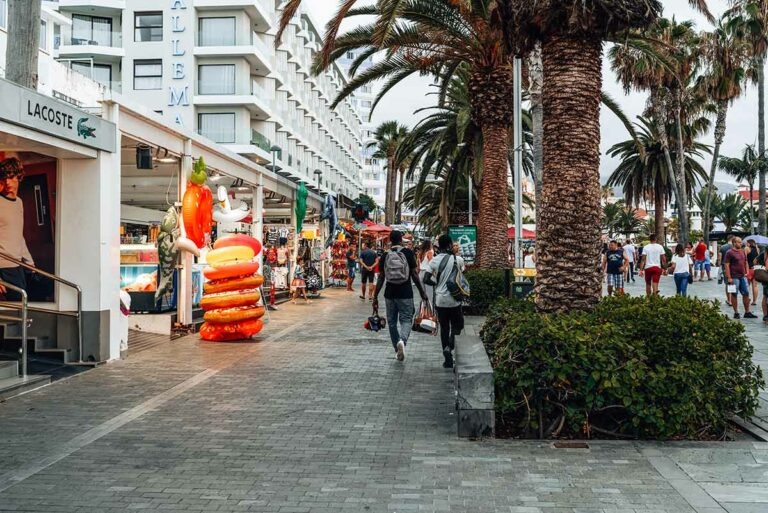
In Costa Calma, María Lirola is standing in the doorway of her café. The tables outside are empty. The hotels next door are full. She doesn't know how much longer she'll hold out.
In the Centro Comercial El Palmeral, one of Costa Calma's biggest shopping centres, 20 shops have become 5. Up to 50 businesses have had to close in recent years — that's the estimate from Excelfuert, the Fuerteventura hotel association itself.
What's actually going on here?
The story is the same everywhere
Walk through Costa Calma, through Caleta de Fuste, through Morro Jable. Hotels everywhere. Full everywhere. And in between: empty restaurants, shuttered souvenir shops, signs reading "Se traspasa" — business for sale.
Tourists are there. Plenty of them. 18 million came to the Canary Islands in 2025. They spent over 23 billion euros.
But none of it reaches the small shops.
Why?
Out of every 100 euros, 20 stay on the island
This is where it gets interesting. When a tourist books an all-inclusive package, the money flows like this:
He pays at home to a tour operator — usually TUI, Jet2, FTI. The operator pays a flat rate to the hotel chain. The hotel chain is mostly international — Riu, Barceló, Iberostar, Meliá. Booking, Expedia and the rest take their commission. And only then does what's left arrive on the island.
Academic estimates calculate it like this: for all-inclusive tourists, less than 20 out of every 100 euros stay on the island. For regular tourism, where people eat out and shop locally, it's 30 to 35.
In plain terms: of every 100 euros an all-inclusive guest spends, 80 disappear straight back abroad. Into booking platforms, into hotel chain headquarters, into tour operator parent companies.
What stays, stays in the hotel
Your hotel guest has breakfast in the hotel. Lunch in the hotel. Cocktail at the pool. Dinner at the buffet. Show programme. Bed. Breakfast. Repeat.
In 4-star hotels — the most common category — roughly half of guests book all-inclusive. The trend is rising.
That doesn't mean they never leave. But when they do, they're not hungry and not thirsty. What can be sold to them outside is limited: a magnet, a beach towel, maybe an ice cream.
The restaurant next door's business? Tiny. The farmer who supplies the vegetables? Even less — hotel chains buy centrally, often abroad, with bulk discounts that no Fuerteventura farmer can match.
The other side: what happens without all-inclusive?
Here comes the hoteliers' argument. And it isn't unreasonable.
A German family planning two weeks of sun with the kids compares prices. Fuerteventura with all-inclusive at 1,200 euros. Turkey with all-inclusive at 900. Egypt at 800. The Caribbean a bit more.
If the Canary Islands scrap all-inclusive, the maths shifts fast. The family books Antalya, not Corralejo.
Spanish constitutional law and EU competition law would barely allow an outright ban on all-inclusive anyway. Freedom of enterprise. Consumer freedom. A direct ban would probably be struck down in court.
So the question isn't "abolish all-inclusive — yes or no?" The question is: how do we get more of the money to stay on the island?
What the politicians are saying
The line here doesn't run between parties. It runs between the cautious and the clearer voices.
The cautious ones: Fernando Clavijo (Coalición Canaria, head of the regional Canary government) and Ángel Víctor Torres (PSOE, former president, now minister in Madrid) both say: improve the model, yes. Risk competitiveness, no.
The tourism ministers: Yaiza Castilla (former) and Jéssica de León (current) focus on a different number — how much each individual tourist spends. Quality, not quantity.
The blunter voices: Blas Acosta on Fuerteventura goes further. He says: it's not about how many tourists come. It's about how much of their money stays on the island.
That's essentially the same question. But it gets phrased carefully. None of those in charge wants to be remembered as the one who broke the tourism golden goose.
The street has a different answer
In Fuerteventura, people regularly take to the streets. "Fuerteventura tiene un límite". "Toda Canarias a la calle". The demands are clear:
- Tourism moratorium — no new hotels
- Holiday rental regulation
- Eco-tax for natural areas
- Housing security for residents
- Fairer distribution of tourism revenue
The protesters are explicit: we don't want to abolish tourism. We want it shared more fairly. As things stand, they say, it's turning the island into a "paradise for visitors and a nightmare for those who live here".
What would actually help
Anyone looking at the problem honestly sees: all-inclusive is a symptom, not the cause.
What would actually help the shops in Costa Calma:
Connect hotels and the local economy. Hotel chains won't buy local out of goodwill — only if it's cheaper. Incentives could change that: tax breaks for hotels that demonstrably use local suppliers. Mandatory quotas for regional products in the buffet.
Lure tourists out of the hotel. Not through bans, but through offers. City tours, experiences, food packages that the hotel itself recommends — with a commission for local businesses.
Regulate holiday rentals instead of banning them. The apartment tourist shops in the supermarket, eats in restaurants, hires a car locally. Their money is more likely to stay on the island. But uncontrolled growth pushes residents out.
Local staff. A hotel that pays local staff keeps the money on the island — through wages spent here.
None of these measures bans anything. All of them are doable. The political will is missing.
And now, directly to you: yes, you
You're planning a holiday in the Canaries. Maybe you've already booked. All-inclusive of course — fixed price, everything in, no surprises.
Understandable. After a stressful year, who wants to do maths on holiday. The kids want chips when they want chips. The poolside cocktails are part of the deal. Who wants to fuss about restaurants on top of that.
Still. Next time you're here, a few honest words:
Get out of the hotel. Not twice in two weeks. Several times.
Eat at a bar in Lajares. Have a coffee in a small village instead of at the pool. Buy your cheese from the majorero, not the magnet from the hotel shop. Leave a few euros at the harbour restaurant, instead of plundering the buffet for the third time, which you've already paid for anyway.
You've got 20 euros for lunch outside? Spend them. You haven't — fine, stick to the buffet. But then don't tell yourself you've seen the "real island".
This isn't a sermon. It's maths.
If nothing exists outside the hotel any more — no bar, no restaurant, no corner shop — then on your next holiday you'll just meet the same hotel staff in the same all-inclusive complex. You're in the bubble. Outside the bubble there's nothing left.
This isn't only about the Canaries. It's exactly what's happening in Turkey, in Egypt, in the Dominican Republic. The same spiral everywhere: more all-inclusive hotels, less life around them, then the tourists need the all-inclusive even more, because outside there's nothing left.
If you want the island you fly to to remain an actual island — with farmers, with bakers, with fishermen, with restaurants — then you need to leave money there. Not out of pity. Out of self-interest. Because otherwise, next time, you'll be flying into a stage set.
Where this leads
The question isn't: abolish all-inclusive?
The question is: how many more María Lirolas in Costa Calma are we going to lose before something changes?
If 30 percent of the Canary population live close to the poverty line, if wages are among the lowest in Spain, if housing becomes unaffordable — and at the same time 23 billion euros of tourism money flows through the archipelago, then something is broken in the distribution system.
The problem isn't that the tourists come. The problem is that the money leaves so quickly.
The Centro Comercial El Palmeral may yet lose its remaining five shops. María Lirola's café may close soon. Maybe by summer there's another "Se traspasa" sign in the window.
And the hotel next door will be full.