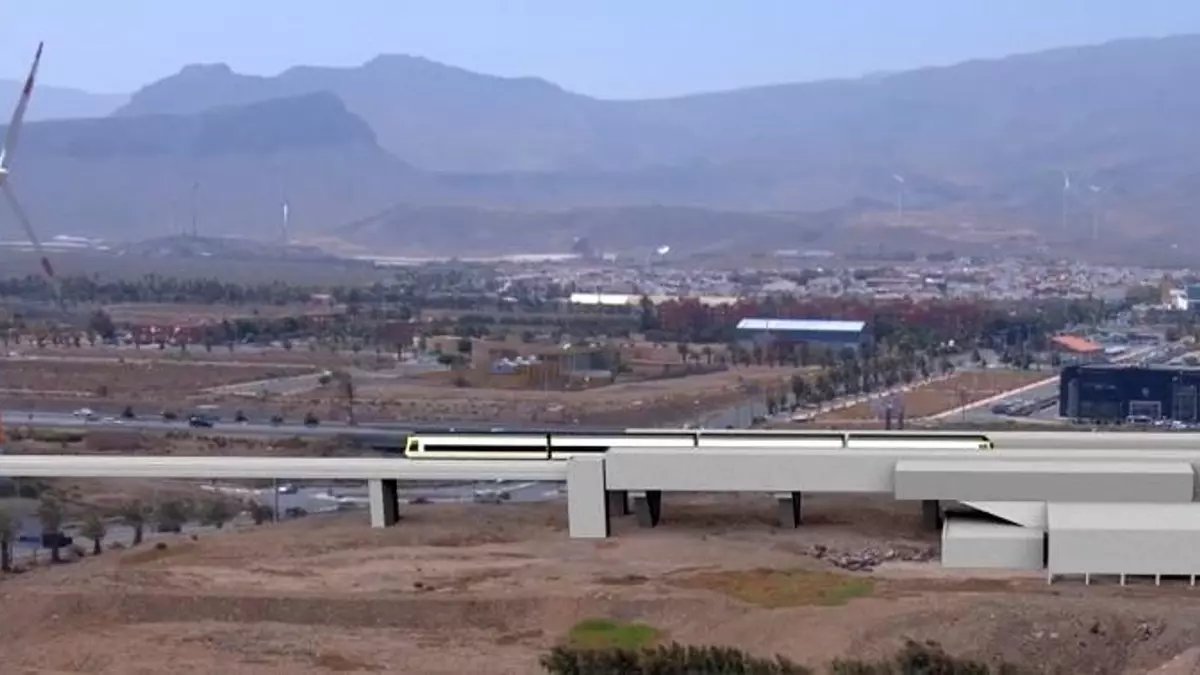
What happened: The environmental impact assessment (DIA) for the Tren de Gran Canaria has been approved unanimously
The route: 58 km, 11 stations, Santa Catalina to Meloneras, up to 160 km/h
Cost: €2 billion estimated — zero funding secured
Power: 100% wind energy — dedicated 26.4 MW wind farm
Timeline: Planned since 2004, earliest construction start 2028
Will Gran Canaria ever get a railway? For over two decades, the project has been planned, presented, promised — and not built. Now it has cleared a crucial hurdle: Gran Canaria's environmental authority has unanimously approved the environmental impact assessment. But the real obstacle lies ahead: €2 billion with not a single cent secured.
What was approved
The Declaración de Impacto Ambiental (DIA) covers not one project but 25: seven track sections, eleven stations, workshops, depots and a wind farm. The review body examined the proposal across 28 sessions, requested six amendments, and evaluated 21 objections plus 23 expert reports. The verdict: no significant environmental harm expected — provided all conditions are met.
Teodoro Sosa, the Cabildo's mobility councillor, called it a "historic moment", noting that in the current three-year term the project has advanced more than in the previous 25 years combined. The Cabildo can now begin land expropriations — budget: €16.67 million.
The route: Santa Catalina to Meloneras
The Tren de Gran Canaria would run along the island's east coast — where 81% of the population lives and 85% of tourism takes place. From Santa Catalina in Las Palmas via San Telmo, the hospital district, Jínámar, Telde, the airport, Carrizal, Arinaga, Vecindario and Playa del Inglés to Meloneras. Double track on the main line, single track at the termini. Maximum speed: 160 km/h. Las Palmas to Maspalomas in around 30 minutes — instead of 45 to 90 minutes on the chronically congested GC-1 motorway.
Each station is designed as an intermodal hub with parking, bus connections and cycle stations. All energy would come from a dedicated 26.4 MW wind farm at Montaña de Piletas near Vecindario.
The funding problem
This is where it gets serious. The estimated €2 billion cost dates back essentially to 2011. Construction costs for steel and concrete have risen massively since then. Critics such as Carlos Medina, dean of the Las Palmas engineers' college, estimate the real cost at 2.5 times that figure — up to €5 billion. Medina calls the entire scheme "a complete absurdity" and doubts the existing plans even comply with current building standards.
Madrid signed a protocol in September 2025 incorporating the Gran Canaria train into Spain's national rail network. But without an approved state budget, there is no money. An EU funding application (Connecting Europe programme) has already been rejected. The Cabildo is trying again — for the first phase (airport to Vecindario, €390 million) it hopes for €190 million from Brussels.
22 years of planning, not a metre of track
The history of the Tren de Gran Canaria is a history of announcements. The concept was first presented in 2004. In 2009 the regional government approved the plans — with an operational start date of 2015. The public company Ferrocarriles de Gran Canaria was established. Costs were estimated at €1.5 billion, then €1.65 billion, now €2 billion. Built: nothing.
Gran Canaria has the highest vehicle density per road kilometre in all of Europe and Spain's highest motorisation rate. The GC-1 between Las Palmas and the airport is gridlocked daily. Demand would be there: studies estimate 22 to 26 million passengers in the first year of operation, 81% of them switching from cars. The CO2 savings would be significant, with energy consumption 70% lower than road transport thanks to wind power and rail friction.
What happens next
With the approved DIA, the Cabildo can begin land expropriations. A monitoring commission including representatives of the Cabildo, regional government, central government and affected municipalities must be established within six months. The next major step would be a financing agreement with Madrid — the Cabildo proposes a 10-year contract with annual payments of €100 to €170 million.
President Antonio Morales says the passage of the state budget is "decisive" for funding. The question is: when will that budget come? And when it does — will the truly be on the priority list?
The 11 stations (north to south):
1. Santa Catalina (underground, Las Palmas)
2. San Telmo (Las Palmas, seafront)
3. Hospitales (hospital district)
4. Jínámar
5. Telde
6. Aeropuerto (airport, underground)
7. Carrizal
8. Arinaga (industrial zone)
9. Vecindario (workshops + control centre)
10. Playa del Inglés
11. Meloneras (southern terminus)
The Tren de Gran Canaria cleared its most important bureaucratic hurdle yesterday. Whether that means a train will actually run between Las Palmas and Maspalomas one day is another matter entirely. Islanders have heard too many announcements. What they need now is not another protocol — but a groundbreaking ceremony.