What happened on Friday afternoon
The notification came through the IAC: the institute told the Cabildo de La Palma, that same afternoon, that the proposal to build on the Roque had been turned down. The Cabildo confirmed it in the evening to Diario de Avisos and the news agency EFE.
The science ministry "deeply" regretted the decision, EFE reported, citing ministry sources. The same sources told eldiario.es that Spain had submitted "a scientifically and technically solid bid": "We respect the decision taken by the international consortium, even though we do not share it."
Why? To this day nothing has been said
That is the heart of this story, and it has not changed 24 hours later: there is no published reasoning. Neither the consortium nor the IAC nor the ministry has added anything since Friday evening.
On Saturday morning, El Faro de La Palma and Libertad Digital Canarias both reported a letter from TIO director Robert Kirshner to science minister Diana Morant: he sincerely regretted having to say that the TMT International Observatory cannot accept Spain's proposal. Both reports stress that the letter praises Spain's commitment and the IAC's standing — and that it gives no explanation.
El Faro adds that the telescope will now be built on Mauna Kea. So far that appears there alone; EFE, eldiario.es and El País do not confirm it, and on Saturday tmt.org carried nothing newer than 29 July 2026.
What was on the table
The science ministry announced on 29 July 2026 that Spain and the European Investment Bank were ready to mobilise up to 1 billion euros. Not a signed contract, but an offer in three parts: 400 million euros from the ministry through the CDTI, up to 300 million euros as an EIB loan and up to 300 million euros from the ICO on equivalent terms, plus state cover through the export credit agency Cesce.
Two qualifications: the package applied only if the consortium chose La Palma, and the larger part of it was credit, not grant. With the rejection it lapses. Nobody has said the money will now go somewhere else.
What the island loses
The most quoted figures come from a single study, by the economist Juan José Díaz Hernández (Universidad de La Laguna), presented by the IAC on 13 January 2020: during construction, 931 full-time jobs a year, 103 million euros of annual output and 6.53% of the island's product; in operation, 745 jobs, 74.5 million euros and 4.81%.
Soundly derived, but scenarios — and old ones: the model assumed construction from 2020 to 2029 and operations beginning in 2030, a timetable long overtaken. What La Palma loses is not a number of jobs that was about to arrive, but the prospect of a second economic pillar alongside farming and tourism.
What stays on the Roque
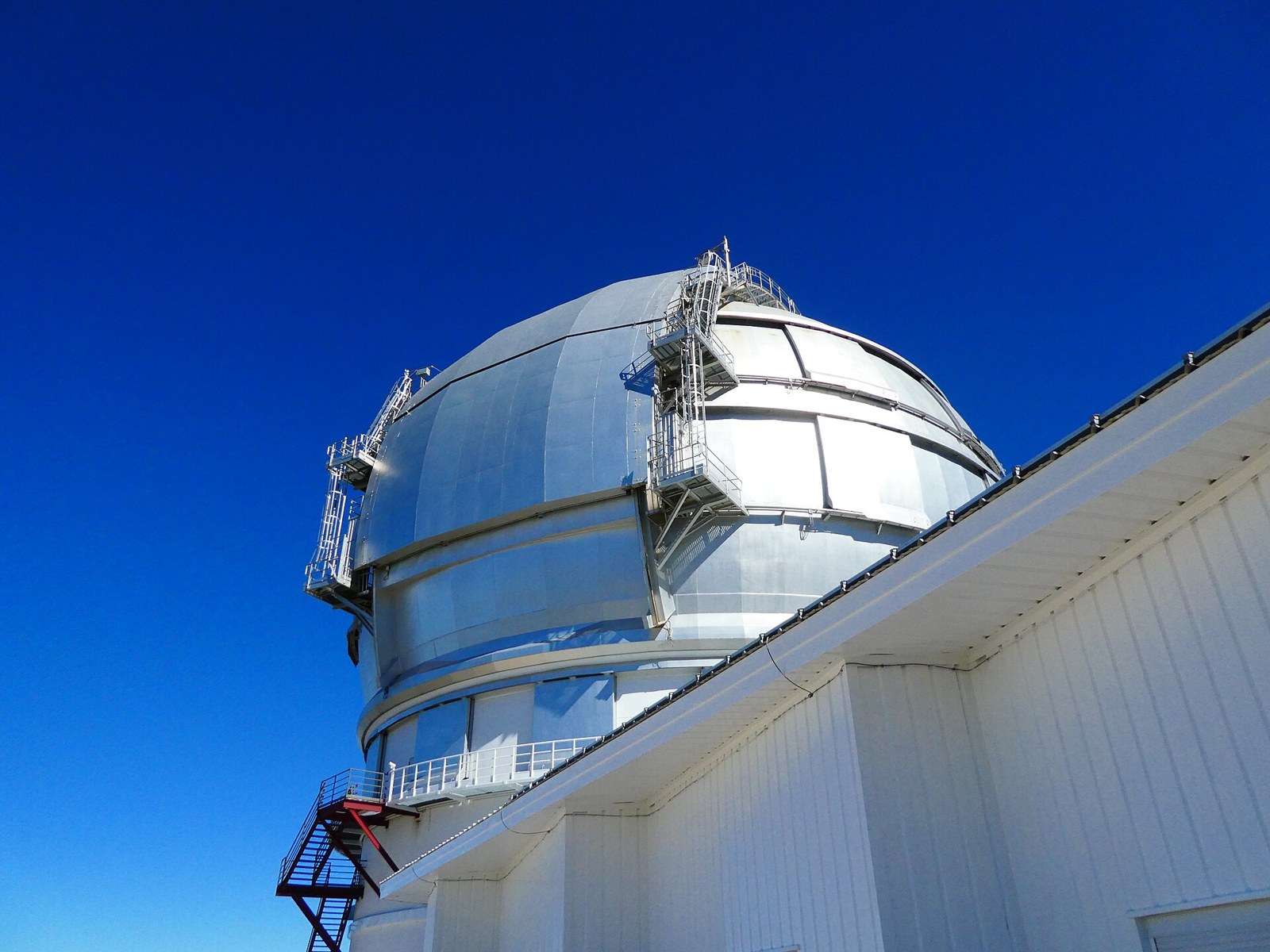
The observatory loses none of what it already has. At 2,396 metres, in the municipality of Garafía, the IAC counts around 21 telescopes and instruments: the Gran Telescopio Canarias, 10.4 metres across and the largest single-mirror optical telescope in the world, the William Herschel Telescope, the Telescopio Nazionale Galileo and the two MAGIC telescopes. And in less than a month, on 15 October 2026, the four Large-Sized Telescopes of the CTAO will be inaugurated there.
Why the mountain was a candidate at all is written into law: the "Ley del Cielo" of 31 October 1988 protects the astronomical quality of the IAC observatories and regulates light pollution, radio interference, air pollution and flight paths. Since December 2012 the island has also been the world's first Starlight Reserve, renewed in 2025 for four more years.
And the plot?
9.8 hectares of public forest in the municipality of Puntagorda were set aside for the TMT; the concession was granted to the IAC in 2019, challenged, annulled at first instance and upheld by the Canary high court in 2022. In law the land is still assigned to the IAC.
What becomes of it, nobody had said by Saturday midday. There is no proposal for another instrument — not from the IAC, not from the Cabildo, not from the Canary government, which had declared the project strategic in May 2026. The news reaches the island on the day the Tajogaite eruption is five years old.