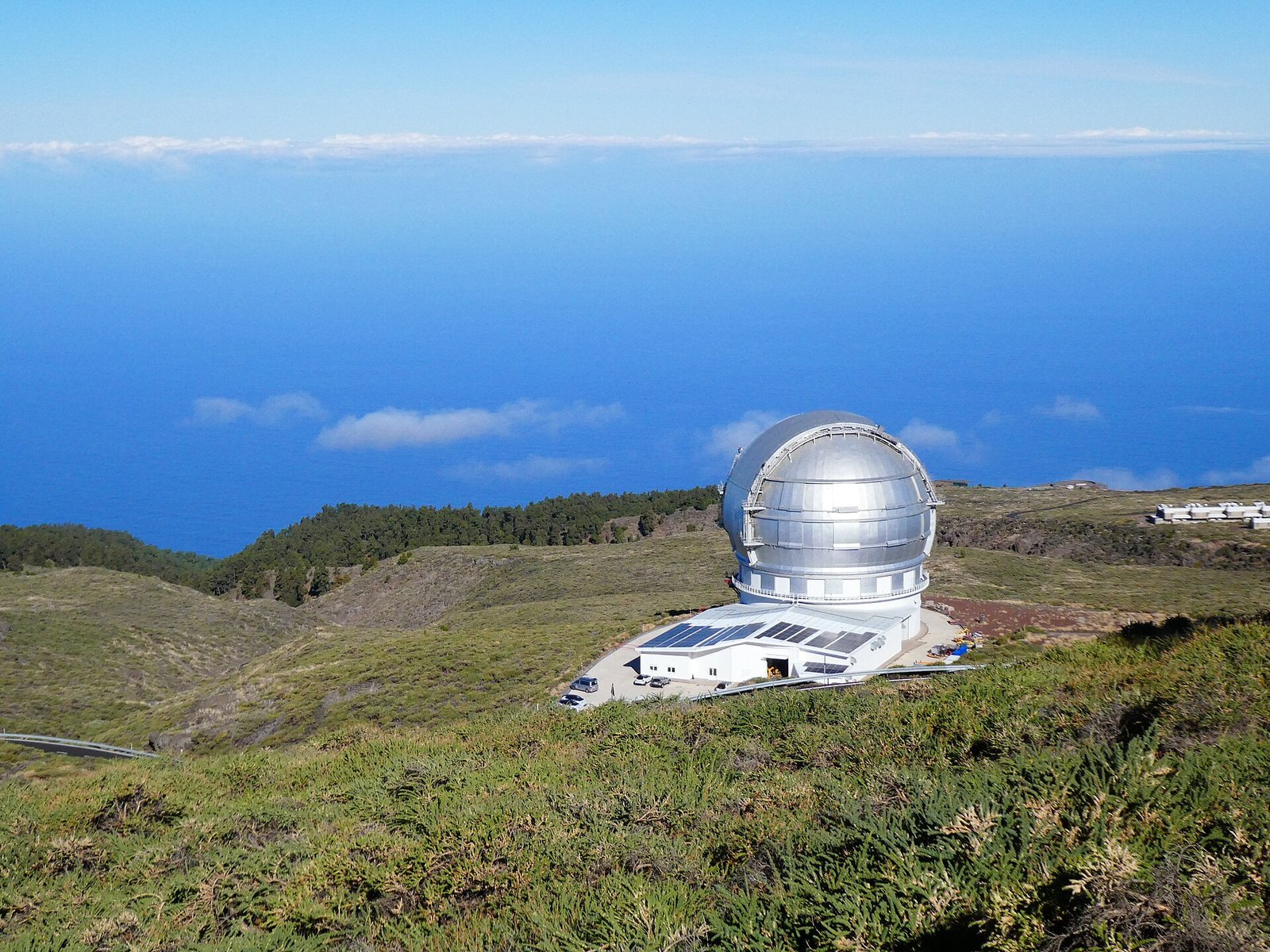
Imagine a telescope so powerful it could peer into the atmospheres of distant exoplanets and look back to the early universe. That is the promise of the Thirty Meter Telescope, and La Palma is now at the centre of a high-stakes international effort to host it. A financing proposal worth up to around one billion euros is being assembled by Spain's government and the European Investment Bank, aiming to tip the scales in favour of the Roque de los Muchachos Observatory.
The plan is ambitious but not yet set in stone. At its core is a commitment of up to 400 million euros from Spain's Ministry of Science, channelled through the Centre for Technological Development and Innovation. The European Investment Bank is working on advisory support and could add up to 300 million euros in financing, while another possible 300 million from the Instituto de Crédito Oficial would bring the total package close to the symbolic one-billion mark. The funds would cover not just construction but also the initial deployment and commissioning of the telescope, according to the ministry's framing.
Why La Palma and why now
The TMT was originally destined for Mauna Kea in Hawaii, a site revered by astronomers for its high-altitude clarity. But years of sustained local opposition and legal challenges have pushed the TMT International Observatory consortium to seriously consider the alternative: the Roque de los Muchachos on La Palma, already home to one of the world's premier collections of telescopes. Spain formally presented its offer to the consortium in July 2025 and has been pushing the case again through mid-2026, with media reports suggesting a decision could come relatively soon.
The island's scientific credentials are strong. The Instituto de Astrofísica de Canarias operates the observatory, and the sky quality above La Palma is protected by law. Local authorities and the IAC argue that the island offers not just technical suitability but also a stable regulatory environment, something that has proven elusive at the Hawaiian site. Still, the consortium has not yet made its final choice, and the permits needed for construction on La Palma are a practical constraint: renewing them could take around two years, adding a layer of urgency to the current push.
What the telescope would mean for the island
If La Palma were selected, the economic ripple effects could be substantial, though the figures come from impact studies commissioned by project supporters and are best read as scenario-based estimates. During the construction phase, the study points to roughly 103 million euros a year in economic output, equivalent to about 6.5 percent of the island's GDP, and around 930 jobs annually. Once operational, the telescope could generate an estimated 74.5 million euros a year in ongoing impact, supporting about 745 jobs with salaries above the regional average.
Beyond the raw numbers, local officials and the IAC see the TMT as a catalyst for transforming La Palma's economic identity. The island's economy still leans heavily on agriculture and tourism, and a flagship scientific infrastructure project of this scale could strengthen its role in high-tech research, engineering, university partnerships and specialised training. Astrotourism, already a growing niche thanks to the island's dark skies, would likely get a significant boost from the global attention a TMT decision would bring.
The hurdles that remain
It is important to separate what is certain from what is still in flux. Spain has made a concrete offer of up to 400 million euros, and the EIB's advisory role is confirmed. But the final financing mix, the exact amount the EIB and ICO will commit, and whether the full package reaches one billion euros in the form now reported are all still subject to due diligence, board approvals and negotiations. The biggest variable, of course, is the site decision itself: the consortium could still opt for Hawaii or explore another path entirely.
There is also the question of timing. Even if the consortium gave La Palma the green light tomorrow, the permitting process would need to be navigated carefully. Supporters are keen to avoid the kind of drawn-out conflicts that have plagued the Mauna Kea plan, and they point to the broad political and institutional backing the project enjoys in the Canary Islands and Madrid as a key advantage. For now, the proposal is a serious, well-funded bid — but it remains a bid, not a done deal.
A telescope for the next generation
The Thirty Meter Telescope belongs to a new class of extremely large observatories designed to tackle questions that current instruments cannot answer. With a primary mirror 30 metres across, it would collect roughly nine times more light than the largest telescopes operating today, allowing astronomers to study the formation of galaxies, probe the nature of dark matter and dark energy, and characterise the atmospheres of planets orbiting other stars. For the global scientific community, the choice of site is about more than logistics — it is about where the next chapter of ground-based astronomy will be written.
For La Palma, the stakes are equally high. Hosting the TMT would place the island at the centre of that story, building on a legacy that already includes the Gran Telescopio Canarias, currently the world's largest single-aperture optical telescope. The financing proposal now on the table is a signal that Spain and Europe are serious about making that vision a reality. Whether the consortium agrees remains the question everyone on the island — and in observatories around the world — is waiting to have answered.
Common questions
- What exactly is the Thirty Meter Telescope?
- It is a next-generation optical and infrared telescope with a 30-metre primary mirror, designed to study exoplanets, galaxies, dark matter and the early universe.
- Where was it originally supposed to be built?
- The original planned site was Mauna Kea in Hawaii, but sustained local opposition has made La Palma the main alternative candidate.
- How much money is Spain offering?
- Spain has offered up to 400 million euros through the Ministry of Science, with additional possible financing from the EIB and ICO bringing the total proposal to around one billion euros.
- Has the final site been chosen?
- No, the TMT International Observatory consortium has not yet made a final decision between La Palma and other options.
- What would the telescope mean for La Palma's economy?
- Impact studies estimate it could generate hundreds of jobs and tens of millions of euros annually, while boosting the island's profile in science and astrotourism.
Read on
- 1 billion euros offered: La Palma will not get the giant telescopeLa Palma · 19 September
- 22 cents exported per euro imported: three quarters of Canary imports come from mainland SpainCanary Islands · 25 September
- Canarias joins Cataluña as the only region backing Spain's financing reformCanary Islands · 19 August
- La Palma: Carnival 2027 poster contest, 700 eurosLa Palma · 28 October
- La Palma TriJazz: 3 jazz trios, 31 Oct to 14 Nov, 20:00La Palma · 27 October
- All events on La Palma →
Stand 30 July 2026. This article is based on publicly available information and official statements. Financing figures are based on the proposal as reported and remain subject to final approvals and the consortium's site decision.