What the numbers say
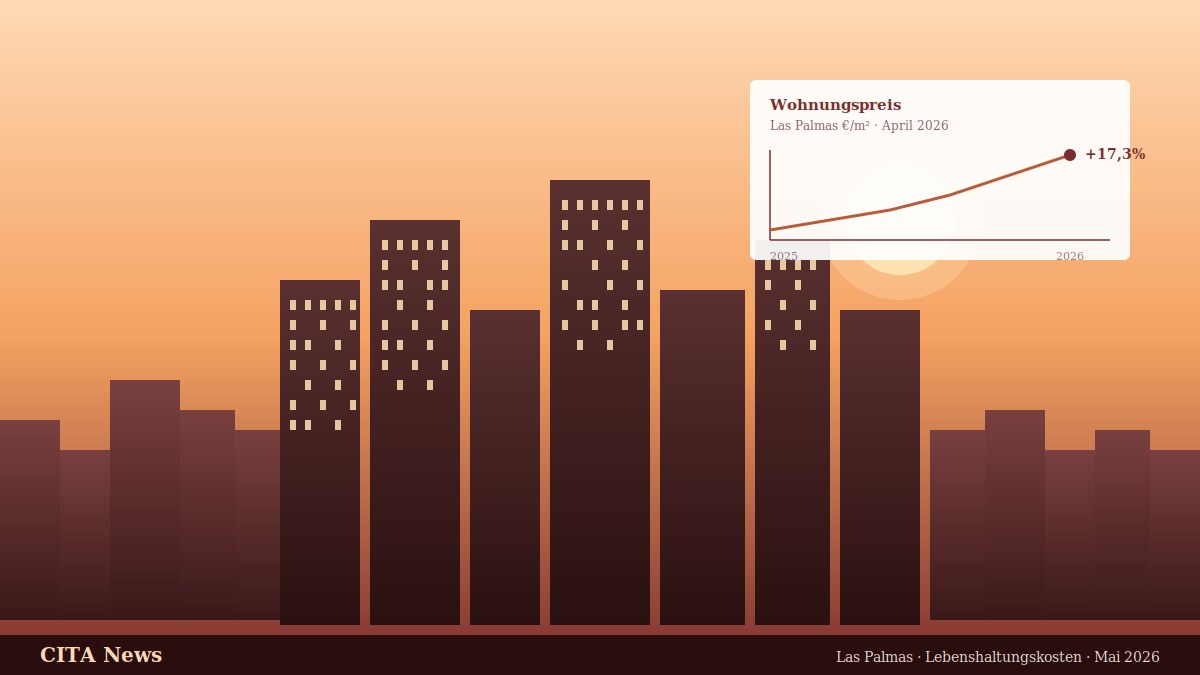
In April 2026, the price per square metre for apartments in Las Palmas de Gran Canaria stood at 3,279 euros. That's eleventh among Spain's most expensive capitals — behind Madrid (6,694 euros/m²), Barcelona (5,399 euros/m²), and Palma de Mallorca (5,169 euros/m²). On year-over-year growth, however, Las Palmas ranks thirteenth among all 50 Spanish capitals: 17.3 percent more than a year earlier. An average 80-square-metre apartment costs 44,389 euros more today than a year ago. Data come from the property portal Fotocasa.
Why prices are rising so steeply
Three factors compound. First: more people are coming to the island — both mainland Spaniards seeking mild climate, and international remote workers. Both groups want long-term homes — and increasingly can't find any. Second: building permits in the city aren't keeping up. Fewer new homes are being built than are demanded. Third: tourism apartments. Many flats are let on platforms like Airbnb instead of long-term. This further squeezes the regular rental market.
What residents have to pay
Rents in Las Palmas are growing faster than wages. The outcome is predictable: young people leave the city because they can't find a flat. Families share apartments. ULPGC students take longer to find a room. In Vegueta, Triana, and Playa de las Canteras neighbourhoods, rents have risen particularly sharply. An apartment near the beaches that cost 600–800 euros in 2020 now costs 1,000–1,300 euros. For contracts signed after May 2023, the new IRAV index applies — capping annual increases.
What changes for tourists
Directly: restaurants, cafés, and hotels become more expensive. The lunch menu that cost 10–11 euros a few years ago now sits at 13–15 euros. Hotel rooms in high season are 10–20 percent more expensive than in 2023. Indirectly: the travel atmosphere may change. The more locals get pushed out of the centre, the less «authentic» the city feels — a concern openly debated in Las Palmas. What remains: Las Palmas is still cheaper than most mainland European cities. But the gap is narrowing.
What the future holds
Las Palmas — alongside Adeje and Granadilla on Tenerife — has petitioned the Canary government to be designated a «zona tensionada» (stressed zone). If approved, that status would let rental prices be more strictly regulated, and the definition of a «large landlord» would drop from 10 to 5 properties. So far, the Canary government has not formally published the declaration. If it does, that would be a clear intervention in the rental market. Until then: anyone planning to live longer-term in Las Palmas should expect prices to keep rising (Gobierno).
Frequently Asked Questions
- How much does an apartment in central Las Palmas cost?
- On average 3,279 euros per square metre (April 2026). An 80-square-metre apartment costs around 262,300 euros.
- How much have prices risen?
- 17.3 percent in a year — one of the highest increases among Spain's 50 capital cities.
- What is a "zona tensionada"?
- An officially designated stressed housing market zone. In such areas, rents can be regulated more strictly, and the threshold for being counted as a "large landlord" is lower.
- Do prices affect tourists?
- Yes, indirectly. Hotels and restaurants are 10–20 percent more expensive than in 2023. Short-term visitors feel it less than residents and long-term renters.
- When will prices fall again?
- Hard to predict. If "zona tensionada" status comes through, rents may stabilise. Sale prices depend strongly on construction activity and demand.