What happens today
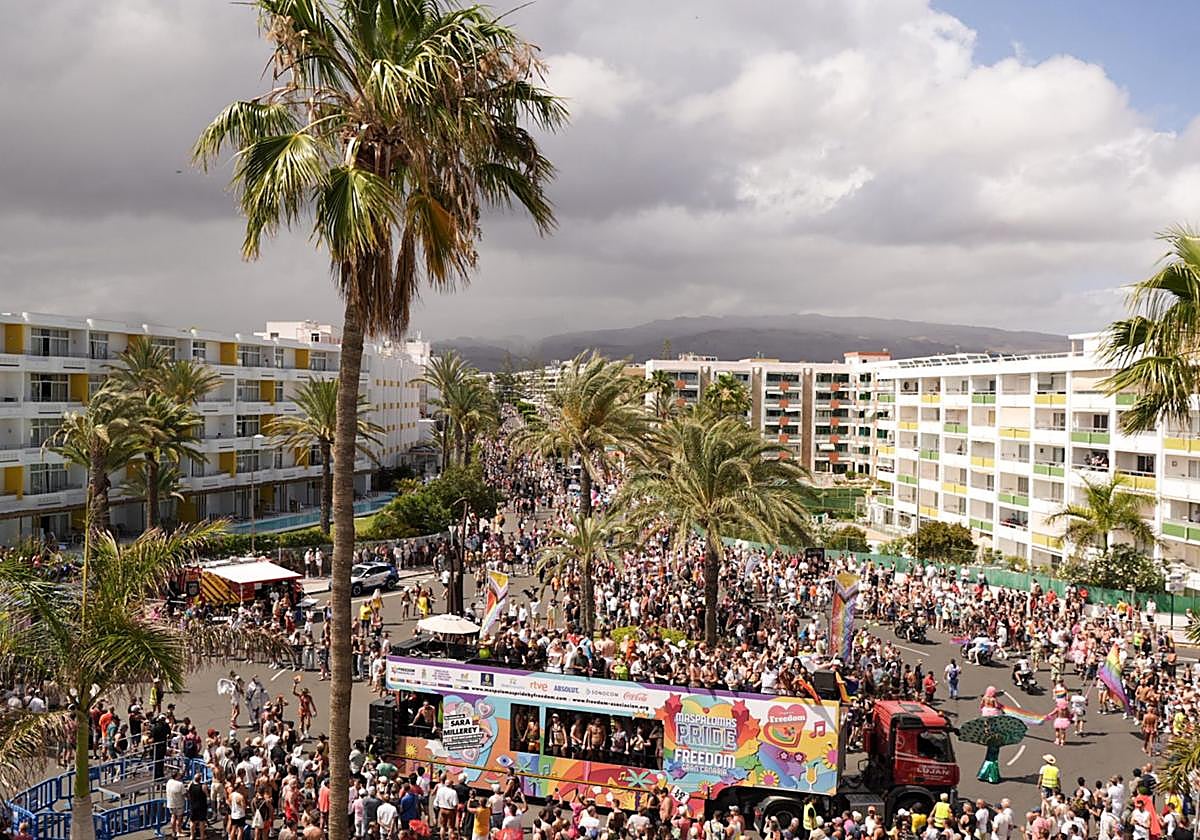
At exactly 16:00 the first truck pulls away from the Hotel Riu Palace in Maspalomas. The Freedom Asociación LGBT banner sits at the front. Behind it: 30 floats, each with its own sound system, its own choreography, its own colours. A truck caravan packed with dancers in sequins and feathers, drag queens and activists, costume creations that would not work anywhere else in the world. Around it: thousands walking along, rainbow flags, oversized fans, some in tutus, some barefoot. Last year, in 2025, 100,000 people lined the route and another 20,000 packed the Yumbo plaza afterwards, according to Canarias7. Organisers expect similar numbers in 2026.
The route runs along Avenida de Tirajana, on through Avenida de Gran Canaria, and ends on Avenida de España, in front of the main entrance to the Centro Comercial Yumbo. There the participants leave the street for the Pride plaza. The cabalgata can stretch until 19:00, depending on the pace of the floats. RTVE broadcasts live on La 2 between 15:15 and 17:30, presented by Roberto Herrera, Luis García Temprano and Sara Fez. TVE Internacional also airs the parade — the kind of reach that has given the cabalgata pan-Spanish and even Latin American attention.
The 25th edition — a different one
It is the 25th anniversary, but it is also the year the festival lasts seven instead of eleven days. Freedom Asociación LGBT had to cut the programme for financial reasons. In an official statement the organisers wrote: «The economic situation of Freedom Asociación LGBT is unsustainable, with debts in the hundreds of thousands of euros.» Shortening the festival is meant to make sure all artists and contractors get paid — a «difficult but responsible» admission, as the statement put it.
Behind the sober wording sits a political message. The organisers accuse local hoteliers and Yumbo businesses of failing to back the festival adequately — even though it draws hundreds of thousands of visitors south every year, by official accounts. The Cabildo of Gran Canaria, the Canarian regional government and the San Bartolomé de Tirajana council have provided subsidies in 2026 — but not enough to cover legacy debt. The visible consequence: 38 floats rolled through Playa del Inglés in 2025, only 30 in 2026. The shrinkage is sharp.
Even so, the programme has highlights. Thursday evening Loles León — the Madrid actress who will read the manifesto — gave an opening address. Friday evening Melody (Spain's Eurovision 2025 act), Canarian singer Agoney, the Gran-Canarian Kimy Tow and Irish pop voice Nadine Coyle filled the Yumbo stage and the Sundance pool party at the Ocean Club, sold out at 5,000 capacity.
The slogan and Loles León
«Nuestra historia, su legado, nuestro orgullo» — three words, an arc. Our history, their legacy, our pride. The 25th edition is dedicated to the older members of the LGBTIQ+ community. The generations who were criminalised in Spain during the Franco dictatorship, who fought for visibility in the first free years after 1975, who lived through the HIV crisis, and who today are no longer automatically part of the Pride imagery — and the slogan deliberately puts them back at the centre.
The manifesto reading in the evening goes to Loles León, one of Spain's best-known character actresses, a longtime LGBTQ+ ally, with a biography that runs through Almodóvar's early films. She steps onto the Yumbo main stage at around 21:00, the Pride Park logo glowing behind her. The 2026 manifesto text is built around the experience of the older LGBTIQ+ generations. It is the moment when the festival shifts from dance to politics — and in past years the moment when the audience traditionally falls quietest.
What runs after the parade
As soon as the last carroza arrives at the Yumbo, the Freedom Pride Gala kicks off at 19:00 on the Pride Park stage. DJs from Brazil, Spain and Venezuela will play into the morning: MCDJ at 19:00, San Keryton at 20:30, Marc at 22:00, Urlan at midnight, José Rendón at 02:00, Joseph Wolf at 03:30. Free entry. In 2025 some 20,000 people joined this Yumbo party — it ran until sunrise.
Sunday midday brings the Ice Cream Pool Party at Hotel Seven Maspalomas, a paid closing pool event. Sunday evening the Sunday Night Pride Closing Show on the Yumbo plaza, free again and open to all. That closes the 25th edition. The next one is scheduled for May 2027 — finances permitting.
Road closures and practical info
If you are driving in Maspalomas or Playa del Inglés today, do not try to cross the Pride zone. The San Bartolomé de Tirajana council has imposed traffic restrictions from midday until the end of the cabalgata. No parking on stretches of Avenida de Estados Unidos, Avenida de Gran Canaria, Avenida de España, Avenida de Bonn and Avenida de Tirajana. The full list is published by Atlántico Hoy.
If you are coming down from Las Palmas, allow 90 minutes — between 14:00 and 16:00 the GC-1 gets congested with hotel arrivals. Take exit 47 Maspalomas or 48 San Fernando, leave the car at one of the larger hotel car parks, then walk to the Yumbo. By Guagua bus: lines 30, 1, 32 or 4. Several routes will be diverted during the cabalgata — check Global Salcai-Utinsa for live updates.
One practical detail on site: bring water. The avenues offer almost no shade, with temperatures around 24 to 26 degrees and a humidity that hangs heavy in May. A hat helps. Sunscreen helps. The famous Pride giant fans are officially on sale again this year — and now with added value: part of the proceeds go directly to clearing the organisation's debt.
Why Maspalomas became a world Pride
Unlike Madrid Pride or Barcelona Pride, Maspalomas is a tourists' Pride. That is exactly what makes it special. Spain's south, an island, a tourism zone built in the 1970s as a German and British beach hotspot, that turned into Europe's LGBT+ island in the 1980s. The Yumbo gallery was built in the early 80s as a plain shopping centre — and gradually filled with bars catering to a clientele still facing discrimination in many European home countries. Today the Yumbo holds over 30 LGBT+ bars and is a meeting point from May to May.
Fernando Ilarduya, president of Freedom Asociación LGBT, frames it like this: «Maspalomas Pride has become one of the most important Pride festivals in the world — a place where you can simply walk freely on the street.» The argument he made last year has gained weight in 2026. Several European countries, the United States and parts of Latin America are seeing rollbacks on LGBTIQ+ rights. Organisers say the 2026 manifesto will explicitly point to «the rise in hate speech, institutional violence and legal regression». Today's cabalgata is not just a party — it is also the annual large-scale counter-statement.
Frequently asked questions
- What time does the parade start?
- Today Saturday 9 May 2026 at 16:00. RTVE broadcasts live on La 2 from 15:15, hosted by Roberto Herrera, Luis García Temprano and Sara Fez. The procession can run until 19:00.
- What is this year's slogan?
- «Nuestra historia, su legado, nuestro orgullo» — «Our history, their legacy, our pride». The 25th edition is dedicated to the elder generations of the LGBTIQ+ community.
- Who reads the manifesto?
- Spanish actress Loles León reads the manifesto on the Yumbo stage in the evening after the cabalgata. It is traditionally the political peak of the Pride week.
- How many floats take part?
- 30 floats. In 2025 there were 38 — fewer in 2026 because Freedom Asociación LGBT had to shorten the festival for financial reasons. The reduction is meant to clear past debts.
- Which streets are closed?
- Avenida de Tirajana, Avenida de Gran Canaria and Avenida de España are closed from midday until the end of the parade. No-parking zones also along Avenida de Estados Unidos, Avenida de Bonn and parts of Avenida de España.
- What happens after the parade?
- From 19:00 the Freedom Pride Gala kicks off on the Yumbo plaza with DJs from Brazil, Spain and Venezuela. Sunday brings the Ice Cream Pool Party at Hotel Seven Maspalomas and the Sunday Night Pride Closing Show — the wrap of the 25th edition.