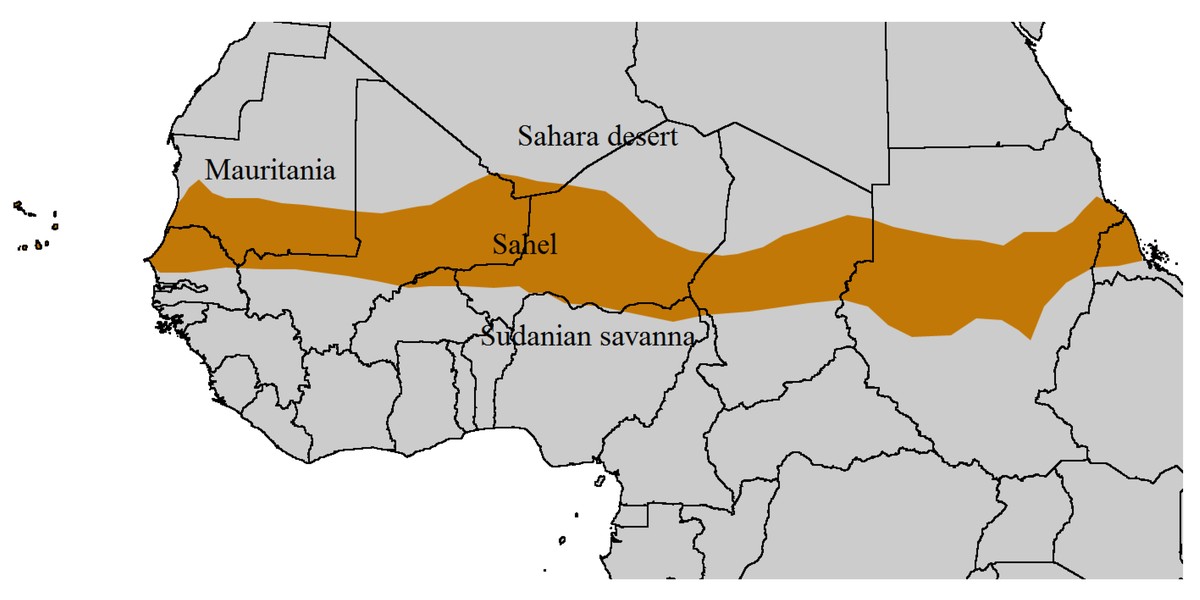
First the map: over 1,500 km away
First the map, because it is often misunderstood. The Sahel is a dry belt south of the Sahara, stretching from Mauritania and Mali through Niger to Chad and Sudan.
The much-quoted claim that the crisis region lies "just 200 kilometres" away refers to Spain's North African border, not the Canaries. Between the islands and the actual Sahel conflict zone lie over 1,500 kilometres.
An honest comparison: Cyprus and the Middle East
To put "proximity" in perspective, it helps to look at Cyprus. The island lies around 100 to 260 kilometres from Syria and Lebanon — there, closeness to the fighting is physical and immediate.
For the Canaries it is different. They are geographically close to the African coast, but far from the Sahel conflict; their exposure is indirect and runs through other channels.
What is happening in the Sahel
In recent years, military governments have taken power in Mali, Burkina Faso and Niger. France, which long led Operation Barkhane, has been pushed out of all three.
Russia has moved into the resulting vacuum. Through the "Africa Corps", the successor to the Wagner group, Moscow offers the juntas security services in exchange for access to raw materials, as analyses by moncloa.com and the Spanish Institute for Strategic Studies (IEEE) describe.
At the same time, the violence has escalated. According to the Global Terrorism Index 2025, over 50 percent of all terrorism deaths worldwide now occur in the Sahel, with around 20 percent in Burkina Faso alone.
Why it still touches the Canaries
The islands' exposure is real, but it does not follow the logic of military range. It runs through migration routes, smuggling networks and security questions.
The EU border agency Frontex cites the instability in the Sahel, the influence of powers such as Russia and China, and cuts in US development aid as factors raising migratory pressure on the Atlantic route. Spain's National Security Council (DSN) in 2026 spoke of a "growing vulnerability" in the Canary–Atlantic arc and at the Strait of Gibraltar.
Context: between genuine concern and alarmism
These links are documented, yet wording decides the effect. Phrases like "war on the doorstep" transfer a physical proximity that does not exist in the case of the Canaries, and can stoke unfounded fears. Experts and institutions describe an indirect, structural risk — through routes, organised crime and geopolitics — not a military threat to the islands. Part of the public debate, such as calls to make NATO's "southern flank" a priority, is also political positioning and should be read as such, not as a settled assessment of the situation.
How to read such reports
Watch whether a headline gives a concrete distance or merely creates a feeling of proximity. Distinguish between documented data (such as death tolls or official reports) and pointed quotes that express an opinion. Check who is speaking — a security agency, a research institute or a party with its own interest. That makes it easier to place a serious but complex situation than relying on single alarm words.