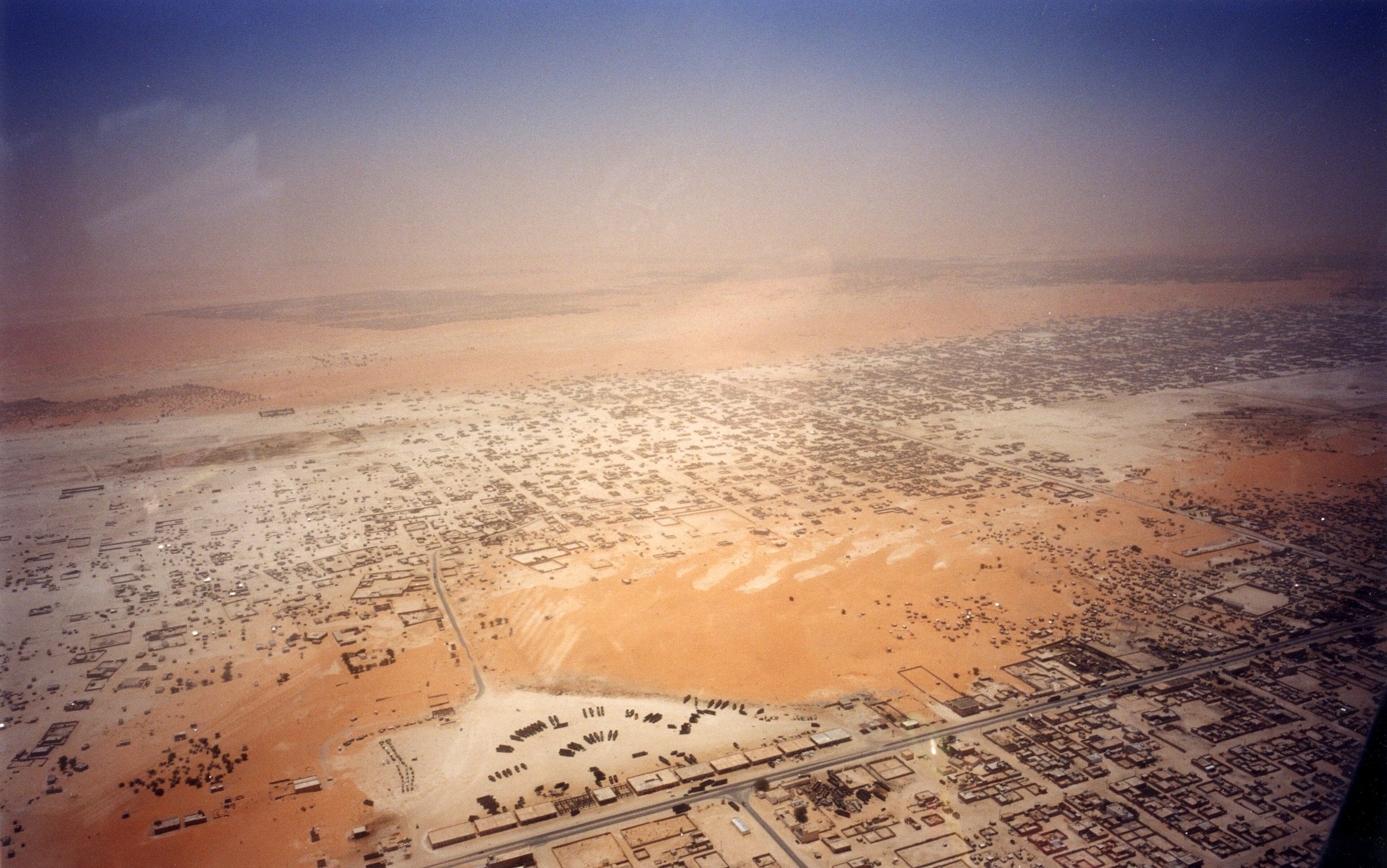
How do I get from the Canaries to Mauritania?
Only Gran Canaria (LPA) has a verifiable nonstop flight to Nouakchott (NKC). Kayak and AirConnect name Binter Canarias and Mauritania Airlines as operators, while Momondo lists Binter for the nonstop route and Mauritania Airlines only for Gran Canaria–Nouadhibou (as of 20 November 2026).
No link to Nouakchott could be confirmed from Tenerife, Lanzarote or Fuerteventura, and none to Nouadhibou (NDB) either. Anyone living on another island must plan their own way to Gran Canaria.
The only primary source on Binter is an Aviacionline report of 9 February 2021. It says Binter has flown the route since November 2020, once a week, until 30 June.
The aircraft was an Embraer E195-E2 with 132 seats. According to Aviacionline, it left LPA at 12:30 and landed in Nouakchott at 14:20 (NT 6504).
Whether Binter still flies the route this way is unconfirmed. Skyscanner shows nine flights a week from Nouakchott to Gran Canaria for January 2026.
A flight tracker lists NT 1804 from Gran Canaria at 22:45 on Mondays, Tuesdays and Thursdays from late October 2026. That would be three flights a week, but neither claim is verified.
Before booking, check the timetable and days on the official website and on the Mauritania Airlines site. Prices are snapshots with no clear year.
AirConnect lists 315 US dollars one way with Mauritania Airlines, as of 22 October 2026. Expedia shows 231 to 305 US dollars.
Flight times in the portals range from about 1:40 to 2:40 hours. Momondo gives roughly two hours.
A passenger ferry between the Canaries and Mauritania is not documented. The offers checked from Fred Olsen and Naviera Armas only serve the Canary Islands, mainland Spain and Morocco.
Which visa do I need for Mauritania from the Canaries?
German citizens have needed an e-visa since January 2025, applied for online before travel, says the Auswärtiges Amt (German Foreign Office; as of 20 November 2026). The portal is anrpts.gov.mr/visa/requestvisa, and the office gives contact@anrpts.gov.mr plus phone and WhatsApp on +222 26 40 84 67.
The visa is normally valid for 30 days with a single entry. A 90-day multiple-entry visa is granted only in individual cases.
According to the office, the printout is checked at the departure airport and at the border. The fee is 55 euros, payable in cash on arrival, says the Foreign Office.
Fingerprints are also taken on entry. GOV.UK describes the same procedure for British travellers.
Visas on arrival have no longer existed since 5 January 2025. Payment is in exact cash, in euros or US dollars, with no change and no receipt.
According to Wikipedia, only citizens of ten countries may enter visa-free for up to 90 days, including Algeria, Senegal and Tunisia. Germany is not among them.
Embassies have reportedly issued no visas since June 2025, and GOV.UK says the Mauritanian embassy in London does not either. Some comparison sites claim EU citizens still get a visa on arrival, but the Foreign Office and GOV.UK say the opposite.
On entry the passport must still be valid for at least six months, says the Foreign Office. A passport, provisional passport and child passport are accepted, but not the national identity card.
Proof of yellow fever vaccination is needed only when arriving from a risk country, and a flight from the Canaries does not trigger it. Foreign currency up to 1,000 US dollars may be brought in without declaration, and larger sums must be declared.
How safe is Nouakchott, and what applies inland?
The Foreign Office has a partial travel warning for Mauritania, unchanged since 12 August 2026 (as of 20 November 2026). It warns against travel to the immediate border area with Algeria and Mali.
It strongly advises against remote parts of the Sahara and the Sahel, namely Tiris Zemmour north of Zouérate and the parts of Adrar east and north-east of Ouadane. As across the Sahel, there is a risk of attacks and kidnapping.
Without an escort and a security plan, the office advises against travel to Hodh El Gharbi and Hodh El Charghi, including Oualata. The same applies to the border with Mali in Guidimaka and Assaba and to the desert east of Tidjikja in Tagant (Tichitt).
The office generally advises against entering or leaving by land through Western Sahara. Britain's FCDO advises against travel to the east of the country, says GOV.UK.
According to GOV.UK, this also covers a 25-kilometre zone around the border with Mali. The FCDO also advises against all non-essential travel to Zouerat.
For daily life, the office mentions demonstrations, where violence cannot be ruled out, especially after Friday prayers. Theft and armed robbery occur, and sexual offences are also reported.
The office says to avoid remote or unfamiliar districts, especially after dark. It calls the capital suitable for city breaks and tells anyone heading inland to ask the tour provider about the fuel situation.
Fuel is scarce because the blockade of the Strait of Hormuz disrupts supply, says the Foreign Office. Mauritania is not directly affected by the Middle East crisis.
The government ordered night driving bans for four-wheeled vehicles, switched off street lighting and raised regulated fuel prices. Filling stations in the capital operate in an orderly way, but queues are growing because deliveries arrive irregularly.
Shortages are also possible in Nouakchott and Nouadhibou. Inland, the office advises carrying water and fuel.
The malaria risk is high from July to January, including in Nouakchott, says the Foreign Office. Meningococcal disease cases rise from December to April.
Emergency care exists only in the large state hospitals and a few private clinics in the capital, rabies vaccine is very scarce and immunoglobulins are lacking. The office recommends insurance that covers medical repatriation.
What are the main dos and don'ts on the trip?
The currency is the ouguiya (MRU), which is not freely convertible, says the Foreign Office, and exporting larger amounts is banned. Credit cards are mostly accepted only in larger hotels.
Cash machines are mainly in Nouakchott and Nouadhibou, and they cannot be assumed to be always stocked. Plan for cash, including the 55-euro visa fee.
Bringing in alcohol and pork is strictly forbidden, says the Foreign Office. Military installations must not be photographed.
The office lists typical mistakes: travelling without a pre-arranged e-visa, showing an identity card instead of a passport, and a passport with less than six months of validity left. It adds trips into restricted zones and entry by land through Western Sahara.
Aviacionline advises in general to check entry rules before buying a ticket. In practice that means applying for the e-visa, packing the printout, checking the passport's remaining validity and keeping 55 euros in cash ready.
For trips beyond Nouakchott, the office recommends asking the provider about fuel and security plans. Travellers should factor in the ordered night driving bans for four-wheeled vehicles.
When is the best time to visit Nouakchott?
Nouakchott has a hot desert climate (BWh), according to long-term averages from WeatherSpark and Weather2Travel. These are third-party providers, not data from the state weather service AEMET.
WeatherSpark puts September as the hottest month, averaging a 93°F high and a 79°F low, and January as the coldest at 83°F and 60°F. Weather2Travel gives about 28 degrees Celsius as the January high.
The rainy season runs roughly from 19 July to 6 October, says WeatherSpark. August is the wettest month at 1.3 inches, and May the driest.
The sea is around 18 degrees in January and March, say the two providers. The data suggest that January to April is cooler and drier.
That is an inference from the averages, not a statement from any source. On health, the malaria season runs from July to January, says the Foreign Office, and the meningococcal peak from December to April.
That leaves no risk-free window. For current readings and warnings, see CITA weather (cita.news/de/wetter.html) and AEMET.
Why does Mauritania appear so often in Canary Islands news?
Mauritania and the Canaries meet in the media almost only on migration. According to Euronews of 5 November 2026, up to 90% of boats came from the Mauritanian coast at the peak.
Interior Minister Grande-Marlaska thanked President Ghazouani. He praised the “joint effort”, says the official website.
RTVC reported on 8 October 2025 that 8,178 people came from Mauritania to the Canaries from January to September 2025. A year earlier the figure was 16,976, a fall of 52%.
From Senegal the number fell 77% over the same comparison. The IOM gives a 65% fall for the whole Atlantic route in 2025 against 2024, according to an RTVC extract.
In October 2026, 6,194 people arrived in the Canaries, says Euronews, citing the Interior Ministry. Of 50 boats, only one came from Mauritania.
The main departures are in Senegal and Gambia, mostly bound for El Hierro. Mauritania has intercepted 37 boats so far in 2026 and stopped more than 4,300 people travelling on, says Euronews.
On victim numbers, the figures differ widely. Sources contradict each other.
Mauritania reported over 100 bodies washed ashore in 2025, says El Salto. Conflicting figures also exist for the course of 2026.
For travellers, the current Binter timetable, the 2026 prices and the visa details on the official Mauritanian site remain open, and only the Foreign Office documents the latter. The office has not changed the partial travel warning since 12 August 2026.