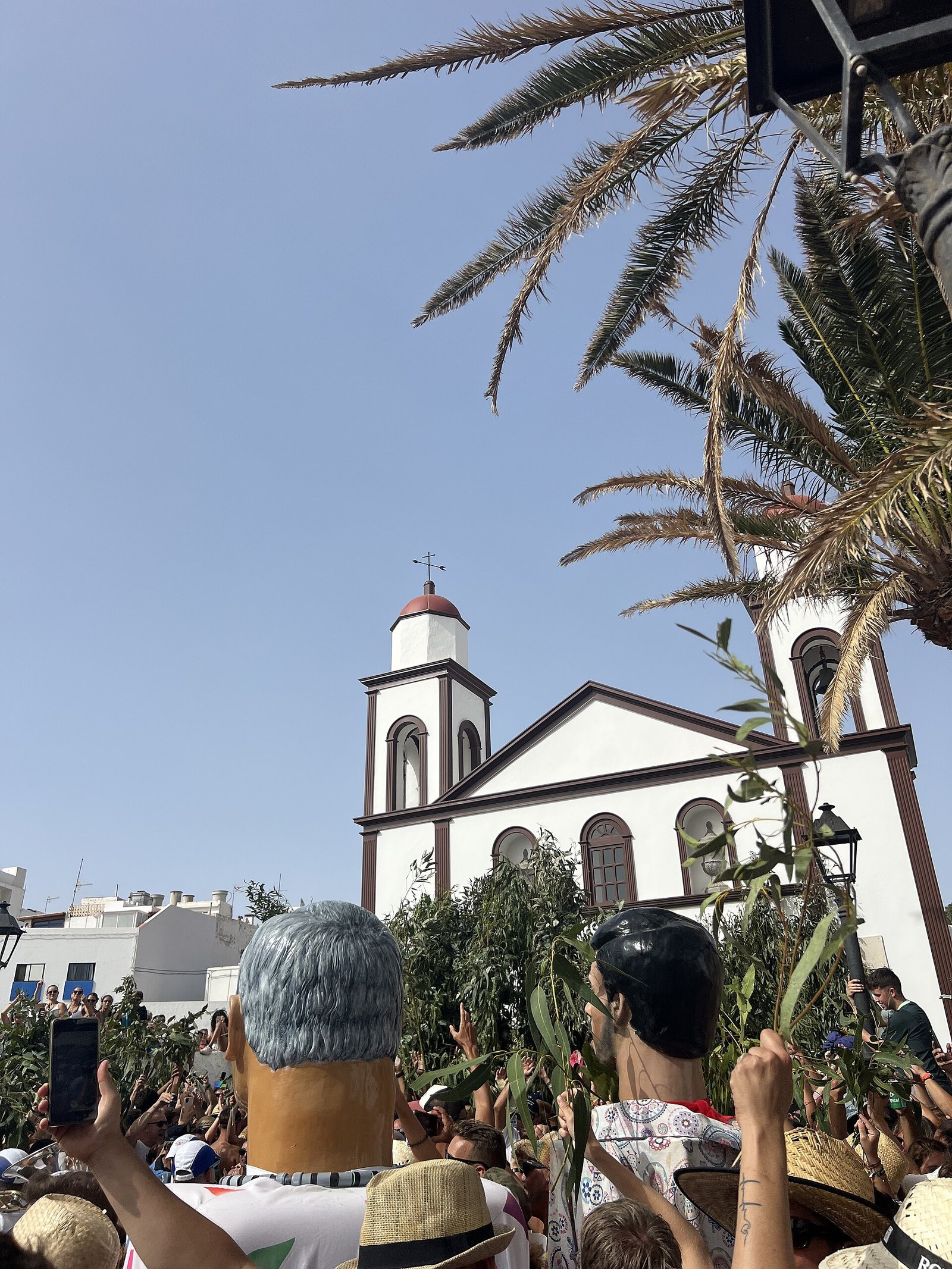
Imagine being woken at five in the morning by cheerful marching music. A few hours later, you are part of a dancing, swaying crowd of thousands, a fresh pine branch in your hand, moving through narrow streets towards the sea. This is not a dream, but the Fiesta de la Rama in Agaete. Every year on 4 August, the tranquil town in the northwest of Gran Canaria transforms into the stage for one of the most original and lively festivals in the Canary Islands. The Bajada de la Rama is a whirlwind of music, tradition and community that you won't soon forget.
The festival is the heart of the Fiestas de Las Nieves, held in honour of the Virgen de las Nieves. For over 50 years, it has officially held the title of a Fiesta of National Tourist Interest. What awaits you here is not a show put on for tourists, but a deeply rooted local celebration where the whole of Agaete is on its feet. The fact that tens of thousands of people from all over the island and far beyond travel here every year speaks for itself. The magic lies in the simplicity: a branch, music and the shared path to the sea.
What is Behind the Tradition of the Rama?
The origins of the Fiesta de la Rama go back a long way. Historically, it is often associated with ancient rituals for asking for rain. In the past, people are said to have gone to the sea with branches to ask for water for the fields in dry times. Today, however, the festival has a clear religious and cultural significance. The municipality of Agaete emphasises that the modern celebration is an offering of branches to the Virgen de las Nieves. It is not a ritual in which the sea is struck with the branches.
So when you see the dancing crowd, you are witnessing a procession of offerings. The participants carry branches of pine, heather, eucalyptus, laurel or mimosa. They dance through the historic centre of Agaete to the sound of the local bands, all the way to the Puerto de las Nieves. There, at the small hermitage of the patron saint, the branches are laid down. It is a powerful image of devotion and connection to nature that has lost none of its fascination to this day.
The Big Day: The Programme for 4 August 2026
The day of the Rama is a marathon of joy, with a fixed schedule that has proven itself over decades. The programme for 2026 is already set and follows this traditional rhythm. It starts early, very early, and only ends after midnight. Here is an overview of the confirmed key events so you can plan your day perfectly.
The first act is La Diana at 5:00 in the morning. A musical parade sets off from the town hall and wakes the village. The bands of Agaete, Guayedra and Clandestina provide the rousing wake-up call. The main event, the Bajada de la Rama, then starts at 10:00. The crowd gathers at the side of the Parroquia de Nuestra Señora de la Concepción. From there, the procession moves dancing through the old town to the Puerto de las Nieves. In the evening, at 22:00, La Retreta begins, a night-time parade with lanterns and music that once again starts from the church. The grand finale is the fireworks display at around 1:00 in the morning, which lights up the sky over the harbour as the crowning finale of the day.
The Day After and the Rest of the Festive Programme
The celebrations don't end with the fireworks. The following day, 5 August 2026, is the actual religious holiday, the Día de la Villa in honour of the Virgen de las Nieves. Traditionally, a procession takes place on this day, bringing the statue of the Virgin from her hermitage in the Puerto de las Nieves to the Parroquia de la Concepción. She remains there for a few days before being returned. The exact times for the processions in 2026 have not yet been published, so it's worth checking the town hall's official programme shortly beforehand.
The entire festive period, the Fiestas de Las Nieves, extends from 25 July to 25 August 2026. The municipality organises around fifty events during this time. The programme typically includes workshops, children's activities, concerts, a Noche Joven, comedy nights, foam parties and much more. However, the specific line-up of artists for 2026 has not yet been confirmed. For the latest details, keep an eye on the official channels of the Ayuntamiento de Agaete.
Practical Tips for Your Visit to Agaete
Attending the Fiesta de la Rama is an intense experience that you should prepare for a little. The most important rule is: arrive early. On 4 August, tens of thousands of visitors are expected, and the access roads and parking situation are correspondingly challenging. The municipality sets up extensive traffic closures and diversions in the town centre and the Puerto de las Nieves. In previous years, the centre was closed to traffic from the afternoon of 2 August until the early morning of 6 August. The road to the harbour, the GC-172, is also closed at times on 4 and 5 August.
The best way to travel is by public bus, known as 'guagua' here, or by using organised transport services. This saves you the stress of searching for a parking space and you can get straight into the festive spirit. The atmosphere is exuberant, family-friendly and characterised by a wonderful mix of locals and visitors. It is a free and open festival. All you need to take part is a branch, which you can buy from numerous vendors on site. Then just join the crowd and let yourself be carried away by the rhythm of the bands.
Common questions
- When exactly does the Fiesta de la Rama 2026 take place?
- The main day is Tuesday, 4 August 2026. The celebrations begin at 5:00 in the morning and end with fireworks around 1:00 at night.
- Is the festival suitable for families with children?
- Yes, the atmosphere is described as a popular and family-friendly celebration with a strong presence of all generations. However, you should be aware of the large crowds.
- Do I need a ticket for the Fiesta de la Rama?
- No, the event is completely free and open to all. You can simply join the procession with a branch.
- How do I get to Agaete on the day of the festival?
- It is strongly recommended to use public buses (guaguas) or organised transport, as the town centre and access roads are closed to private cars.
- What kind of branches are used in the procession?
- Participants traditionally carry branches of pine, eucalyptus, heather, laurel or mimosa, which are later offered to the Virgin.
Read on
- El Médano: no confirmed fiesta programme 14–17 OctoberTenerife · 10 October
- Puerto de Mogán bars: cocktails, live music, drinks €2–5Gran Canaria · 31 October
- Gran Canaria: win 2 double tickets for Víctor ManuelGran Canaria · 31 October
- Gran Canaria: Luis Zahera show moved to 11 April 2027Gran Canaria · 29 October
- Gran Canaria: Finaos in Vega de San Mateo postponedGran Canaria · 29 October
- All events on Gran Canaria →
Stand 3 August 2026. All information based on official announcements from the Ayuntamiento de Agaete, the Cabildo de Gran Canaria and the Canary Islands government. Details of the supporting programme may be subject to change.