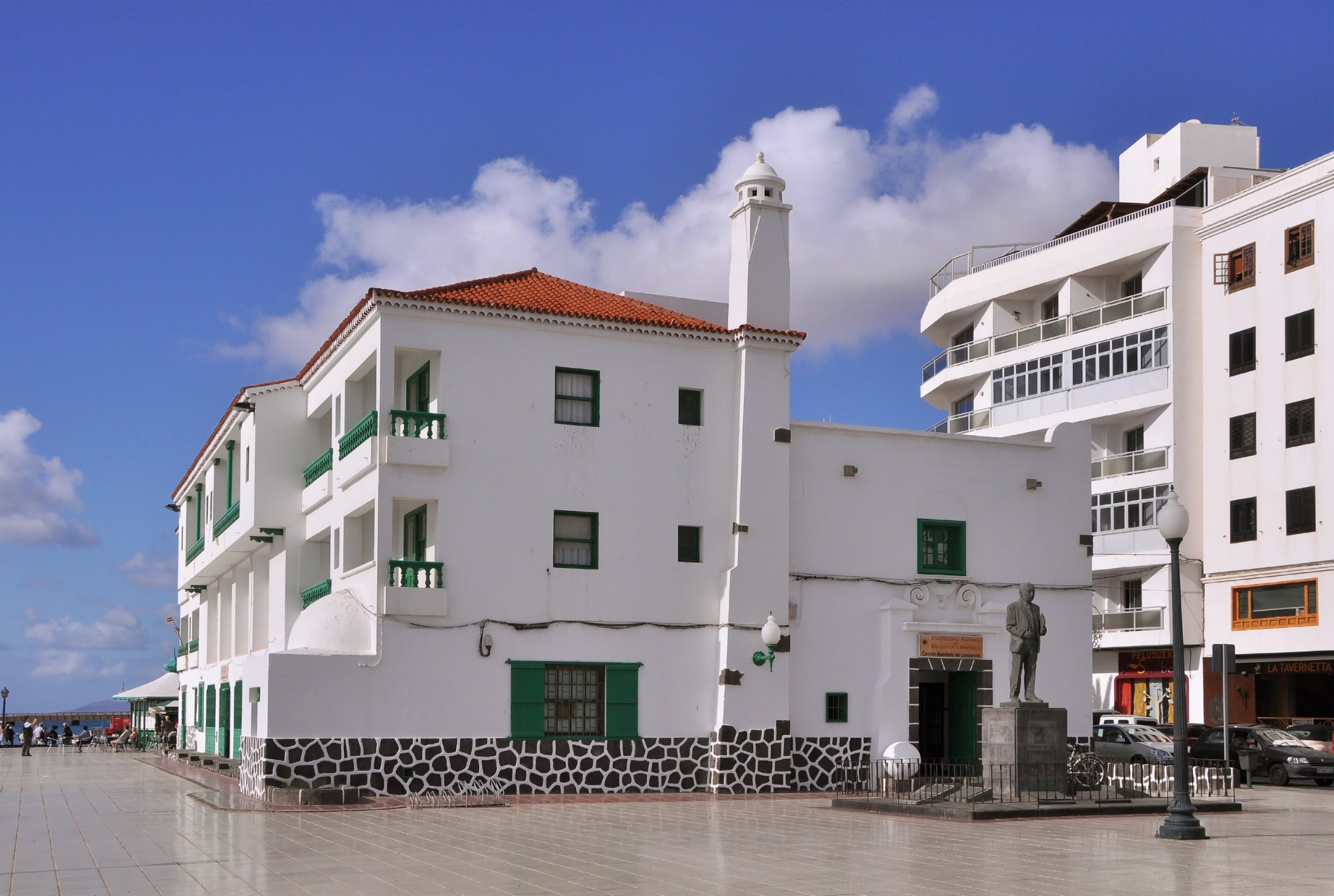
What is there to see on Lanzarote? The main places
The Cabildo runs seven Centros de Arte, Cultura y Turismo (CACT): Jameos del Agua, Cueva de los Verdes, Jardín de Cactus, Mirador del Río, Castillo de San José, Monumento al Campesino and Montañas del Fuego in Timanfaya National Park. They anchor every sightseeing tour, and all prices and times below apply in November 2026, according to the CACT website.
UNESCO declared Lanzarote a biosphere reserve on 7 October 1993, and the reserve covers 124,955.69 hectares, according to the Spanish tourism site spain.info. The Cabildo's reserve office can be reached at biosfera@cabildodelanzarote.com and on lanzarotebiosfera.org.
Spain.info lists three core protected areas: Timanfaya National Park, the surrounding Los Volcanes natural park and the Archipiélago Chinijo natural park, the sea around La Graciosa. Volcanic landscape and conservation frame almost every outing on the island.
César Manrique (1919 to 1992), born in Arrecife, shaped a tourism model that fits buildings into the landscape, say university and Cabildo sources. Credited with the 1993 biosphere status, he won the 1978 World Prize for Ecology and Tourism, and the Italian site greenme.it points to the missing billboards as a result of his approach.
Lanzarote sights: what do the Centros cost and when are they open?
The CACT website lists Montañas del Fuego (Timanfaya) at €30 for adults, open daily from 09:00 to 15:45. Reduced rates for Canary Islands residents, Lanzarote residents and people with disabilities are sold only at the ticket office, while blog prices of €20 or €22 are outdated or unchecked, in the research's view.
Jameos del Agua costs from €17 and opens daily from 10:00 to 18:00, with the “Noches de Jameos” evening event on Fridays from 18:30 to 20:30. One tour operator gives 10:00 to 17:00, but the CACT figure is the one that counts, so check the site before you go.
The Cueva de los Verdes costs €17 and opens daily from 09:30 to 16:45. The CACT website says tickets are sold only online with a fixed date and time, so anyone arriving at the cave without one risks not getting in.
Jardín de Cactus and Mirador del Río cost €9 each and open from 10:00 to 17:00; the Castillo de San José, home to the MIAC contemporary art museum, costs €5.40 and opens from 11:00 to 18:00. The Casa Museo del Campesino is free, according to the CACT, and opens from 10:00 to 18:00, with the exhibition “Juan Brito y la Princesa Ico” listed on its page.
Gazette Life reported in October 2025 that the Centros passed their budget and postponed possible price rises, so prices can change.
Timanfaya: how does booking work since June 2026?
Since Monday 15 June 2026, online buyers must pick a Timanfaya date and entry time in advance, Gazette Life reported on 16 June 2026, citing a Cabildo announcement. No Cabildo statement of its own could be found, but the CACT page marks online purchase for Montañas del Fuego as required.
Gazette Life says guests should arrive 15 minutes before their slot to validate the ticket, which covers only the chosen date and time and allows no changes, exchanges or refunds. The private portal lanzarote3.com adds that you should bring the QR code and that daily capacity is limited, with sales via ventaonline.cactlanzarote.com.
A search summary says the €30 includes the bus tour, parking and geyser demonstration, but no official page confirms it. Child prices conflict too: one source says €15 for ages 7 to 12, another €10, and only the adult fare and free entry up to age 6 are officially confirmed.
A blog gives a summer schedule of 09:00 to 17:30 from 1 July to 15 September, while the CACT page shows only 09:00 to 15:45. No official visitor limits or parking rules turned up, so check the CACT page shortly before you visit.
Lanzarote: what to see outside the Centros, from the beach to La Graciosa?
Papagayo beach lies in the Los Ajaches natural monument and is reached by a gravel track, with free access on foot or by bike. Yaiza council charges non-residents a one-off €3 per vehicle, say La Voz de Lanzarote and RTVC 3; the barrier is open 09:00 to 19:00, and the fee is about 25 years old.
In the first half of 2025, 58,148 vehicles of non-residents entered, about 17% more than a year earlier, according to RTVC (14 August 2025). The fee raises a little over €300,000 a year, which Yaiza council considers too little, and it is weighing an increase, though the source named no decision.
Driving off-road in protected areas is costly, with fines from €1,500 for leaving the tracks and an “exemplary” €4,500 penalty for a buggy in Los Ajaches, La Voz de Lanzarote reports.
Famara beach has about 5 kilometres of sand below the Risco de Famara, a 670-metre cliff and the island's highest point, and is a surf spot, easier for beginners in winter, says the blog La Maleta Inquieta. A blog says swimming at the Charco de los Clicos in El Golfo is banned because the area is protected; the rule itself was not found.
The ferry to La Graciosa leaves from Órzola, not Playa Blanca, and Líneas Romero gives about 25 minutes for its fastest crossing. An unconfirmed note lists 07:00 and 19:00 as first and last departures; a travel blog puts kayak and snorkelling tours to the Papagayo coves at about €40 to €50 for half a day.
When is the best time to travel? The climate on Lanzarote
AEMET, the state weather service, runs the Lanzarote Aeropuerto station (C029O) at 14 metres altitude in San Bartolomé. Its normals cover 1981 to 2010 and are airport values, so the coast and the north differ. The annual mean is 21.1°C, the mean maximum 24.8°C and the mean minimum 17.4°C.
Monthly means stay between 17 and 25°C all year, according to AEMET, from January at 17.4°C, the coolest, to August at 25.2°C, the warmest. August has a mean maximum of 29.1°C, January a mean minimum of 14.0°C, and the mean is 20.7°C in November and 20.8°C in May.
Rain falls mainly in winter: December is the wettest month with 29 millimetres and 3.8 rain days (1 millimetre or more), and the year totals 111 millimetres and 19.0 rain days. June, July and August stay practically dry, with 0 millimetres in June and July according to AEMET, and May brings 2 millimetres.
AEMET records 2,986 hours of sunshine a year, with July leading on 308 hours and December lowest on 196. The research does not document sea temperatures or the timing of calima (dust-laden air from the Sahara) and the trade wind, so they are not given here; current values and warnings are at CITA weather (cita.news/de/wetter.html) and AEMET.
What is still open, and what should visitors watch for?
La Voz de Lanzarote reports about 3 million visitors to the Centros from January to October 2023 and just under 2.5 million in the same months of 2024, a drop of about 15.6%. The count fell 19.7% in both June and July 2024 and 22.3% in August, and the research found no figures for 2025.
The same report says the Centros stayed profitable, with an operating result of €8.7 million and a pre-tax profit of €4.4 million in the first half of 2024. The article gives no figures for individual Centros, and visitor numbers per attraction are not available.
A guided day tour taking in Timanfaya, Jameos del Agua, Cueva de los Verdes, La Geria and Monumento al Campesino costs about €87 to €89 for adults and €55 for children aged 2 to 11, depending on the provider. The research names a free alternative: driving through La Geria, a wine region where vines grow in pits in volcanic soil, with an optional tasting at a bodega (winery).
The Mancha Blanca visitor centre offers exhibitions and audiovisuals without admission, while prices at the César Manrique foundation, access rules for Playa Blanca and details on the La Geria wine region remain unconfirmed.