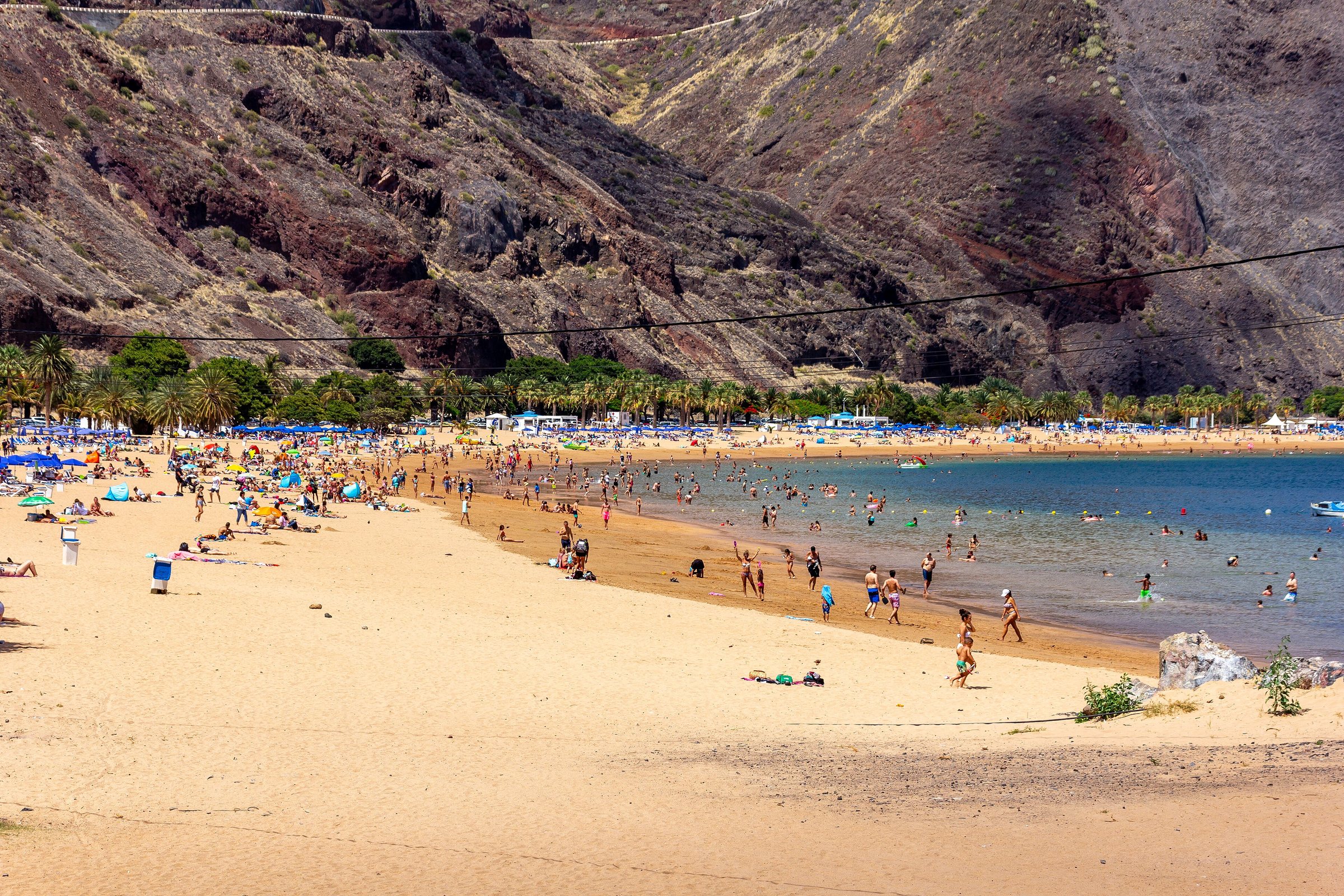
Can you swim at Las Teresitas at the moment?
Yes, the beach is open: Playa de las Teresitas stayed open to bathers four days after the 16 November analysis. No official closure or warning is known so far.
The sample showed 800 bacteria per 100 millilitres (unit UFC, colony-forming units), according to NAYADE, the national information system for bathing water. The report names 500 as the recommended maximum that obliges action.
The analysis itself notes that the health authority must still assess the result. That means the Salud Pública (the Canary Islands public health inspectorate), which asks municipalities to close beaches.
The Spanish health ministry publishes current readings on NAYADE. Municipalities post closure and reopening notices, so check there and on NAYADE before you travel.
Does this affect the beaches in the south too?
The analysis covers only Las Teresitas in Santa Cruz de Tenerife. The report contains no readings or notices for other beaches.
Short-term closures have happened on Tenerife before: from January to 24 September 2026 the Servicio Canario de la Salud (Canary Islands health service) recommended 11 of them. They included Los Cristianos and El Médano, and Playa Jardín in Puerto de la Cruz three times.
Las Teresitas was not on that list. That makes the 16 November reading an outlier compared with the earlier samples.
How far does the reading differ from earlier ones?
The new reading is around 27 times the one from 19 October. The three samples before it came to 29, 9 and 29 bacteria per 100 millilitres, taken on 7 September, 21 September and 19 October.
Intestinal enterococci, a second indicator of faecal bacteria, stood at only 6 per 100 millilitres in the same sample. The report rates that as a good result.
The report suspects the sharp jump prompted the authority’s review. It is also surprised that nobody acted at once, as is usual at other beaches in the Canary Islands.
Who decides on a closure?
A closure is not automatic. Real Decreto 1341/2007 (a Spanish royal decree) of 11 October, published in the BOE (the official state gazette) as No. 257 on 26 October 2007, lets the authorities ban bathing or advise against it, and it transposes an EU directive.
In practice, the Salud Pública on Tenerife takes the samples, assesses them and recommends closures. The municipality carries them out.
Carlos Tarife, councillor for public services and the environment in Santa Cruz, described the split of duties in July 2026. The regional government’s programme takes and analyses the samples, he said, while the city looks after infrastructure and maintenance.
For short-term pollution expected to last no more than 72 hours, the decree requires new samples at intervals of no more than 72 hours until one meets the limits. Meanwhile the authority informs the public and, if needed, temporarily bans bathing.
It is not known whether the Salud Pública has recommended a closure or taken a new sample. There is also no statement from the city of Santa Cruz or the Canary Islands government.
What is the overall picture for Las Teresitas?
On 1 July 2026 the city of Santa Cruz, under mayor José Manuel Bermúdez, said the beach kept its annual “Excelente” rating. Visual checks had shown no residues, oil, foam or algae, and the reports were updated on 22 June.
The environmental group Ecologistas en Acción awarded Las Teresitas a Black Flag (Bandera Negra) in June 2026. That is the group’s own view, not an official rating, and its reasons are not documented here.
On 2 July 2024 the city closed a stretch at access point 8. Another closure followed on 12 November 2024, and the beach reopened on 13 November.
The cause of the high reading is unknown. The report does not name one.
No one has named a date for a new sample. No one has named a decision by the Salud Pública either.