In the Canaries: around 40 cases were recorded in 2025, most belonging to an outbreak declared over in March 2026 — all cases stayed mild
The protection: the vaccine (triple vírica / MMR) in two doses, at 12 months and at 3 years
The coverage: around 95 percent of the Canary population is correctly vaccinated in the first year of life
Who should check: parents of children up to 4, those born after 1978 without two documented doses, healthcare workers, international travellers
Sources: Dirección General de Salud Pública (SCS), RTVC, Canarias7, WHO/PAHO
Let's start with the news behind the individual case reports — the part that really carries weight. In February 2026 the World Health Organization announced that Spain no longer meets the criteria for a measles-free country, owing to renewed sustained transmission of the virus and rising infections in 2024 and 2025. Health authorities described it as a clear step backwards. Spain is not alone: Germany, Italy, France, Austria, the United Kingdom and the United States have all recently lost this status too. Last year Spain counted almost 400 measles cases — twice as many as in 2024.
How it played out in the Canaries
On the islands, things stayed comparatively mild. Around 40 cases were recorded in 2025, the great majority belonging to a single outbreak that began in October 2025 on La Palma and spread to Tenerife and Gran Canaria. The health authority declared it over in March 2026. Both remarkable and reassuring: all cases stayed mild, no one needed intensive care, and the reproduction number in this outbreak was around 1 — whereas measles is normally extremely contagious, with one infected person passing it on to about 14 others on average. The reason for the low spread: the virus circulated in a largely immunised population and found few unprotected people.
How dangerous is measles really?
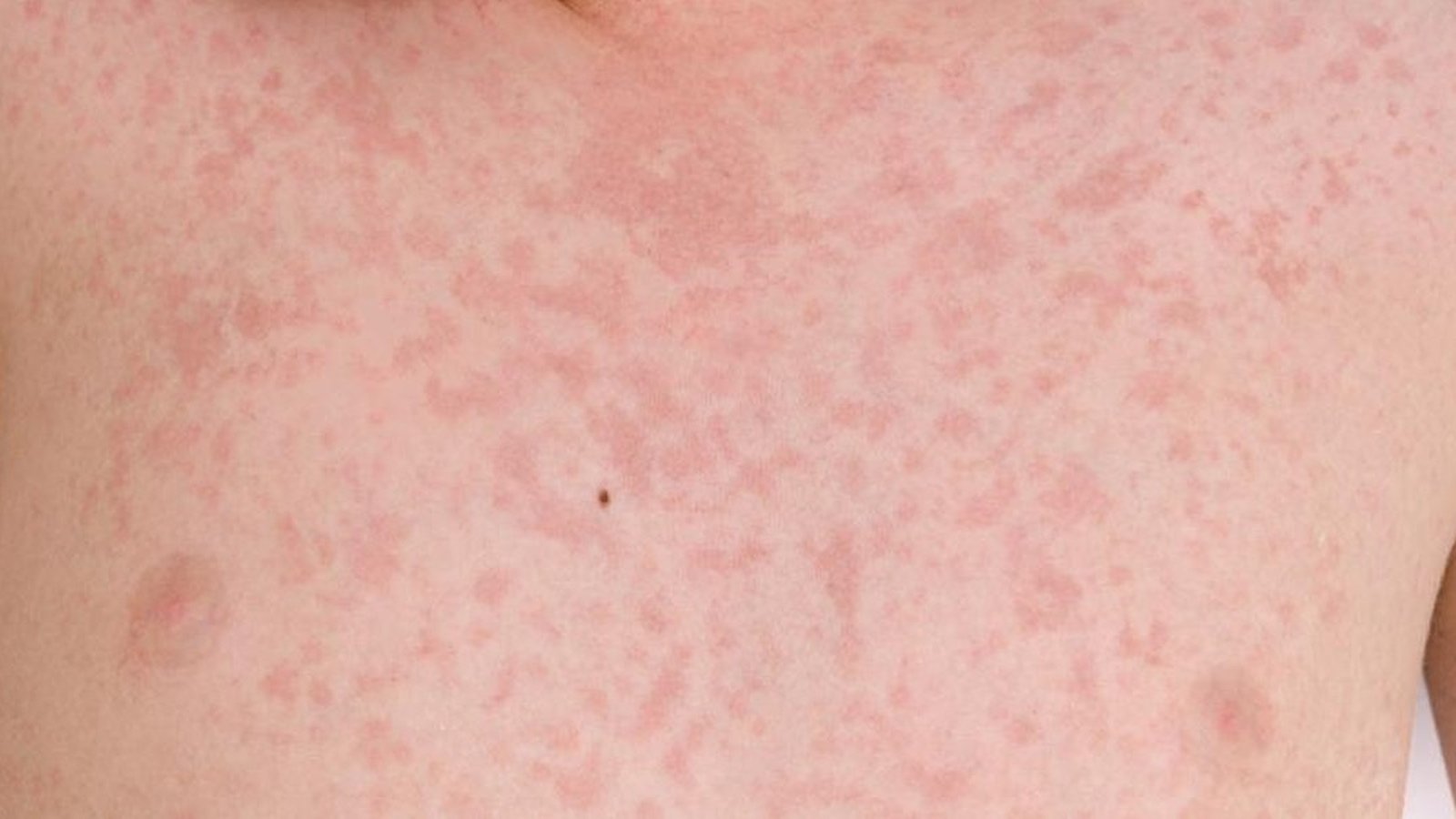
Measles begins with fever, a runny nose and a cough, often with small whitish spots on the inside of the cheeks; the typical rash appears after three to seven days, starting on the face and spreading across the body. In most cases the illness is benign. But it can have complications — pneumonia, middle-ear infection, laryngitis or measles-associated hepatitis. Those most at risk are babies still too young to be vaccinated, and unvaccinated adults. That is exactly why high vaccination coverage protects not only the individual but also those who cannot be vaccinated themselves.
Frequently asked questions
- Is there a measles outbreak in the Canaries right now?
- The major outbreak of October 2025 was officially declared over in March 2026. Individual cases can still occur as long as the virus circulates again in Spain and Europe. The current notices from the Dirección General de Salud Pública are what count.
- When is the vaccine given?
- In two doses: at twelve months and at three years. Around 95 percent of the Canary population is correctly vaccinated in the first year of life.
- I'm a resident and don't know whether I'm protected.
- Anyone born after 1978 without proof of two doses or of having had measles should seek advice at their centro de salud.
- Should I worry as a holidaymaker?
- With full vaccination the risk is very low. If unsure, check your vaccination record before travelling. A good level of protection in the population markedly slows the spread.
- Why does this matter now?
- Because Spain lost its WHO "measles-free" status in 2026 and case numbers are rising across Europe. A verified vaccination is the simplest precaution.
Read on
- Canaries: 2,444 homes back in long-term rental marketCanary Islands · 24 October
- €224 a day: why the Canaries grew at only a third of Spain's pace in AugustCanary Islands · 2 October
- 140,303 unemployed: Canaries down, Spain up by 23,587Canary Islands · 2 October
- Canary Islands rent: 60.7% of tenants can't afford a new letCanary Islands · 7 November
- Canary Islands: orange rain warning on 8 November, 5 islandsCanary Islands · 6 November
- All events on the Canary Islands →
As of 23/06/2026. Sources include the Dirección General de Salud Pública of the Servicio Canario de la Salud (SCS), RTVC, Canarias7 and the WHO/PAHO. Figures on case numbers and outbreak status reflect the cited notices and may change; the current official publications are what count. This article is general health information and does not replace medical advice. Illustration.