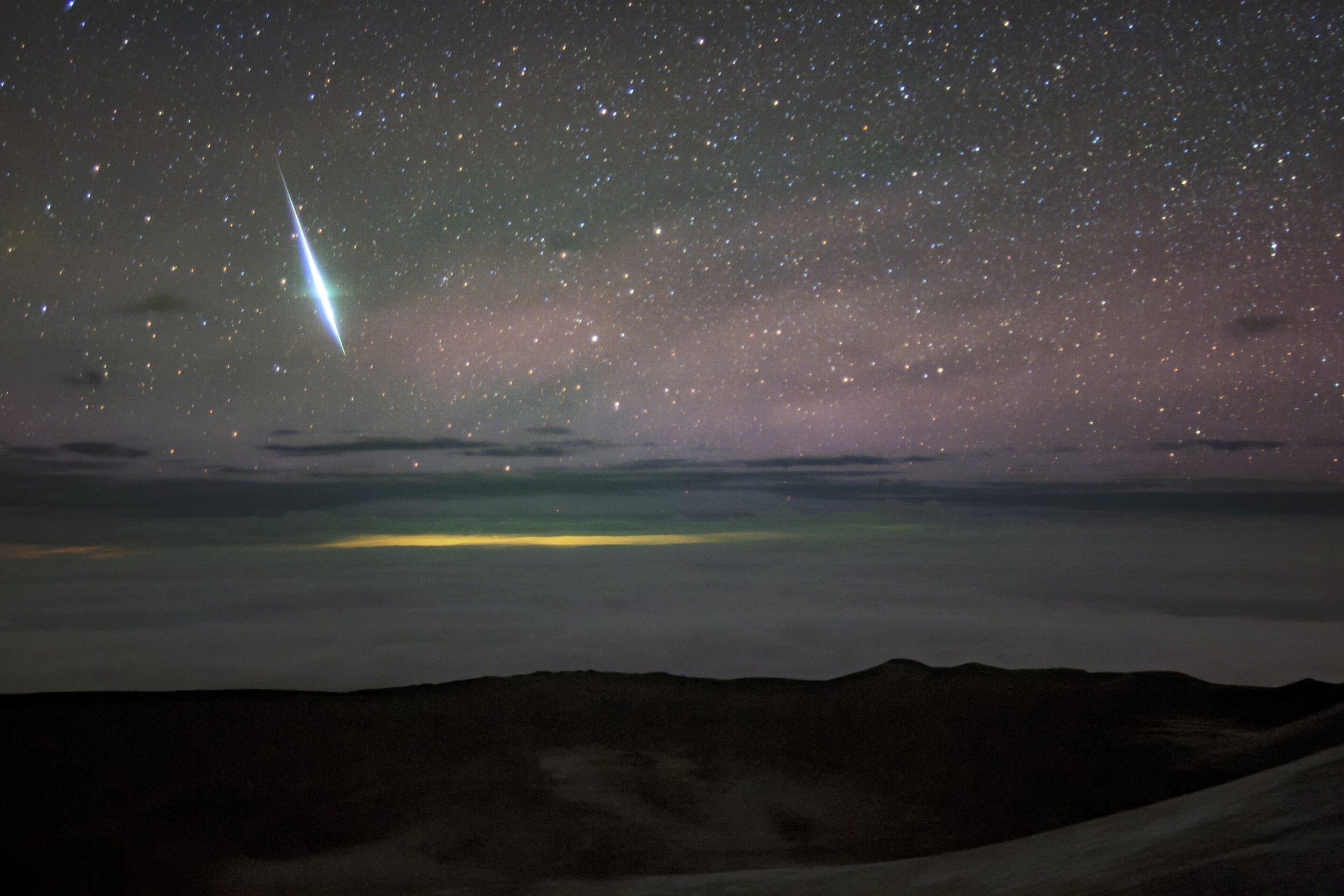
When is the best time to see the Geminids?
The peak falls in daylight: the IGN says the Geminids reach it on 14 December 2026 at about 15:00 Spanish mainland time. On Tenerife it is light by then, so no shooting stars are visible.
Fortunately the peak is broad and lasts about twelve hours, according to the IGN. That is why the nights of 13 to 14 and 14 to 15 December also bring high activity.
The IGN says the shower is visible from about 4 to 17 December. For several days the rate stays above 120 meteors an hour.
How many shooting stars can you realistically expect?
At the peak, up to 150 shooting stars an hour can be seen, writes the IGN. That is a best case, not a guaranteed figure.
How many you count depends on your location and the sky. A table of observations shows only 57 an hour for the Netherlands at 04:30, and gives no value for Tenerife.
The Moon hardly interferes in 2026: the IGN says it has not yet reached first quarter and is about 20% illuminated. The IGN rates the conditions as “fairly good”.
The Geminids originate from the asteroid (3200) Phaethon, not from a comet, as the IGN writes. The IRAS space telescope spotted it in 1983.
Where and when should you look on Tenerife?
A dark place with a clear horizon is enough, with no optical instruments, the IGN advises. In the Canary Islands, mid-altitude or a rural area is often all you need.
Above 1,500 to 2,000 metres, the sea of clouds and the temperature inversion keep the air stable and clear. That advantage explains why the observatories stand in the Canary Islands.
Clouds in the north of an island can spoil the view while the south stays clear. Visitors in the south of Tenerife should check the forecast just before setting off, as no reliable one exists yet for these nights.
According to the IAC, the radiant in the constellation Gemini rises at about 20:00. The best hours run from after midnight until dawn, when the Moon has long since set.
The IGN suggests lying back and looking at the darkest part of the sky, away from the Moon. Your eyes need about 20 minutes to adapt, and a glance at your phone resets that.
At mid-altitude, December nights are much colder than many people expect. Pack warm clothes.
What rules apply at Teide and the observatories?
We found no rules, fees or deadlines for watching from public land. There is also no official information on special rules in Teide National Park for the night of 13 to 14 December.
The free open days on 20 and 21 June 2026 were fully booked. No new date has been published.
Stargazing tours at Teide exist, but they are not tied to the Geminids. Whether operators run tours that night and what they charge is not confirmed, so ask the provider.
Law 31/1988 has protected the sky above the IAC observatories since 23 November 1988. It covers outdoor lighting, radio transmitters and disruptive activities, and particularly strict limits apply from 1,500 metres.
What is still unknown and what comes next?
Whether the IAC, the Cabildo de Tenerife (the island government) or the Museos de Tenerife plan a public event is not known. We found no official events page for 2026.
On 14 December 2023 the IAC broadcast the Geminids at 22:30 Canary time on its official website, from the Teide Observatory and from El Anillo in Extremadura. No broadcast is confirmed for 2026.
The Leonids pass earlier, a smaller shower on the night of 17 to 18 November, peaking at about 00:45 mainland time. In a normal year they bring about 15 shooting stars an hour, and the Moon is in its first quarter and sets around midnight, before the peak.