What it is about
There are festivals that advertise with headliner lists and fill stadiums. And then there is the Up&Down. For ten years it has been bringing jazz, flamenco, African rhythms and new compositions to places where music sounds different — in a small hotel spa on La Gomera, in a fortress from the seventeenth century facing the Atlantic. Tenth edition, five concerts, tickets from three euros. The idea: not to reach as many people as possible, but to get as close as possible.
From 9 to 17 May 2026 the programme runs between the islands. The start is on La Gomera with Ibolia and her Andalusi flamenco sound. Then the action shifts to the Castillo San Felipe in Puerto de la Cruz, where four evenings play in a row. The closing comes from a Cameroonian singer whose voice once stood before the UN General Assembly in New York.
The opening at the spa on La Gomera
On 9 May an artist named Ibolia takes the stage at the Bancal Spa & Hotel on La Gomera. Where exactly? In a boutique hotel on the smallest of the major Canary Islands, in a place that on its own is a kind of concert. Ibolia brings something the Up&Down programmers lovingly describe as «Andalusi sound»: flamenco with the influences that grew in southern Spain from Arab, Jewish and Roma music. A mix that suits the location. La Gomera lies on the way to Africa and has caught all kinds of routes in its history.
Then there is a pause. Five days. The artists travel on, the audience too, the islands have to be crossed. Those who miss the opening have the next chance from 14 May.
The Castillo, the pirates, the jazz
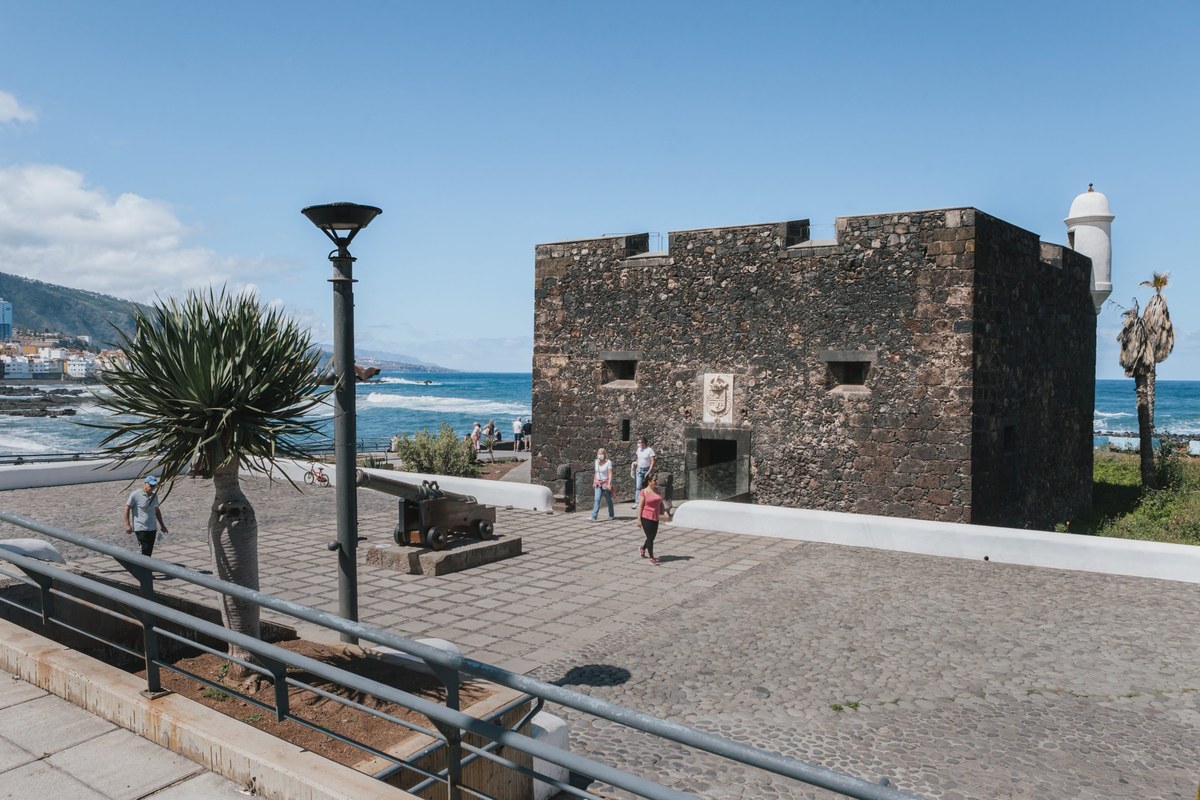
The Castillo San Felipe was built because Puerto de la Cruz was rich in the seventeenth century — and pirates knew it. Construction started in 1599, finished on 6 January 1604. Pentagonal shape, three iron cannons, quarters for the crew above, ammunition storage below. From 1641 it was a defensive facility, in 1869 it was taken out of military service, in 1891 it passed to the municipality of Puerto de la Cruz. Then it had a long life in various functions — lazaretto, depot, even briefly a restaurant. In 1993 it was renovated. Today it is a cultural centre.
And that is what makes it an unlikely concert venue. If you walk along the Playa Jardín promenade on a May evening, you sometimes hear saxophone between the walls. The acoustics are not perfect — the walls were not built for music but against cannon balls. But it is intimate. Three metres between the stage and the first row. If you want to hear a solo flautist breathe, this is the place.
Four evenings, four worlds
14 May — Ancor Miranda Quartet. The drummer and composer from the Canaries opens the Tenerife programme with his quartet. Miranda is among the musicians who treat the drum kit not as a rhythm instrument but as a voice. His quartet has a reputation for playing harmonically dense and rhythmically free — an opening that whets the appetite.
15 May — Ana Ayala Quartet. The Canarian flautist Ana Ayala Vidaurrázaga graduated with honours from the Conservatorio Superior de Música de Canarias, moved to Barcelona in 2021 and finished in 2025 at the Conservatori del Liceu with the Premio Extraordinario de Música Jazz y Moderna. In 2026 she received the Premio de Música Joven Alberto Delgado from the Fundación CajaCanarias. Her music moves between contemporary jazz, classical music and free composition.
16 May — Álex Abril. A Madrid duo formed by Abril Saurí and Álex Duato. They merge modern jazz fusion with flamenco tradition. Rhythmic complexity, melodic sensibility — the young faces of the Spanish scene.
17 May — Lornoar A Trío. The closing act. More on this in the next section.
Lornoar: A voice from Yaoundé
The singer who closes the festival is named Lornoar. Born in Yaoundé, capital of Cameroon, she belongs to the Eton people — a Bantu group that lives in central Cameroon. That is not incidental: «Yaoundé» is the Spanish-French spelling of the Eton name «Jaunde», which the German colonial rulers adopted. The city thus bears the name of Lornoar's people.
In 2007 she started singing professionally in clubs in Yaoundé. In 2010 she won the nationwide women's voice competition «MASSAO» in Douala. In 2011 her first solo album appeared. In 2014 she was invited to New York, recorded her second album «100%» there — and on 10 December of the same year stood before the UN General Assembly. She sang «Pupuma», a song about freedom, for the official launch of the International Decade for People of African Descent. In 2017 she represented Cameroon in the Chanson category at the Francophonie Games in Abidjan.
What she sings: Bikutsi, Ekang, Assiko, Makossa, Bakanga, Mbalax — and everything in the Western pop world that bears a kinship with these: Bossa Nova, Pop, Funk, Jazz, Reggae, Soul. Her songs are in Eton, French and English. What she sings about: love, faith, comfort, tolerance, protection of childhood, violence against women.
Bikutsi translates as «we strike the ground». It was originally a dance of the women of the Beti ethnic group in central Cameroon, a space where women could make themselves heard in a patriarchal society that otherwise denied them that. In the seventies men took over the rhythm, modernised it, and in the nineties it became audible worldwide. Lornoar stands in this line and carries it forward.
Those sitting in Puerto de la Cruz on 17 May will not simply hear world music. They will hear a tradition that reaches back to German cocoa plantations, made a stop at the New York of the UN General Assembly, and now, at a fortress from the pirate era, finds its closing point.
What «boutique festival» means
The organisers call it «jazz boutique». That sounds like wine self-importance, but it is a serious concept. Boutique here means: few concerts, small rooms, high musical quality, no huge sponsor noise. It also means: low ticket prices, because the agreement is that music should not only be accessible to people with fat wallets. A three-euro minimum is a political statement.
Since the first edition in 2017, the organisation has aligned itself with the UN Agenda 2030. At the concerts there is a donation point — donations go to sustainability projects, to the promotion of diversity, gender equality and dialogue. That is on the website, and it makes the festival one that wants more than entertainment.
Earlier editions ran through Tenerife, Gran Canaria, Lanzarote, La Gomera and La Graciosa. The tenth edition concentrates on two places. Less travelling, more depth. That is a conscious decision.
Practical for visitors
Tickets are available from three euros via the Tickety platform. The exact start times vary — the opening with Ibolia on 9 May at the Bancal Spa starts in the evening, the concerts at the Castillo San Felipe regularly at 20.00 or 20.30. Getting to Puerto de la Cruz is easy and cheap by bus from Santa Cruz or Los Cristianos; on La Gomera the ferry runs daily from Los Cristianos to San Sebastián, the Bancal lies a little outside and is reached by taxi or rental car.
If you want to see several concerts, you can combine it well with a short stay. Puerto de la Cruz has mild weather in May, the northern north of Tenerife shows its green side. Restaurants and small bars on Calle Quintana are five minutes' walk from the Castillo. Extending an evening after the concert into a long-established bodega is worth it.
Frequently asked questions
- What does a concert at the Up&Down Festival cost?
- Tickets start at three euros per concert. More precise prices per show available at Tickety.
- Who performs in 2026?
- Ibolia (9 May, La Gomera), Ancor Miranda Quartet (14 May, Castillo San Felipe), Ana Ayala Quartet (15 May), Álex Abril (16 May) and Lornoar A Trío (17 May).
- Where do the concerts take place?
- On 9 May at the Bancal Spa & Hotel on La Gomera, from 14 to 17 May at the Castillo San Felipe in Puerto de la Cruz on Tenerife.
- Who is Lornoar?
- A Cameroonian singer from Yaoundé, Eton people. She combines traditional African rhythms such as Bikutsi and Makossa with jazz, funk, soul and bossa nova. Sang before the UN General Assembly in 2014. Closes the festival on 17 May.
- How do you get to the Castillo San Felipe?
- Calle Luis Lavaggi 10, Puerto de la Cruz, directly on the Playa Jardín promenade. Accessible by bus from Santa Cruz. Open from 19.00 for concerts.