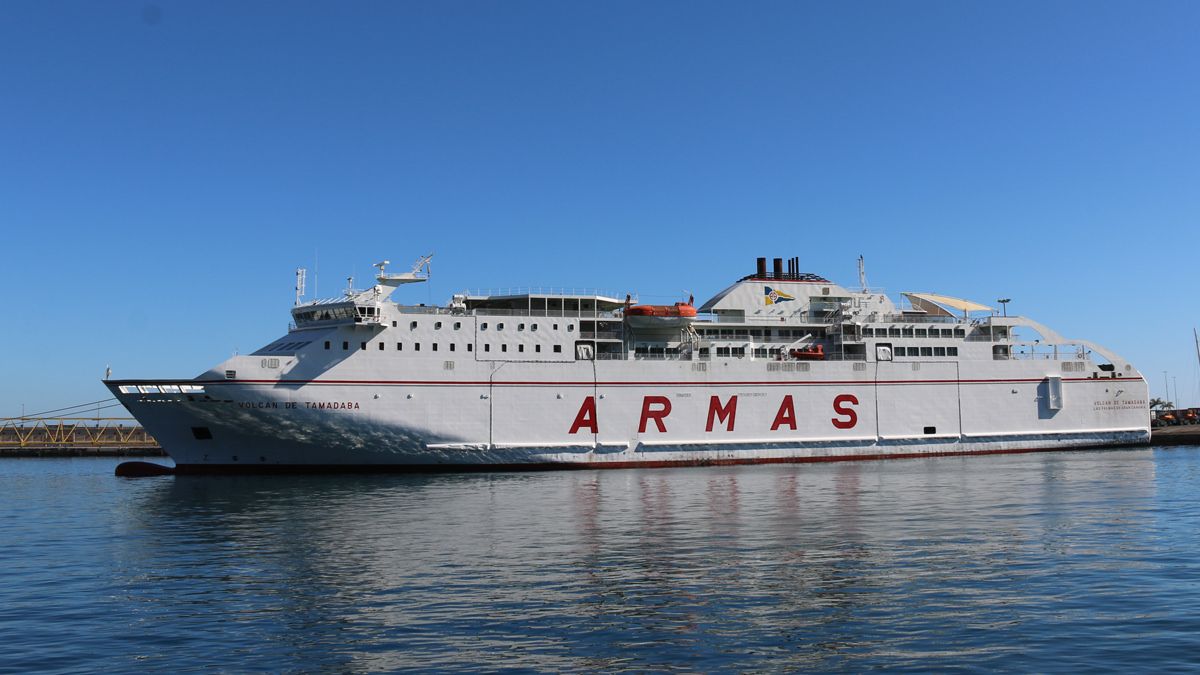
Antonio Armas Curbelo founded his shipping company in 1941 on Lanzarote. First vessel: a small freight barge for the short route between the islands. Over eight decades, that Canarian family company became one of the three big ferry operators in the islands — ships with «Volcán de…» in their names, logos at every major island port, an entire generation of Canarian sailors who served under that flag.
Since 18 May 2026, all of it belongs to Baleària. The group from Dénia, on the Valencian Mediterranean coast, has taken over the Canary Islands assets of Armas Trasmediterránea — ships, routes, port licences, employees. Adolfo Utor, president of Baleària, put it dryly at the announcement: «Today is a great day. The new Baleària is ready to guarantee the efficiency of the entire national maritime transport network across all routes.»
That marks the end of a long decline. Armas Trasmediterránea had merged the two brands into one group in 2017 (Naviera Armas took the majority of Trasmediterránea then), but suffered in recent years from debt, delayed investment and weak market position against the faster Fred. Olsen Express. Utor himself admitted it would «not be easy» to recover the traffic Armas has lost in recent months.
Why this takeover isn't «just business»
On the factual level: a market consolidation move. Two national market players become one. It happens everywhere, regularly.
On the Canarian identity level: the last purely Canarian element of island ferry transport is gone. Fred. Olsen Express belongs to a Norwegian-Spanish holding. Baleària Canarias belongs to a Valencian group. Anyone moving between the islands — commuters between Gran Canaria and Tenerife, La Palma residents heading to the mainland, freight forwarders between Tenerife and Lanzarote — now operates entirely in an industry whose owners no longer come from the archipelago.
Does it matter? Economically not necessarily. Symbolically very much so. Naviera Armas was one of the great success stories of 20th-century Canarian private business — most local families have at least one relative who worked under the Armas flag at some point.
What the competition authority attached
The Spanish competition authority CNMC authorised the takeover at the end of March — with a tricky condition. Until then, Baleària and Fred. Olsen had operated the Huelva (mainland–Canaries) route jointly, sharing costs and logistics. This alliance had to be dissolved so the takeover could go through — otherwise, Baleària would have controlled the majority of mainland-Canaries connections while cooperating with its biggest rival. Effectively a monopoly.
The solution: Fred. Olsen will probably keep the Huelva route on its own. Baleària focuses on the original Armas routes — Cádiz, inter-island, some Mediterranean lines.
What changes for island commuters
The immediately tangible consequences will show up over the coming months. Four areas to watch:
1. Prices. Market consolidation means fewer competitors. Classical economic theory: less competition, higher prices. Reality: the CNMC has imposed conditions designed to prevent exactly that. Whether it works will only become clear next high season.
2. Frequencies. Baleària has announced €45 million in investment in the Canary Islands over three years. That should mean more, newer ships and possibly more departures. But: when two operators become one, route cuts can also happen, especially on less profitable connections (smaller islands).
3. Service quality. Naviera Armas had a reputation — affordable prices, older ships, occasional delays, but a Canarian atmosphere. Baleària is a classic mainstream Mediterranean operator. The next trip will feel different.
4. Jobs. Baleària has pledged to take over the workforce. Anyone working in the ferry industry as a resident keeps their job for now. Medium-term, consolidations are typical — duplicated administrative functions get cut.
Fred. Olsen — the chosen winner
Fred. Olsen Express remains the independent competitor. From a Norwegian tradition (the Fred. Olsen family has been in shipping for over 175 years), in Spain since the 1970s, with a fast catamaran fleet and a premium orientation. The CEO told La Provincia yesterday that his company was perfectly happy with competition — and his own strategy was «professional communication, not public conflicts».
What that translates to: Fred. Olsen will watch closely over the coming months whether Baleària actually delivers what it has promised — or whether service quality drops. If it drops, Fred. Olsen takes the market share.
What residents should do now
If you take the ferry regularly — for work or for travel:
- Compare prices. Consolidation will affect prices in the medium term. It's worth comparing both operators (Baleària Canarias and Fred. Olsen) regularly, especially for high-season bookings.
- Check booking apps. Both operators are currently revising their apps. The majority of Canary Islands inter-island bookings are now digital — anyone on an outdated app loses visibility.
- Loyalty programmes. Naviera Armas had its own resident programme («Residente Canario» with 75% discount on many routes). It continues under Baleària — but check the exact conditions, as smaller details may change.
- A word for freight operators and business clients: freight contracts with Armas were signed under the old name. Contracts are honoured, but for the next contract round these are now different counterparties.
One industry, one sector, one historical chapter fewer
84 years ago a Lanzarote ship-owner acquired his first vessel. Today the brand still exists — as a subsidiary of a Valencian group. The takeover is economically rational, legally authorised, technically correct. But it is also the end of a Canarian success story whose first chapter began with a single man in a port on Lanzarote.
For the British, German and other international resident communities on the Canary Islands, it means: nothing dramatic for daily life. The ferry still sails, prices are regulated, safety standards remain. But the next time you take the boat from Las Palmas to Santa Cruz and see the blue Armas logo — know that it's history now.
Frequently asked questions
- Who is Baleària?
- A Spanish ferry operator, founded in 1998 in Dénia (Alicante province). Specialises in Mediterranean routes (Spain–Balearics, Spain–Morocco). Aggressively expansive since the mid-2020s. President: Adolfo Utor. With the Armas takeover, now the biggest player in Spanish maritime transport.
- What was Naviera Armas?
- Founded in 1941 in Lanzarote by Antonio Armas Curbelo. A Canarian family ferry company that grew over decades into one of Spain's largest. In 2017 Armas took the majority of Trasmediterránea (founded 1916) — together they became «Armas Trasmediterránea». Since May 2026, the Canary Islands assets belong to Baleària.
- What is Trasmediterránea?
- Spain's oldest major ferry operator, founded in 1916 in Madrid. Focus: mainland–Balearics, mainland–Canaries, mainland–Morocco. Part of the Armas group since 2017. Now part of Baleària.
- Does Fred. Olsen stay independent?
- Yes. Fred. Olsen Express belongs to the Norwegian Fred. Olsen family, present in Spain since the 1970s. Premium operator with fast catamarans, mainly inter-island traffic. Has announced it will face the new competitive situation actively.
- Does the resident discount change?
- Naviera Armas applied the resident programme with 75% discount for Canarian residents — a state-mandated rule that applies to all operators. It is preserved as it is legally enshrined. The exact booking modalities may change slightly under Baleària.
- What does this mean for my existing booking?
- Bookings made under the Armas name are honoured 1:1. Tickets remain valid, the trip happens — possibly under Baleària branding, but at the booked price and time.
- Will prices go up now?
- The CNMC has imposed conditions to prevent price explosions. What actually happens will become clear next high season. Medium-term, a modest price rise is usual after market consolidations.
- Which routes are affected?
- All former Armas-Trasmediterránea routes — inter-island in the Canaries, mainland–Canaries connections (Cádiz–Canaries), Mediterranean Spain–Morocco. The Huelva route is treated separately due to the CNMC condition: likely Fred. Olsen will take it on alone.
- What happens to the staff?
- Baleària has committed to taking over the workforce. Medium-term consolidations are usual after mergers — administrative posts first, later possibly port staff at non-strategic locations.
Read on
- Canary Islands 15 October: book fair, fiestas, concertsCanary Islands · 15 October
- Canary Islands: Calima lingers, Saturday rain, DANA possibleCanary Islands · 15 October
- Canary Islands 14 October: fiestas, opera and club nightsCanary Islands · 14 October
- Canary Islands inflation hits 4.4% in SeptemberCanary Islands · 15 October
- Canary Islands: €47.5m for free buses and tramsCanary Islands · 14 October
- All events on the Canary Islands →