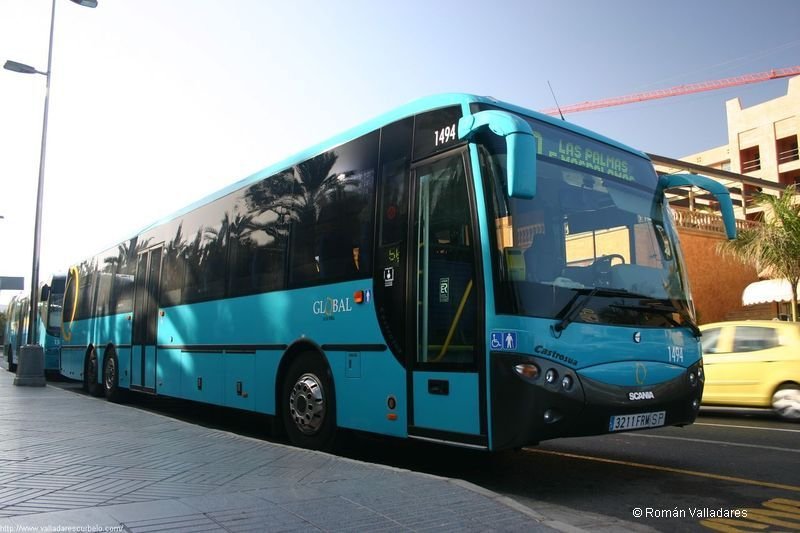
For anyone who has ever juggled a TITSA card in Tenerife, a Global/Guaguas Municipales pass in Gran Canaria, and yet another abono in Lanzarote, the news feels long overdue. The regional government has confirmed it is working on a “título único” — one transport title that lets a resident use public buses anywhere in the archipelago with a single card. The pilot is explicitly aimed at frequent users, the people who already rely on monthly abonos rather than single tickets.
The project is being built on the backbone of the existing Bono Residente Canario, the subsidised resident pass already available on each island. The difference is interoperability: instead of your card being locked to the island that issued it, the new system will recognise it on any participating network. As the Transport director general put it, the goal is that “regardless of the island of issue, it will work in any island.”
Which Islands and Operators Are Included?
The government’s commitment in Parliament is for a bono compatible “para todo el archipiélago” — for the whole archipelago. In practice, this means the major bus networks that already operate under the Bono Residente Canario umbrella are the natural starting point. In Gran Canaria, that covers both Global (interurban) and Guaguas Municipales (Las Palmas de GC urban buses), which already share a unified resident card with unlimited 30-day travel. In Tenerife, TITSA buses and the Tranvía de Tenerife are included. Lanzarote has its own island-wide Bono Residente Canario at 20 euros per month, while El Hierro offers it for just 10 euros per month.
Other islands — Fuerteventura, La Palma, and La Gomera — all receive specific funding for their resident passes and are expected to be part of the pilot, though the exact operator-by-operator list has not yet been published. The Instituto Tecnológico de Canarias (ITC) is currently handling the technical integration work that will make cross-island recognition possible. Until that work is complete and a formal resolution is issued, it is safest to treat the inclusion of smaller networks as highly likely but not yet fully confirmed.
How Will It Actually Work?
The unified bono is not about inventing a completely new physical card from scratch. The existing Bono Residente Canario is already a personal, nominative plastic card with an electronic chip, valid for five years and recharged with flat-fee abonos. The December pilot is expected to reuse this format, upgrading the back-office systems so that any operator can read and accept the card. For you, that means less plastic in your wallet and no more queuing at a new cabildo office every time you visit another island.
Use patterns will likely mirror what already exists: a monthly recharge that gives unlimited travel on the issuing island’s networks, now extended to work everywhere. The government stresses “compatibilidad” — compatibility — rather than fully identical fares across all islands. Each cabildo retains control over its own detailed tariff and discount policies, so the price you pay for the underlying abono may still vary depending on where you live. What changes is that the card itself becomes a universal key.
What About the Cost? Free Travel Continues in 2026
Here is the part that makes the pilot particularly attractive: for the whole of 2026, the Spanish state has extended the 100% discount on abonos and multi-trip titles for public transport in the Canary Islands. This means that for qualifying residents, guaguas and the tram are effectively free all year, with the cost covered by state and regional subsidies. The unified bono is expected to be classified under this same abono framework, so during the December pilot, there should be no extra out-of-pocket cost for residents who already meet the conditions for free travel.
To access the free travel, users typically need to make a minimum number of trips per period — often around 15 trips in 30 days, depending on the operator. If you fall below that threshold, the next recharge may not be subsidised. The exact conditions for the unified bono under the 100% discount regime are still being finalised, but the government’s clear intention is that the pilot adds convenience without adding cost.
Looking beyond 2026, no single Canary-wide price has been set. Historic proposals once floated figures around 40 to 50 euros per month for a unified resident pass, but those discussions predate the current free-travel regime and may be superseded. For now, the practical takeaway is simple: if you are a resident who already travels free, the unified bono just makes your card work on more islands.
What the Unified Bono Is — and What It Is Not
It is easy to confuse this regional project with the separate “abono único nacional” that the Spanish government has rolled out for the peninsula. That national pass bundles interregional buses, Cercanías, and media distancia trains into a flat 60 euros per month (30 euros for under-26s). It does not apply to Canary Islands local guaguas or the tram, because the archipelago already has its own 100% discount regime. Canary residents can still buy the national pass for mainland travel, but it adds no practical benefit for day-to-day island mobility.
The Canary bono único de guaguas is an intra-archipelago interoperability project. It is designed to solve a very local frustration: the fact that moving between Gran Canaria and Tenerife, or even visiting La Gomera for a weekend, currently means navigating completely separate ticketing systems. The government has even proposed that the Canary Islands could serve as a pilot territory for eventually merging the regional unified card with the Spain-wide scheme, but that is a future ambition, not part of the December 2026 launch.
Common Questions About the Unified Bus Pass
- When exactly does the pilot start?
- The regional Mobility councillor told Parliament it will launch “a partir del próximo mes de diciembre” — from December 2026 onwards — once ITC finishes the technical integration work.
- Do I need to get a new card?
- Probably not. The unified bono is expected to reuse the existing Bono Residente Canario format, so your current card should either work directly or be replaced through a simple renewal process.
- Will it work on the tram in Tenerife?
- Yes. The tram is already integrated with TITSA under the Bono Residente Canario, and the unified pass is designed to include it.
- Is it free during the pilot?
- For residents who meet the conditions of the 2026 100% discount regime, the effective cost should remain zero. You still “recharge” the card, but the amount is fully subsidised.
- Can tourists or digital nomads use it?
- All official language refers to “Bono Residente Canario,” so it is likely restricted to residents. Non-residents should continue using existing tourist passes per island.
Read on
- Canary Islands 21 October: fiestas, concerts and partiesCanary Islands · 21 October
- Canary Islands 20 October: fiestas, concerts and partiesCanary Islands · 20 October
- Canary Islands 19 October: Michael show, Periplo, San RafaelCanary Islands · 19 October
- Canary Islands: time difference, clocks and calima guideCanary Islands · 19 October
- Canary Islands doctors' strike resumes 19 OctoberCanary Islands · 19 October
- All events on the Canary Islands →
Stand: 22 July 2026. Details on operator inclusion, final tariff models, and non-resident eligibility are still under development and subject to formal publication by the regional government.