Canaries as stepping stone: is Gran Canaria becoming the bridge between Latin America and Africa?
Quick Summary
Topic
Canaries as stepping stone: is Gran Canaria becoming the bridge between Latin America and Africa?
Category
Canary Islands News
Source
CITA News Editorial Team
The port of Las Palmas is courting Brazilian trade flows. The Zona Franca is negotiating in Santiago. The BCIE deal opens doors to Central America. A Deep Guide: facts, arguments, risks.
In the second week of April 2026, a delegation from the Autoridad Portuaria de Las Palmas stood at the Intermodal South America fair in São Paulo — one of the most important logistics exhibitions in Latin America. Led by president Beatriz Calzada, the delegation met freight forwarders, transit operators and logistics companies. The message was clear: stop routing your Africa-bound exports through Rotterdam and Hamburg. Route them through us.
This is not a new pitch. Under former port president Luis Ibarra, the port authority and Fedeport (the Canarian port employers' federation) had organised trade missions to Brazil for years. What is different this time: the offensive is broader. It now encompasses not just the port, but also the Zona Franca, the regional government and, for the first time, Chile as a target market.
Chapter 2
The numbers — 20 million tonnes in nine years
Between 2016 and 2025, the ports of the Autoridad Portuaria de Las Palmas handled a total of 20.4 million tonnes of freight originating from or destined for Brazil. That is a significant figure — it shows that the Brazil–Canaries trade route is not a fantasy but an existing reality.
The port of Las Palmas (Puerto de La Luz) is the largest industrial site in the Canary Islands. It offers container handling, ship repairs, bunkering (fuel supply), transhipment and logistics services. It is a multipurpose port — not a pure container terminal like Algeciras or Tanger Med, but one that fulfils many functions simultaneously.
Fact box — Puerto de Las Palmas
Location: 28°N, 15°W — mid-Atlantic, halfway between Europe, Africa and Latin America. Brazil freight 2016–2025: 20.4 million tonnes. Functions: container handling, bunkering, ship repair, transhipment, cruise. New cruise terminal (Global Ports Holding) announced as Seatrade Cruise Med 2026 venue. Largest industrial site in the Canaries.
Chapter 3
The logic — why the detour via Rotterdam makes no sense
A container travelling from Santos (Brazil) to Lagos (Nigeria) today often goes via Rotterdam, Antwerp or Hamburg — through the English Channel, then down Europe's west coast, past Spain and Morocco to West Africa. That is a detour of thousands of kilometres. The route via the Canaries would be shorter, faster and cheaper.
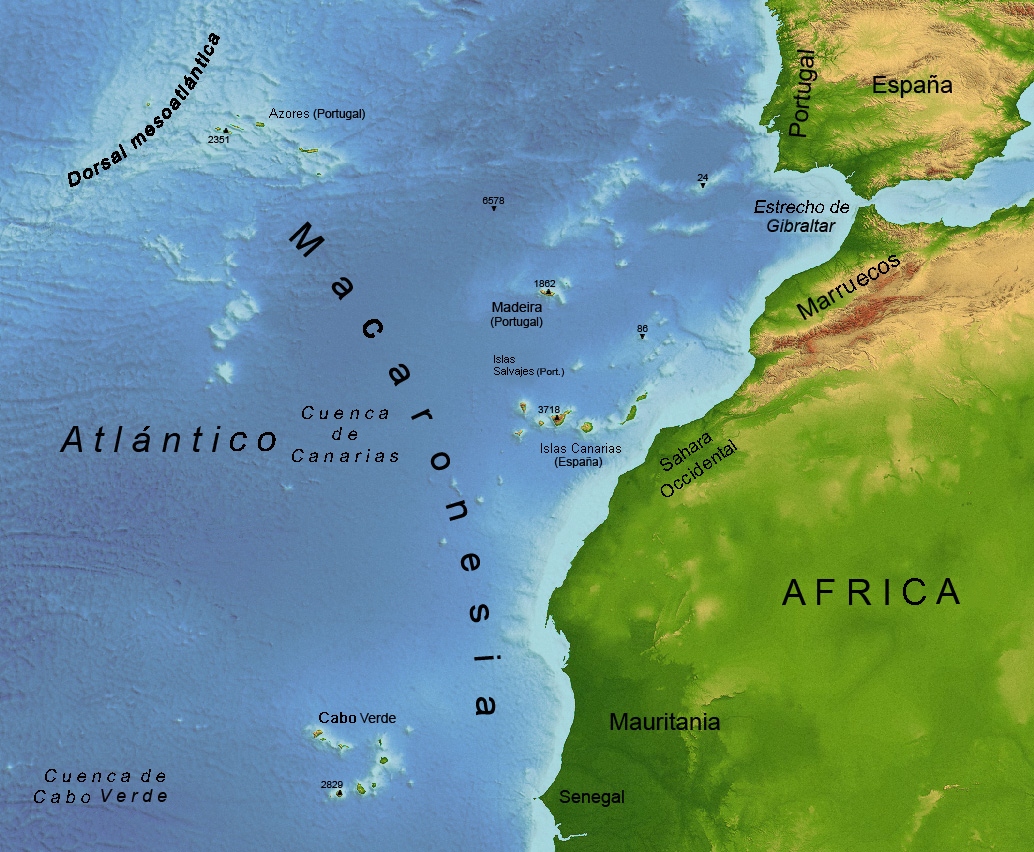
The port authority's argument is this: Las Palmas sits on the direct line between South America and West Africa. A container ship travelling from Brazil to West Africa or back passes the Canaries anyway — or could, if the logistics infrastructure and trade links are in place.
The president of the Brazil Africa Institute, João Bosco Monte, put the problem this way when signing a cooperation agreement with the port authority in 2024: a container from Brazil to the African coast takes far too long — that is no longer acceptable.
Chapter 4
Chile joins in — the Zona Franca mission of March
Three weeks before the São Paulo mission, another event took place that generated fewer headlines but may be strategically more important. From 16 to 18 March 2026, a delegation from the Zona Franca de Gran Canaria was in Santiago de Chile — the first direct trade mission to the country, as part of the international promotion strategy in Latin America 2025–2026.
The delegation met Chile's most important business associations: the Confederación de la Producción y el Comercio (CPC), SOFOFA, the Cámara Nacional de Comercio, the Asociación Logística (ALOG), Frutas de Chile, ProChile and ChileAlimentos. The pitch was the same as in São Paulo: use the Canaries as a platform to export to Africa and Europe.
Results according to the Zona Franca: interest from Chilean companies in using the Canaries as a gateway to African and European markets. The possibility of including the Canaries in future Chilean trade missions to Spain. Identification of opportunities in the technology, food and aquaculture sectors.
Chile is an interesting candidate because the country itself operates as a hub — but in the Pacific. Chile's ports (Antofagasta, Iquique, Valparaíso) connect South America with Asia and Oceania. Ninety per cent of Chilean exports go by sea. Trade accounts for 75 per cent of Chilean GDP. What Chile lacks is an efficient route into the Atlantic space — to West Africa and southern Europe. That is exactly what the Canaries offer.
Chapter 5
The BCIE deal — door to Central America
On 29 January 2026, the Canarian government signed an agreement with the Banco Centroamericano de Integración Económica (BCIE) — a multilateral development bank that finances projects in Guatemala, Honduras, Costa Rica, Panama, the Dominican Republic and Colombia.
The Canaries are the first Comunidad Autónoma in Spain to sign such a deal. It provides for Canarian companies to participate in BCIE-funded projects — in areas such as tourism, the environment, the blue economy, urban planning and infrastructure. The volume for 2026: €204,000 from the Canarian side, with the BCIE matching the amount.
Vice-president Manuel Domínguez put it this way at the signing: we export Canarian know-how — we don't just sell sun and beach, we sell engineering and tourism consultancy at an international level.
The BCIE deal has a different quality from the port offensive. It is not about containers but about services: Canarian consultants, engineers and technology companies working on Latin American projects. It is an attempt to broaden the economic base — away from pure tourism and logistics dependency.
Chapter 6
The bait — ZEC, Zona Franca and the REF
Why would a Brazilian exporter or a Chilean agri-trader choose the Canaries as a transhipment point? The answer lies in the tax regime.
The Canaries have their own economic and fiscal regime (Régimen Económico y Fiscal, REF) that is unique within the EU. The key instruments: the Zona Especial Canaria (ZEC), which offers a corporate tax rate of just four per cent — the lowest in the EU. The Zona Franca, which provides customs and tax advantages for storage, processing and distribution. And the reduced IGIC (Canarian sales tax) of seven per cent instead of Spain's 21 per cent VAT.
For a Latin American company looking to export to Europe or Africa, that is an attractive combination: EU market access, low taxes, a free trade zone, geographical proximity to Africa — and all on Spanish territory with European legal certainty.
Chapter 7
Arguments in favour
Geography. The Canaries sit at 28°N, 15°W — closer to Dakar than to Madrid, halfway between São Paulo and northern Europe. For trade between South America and West Africa, they are the logical waypoint.
Tax advantages. Four per cent corporate tax (ZEC), Zona Franca, reduced IGIC — unmatched in the EU. For companies seeking a European base with low costs, the Canaries are objectively attractive.
EU access. The Canaries are part of the EU and the Schengen area. Companies that establish themselves here have free access to the European single market — an advantage neither Tangier nor Dakar can offer.
Existing infrastructure. The port works, the Zona Franca exists, the connections to Brazil are established (20 million tonnes in nine years). This is not about building from scratch but about making better use of existing capacity.
Diversification. An economy that depends on tourism for over 35 per cent of its output needs a second pillar. Logistics and trade could be that pillar — if the strategy works.
Chapter 8
Arguments against
Port capacity. Puerto de Las Palmas is a multipurpose port, not a mega container terminal. Tanger Med in Morocco handles over seven million TEU annually. Las Palmas is a fraction of that. Anyone who seriously wants to compete with the big hubs needs massive infrastructure investment.
No industrial base. The Canaries have almost no manufacturing industry. A logistics hub works best when value is also created nearby — when containers are not just passed through but goods are processed, packaged and refined. That is largely absent on the islands.
Energy infrastructure. The CCE's 2024 annual report explicitly warned of ageing energy infrastructure with blackout risks. A logistics hub that depends on cold chains, round-the-clock port operations and digital systems cannot afford power cuts.
Housing and labour. The Canaries already have a housing crisis and Spain's lowest wages. More economic activity sounds good — but if it comes with a further rise in the cost of living without wages keeping pace, it will deepen social tensions.
Wishful thinking vs. reality. Trade missions, declarations of intent and press conferences are not contracts. The question is not whether the Canaries could theoretically be a hub — geography says yes. The question is whether the concrete investments, regulations and partnerships will follow to turn an idea into reality.
Chapter 9
Who else wants in — Tanger Med, Dakar, Chancay
The Canaries do not operate in a vacuum. Other locations pursue similar ambitions — some with considerably greater resources:
Tanger Med (Morocco) is already one of Africa's and the Mediterranean's largest container ports. It sits on the Strait of Gibraltar, has direct connections to Europe and West Africa, and is being massively expanded. Its advantage: proximity to Europe at significantly lower operating costs than the Canaries. Its disadvantage: no EU access.
Dakar (Senegal) is expanding its port and positioning itself as a West African hub. For Brazilian exports to West Africa, Dakar could be the more logical direct destination — without the detour via the Canaries.
Chancay (Peru) is the new Chinese-financed mega port on South America's Pacific coast, opened in 2024. It targets trade between Latin America and Asia. It is not a direct competitor for the Atlantic route — but it shows that other actors (above all China) are investing heavily in Latin American port infrastructure, while the Canaries operate with comparatively modest means.
Chapter 10
What this means for the islands
The Canaries' hub strategy is not a single project — it is a collection of initiatives all pointing in the same direction: economic diversification beyond tourism. The port courts business in São Paulo. The Zona Franca negotiates in Santiago. Proexca signs deals with the BCIE. The regional government promotes the REF as an investment incentive.
Whether it works depends on two things. First: whether words are followed by investment — in port infrastructure, energy supply, training and housing. Without these foundations, the hub idea remains a PowerPoint presentation at a trade fair in São Paulo.
Second: whether the Canaries are honest with themselves. The islands have real advantages — location, tax regime, EU access. But they also have real weaknesses: Spain's lowest productivity, a chronic housing crisis, energy infrastructure at its limits, and an economy that for decades has put all its eggs in one basket.
The question is not whether the Canaries could be an Atlantic hub. Geography says yes. The question is whether they are prepared to do what it takes to make it more than a slogan.
A dark fleet of on average 50 Russian tankers per week operates off the Canaries under Gabon, Comoros and Panama flags. Las Palmas has become a bunkering hub — and a geopolitical risk factor. For the Atlantic-hub narrative this means: Las Palmas is not only a gateway to Latin America and Africa, but also an unintended node in the Russian sanctions-evasion network. →
Air Transat launches a direct Toronto-Gran Canaria service from November 2026. For the first time the Canary Islands have a direct trans-Atlantic link into the North American market beyond the existing New York connection. A concrete example of how the Atlantic-hub concept is expanding from Brazil and Argentina north toward Canada. →
Atlantic hub · Puerto Las Palmas · port · Brazil · Chile · Zona Franca · Latin America · Africa · trade · logistics · BCIE · ZEC · REF · Canary Islands · Gran Canaria · Deep Guide · 2026