What's at stake
On 13 May 2026 the Departamento de Seguridad Nacional, a body reporting directly to the Spanish prime minister's office, published its annual report.
It contains a sentence remarkable for the Canary Islands: in 2025, the transit of Russian tankers near the islands has quintupled.
Each week 50 ships are counted that appear on the EU sanctions list — ships carrying Russian, Venezuelan or Iranian oil past official insurance, past official controls.
«Spain is considered a secondary target of Russian hybrid activity», the report says. «But the growing action of these tankers, which evade sanctions and operate close to the Spanish coasts, adds risks.»
What the «shadow fleet» is
The «flota fantasma» — in English «shadow fleet» or «dark fleet» — is the collective term for tankers sailing under flags of convenience such as Gabon, Eswatini or the Cook Islands.
Their ownership is obscured through opaque corporate structures. The economic beneficiaries — mostly Greek shipowners — disappear behind a chain of offshore companies.
Their task: to bring Russian oil past the Western price cap (60 USD/barrel since December 2022) and past EU sanctions to Asia. India and China are the main buyers.
The technical manoeuvre is called ship-to-ship transfer on the open sea: smaller tankers transfer their cargo to larger ones, outside the 12-mile zone, outside any port protocol. Between 2022 and 2025 the fleet grew to several hundred ships.
Why the Canaries
Three reasons make the Canaries a hub.
First, geography: the islands lie on the route from Russia (Baltic, Black Sea) and the Mediterranean towards Asia. The traffic separation schemes between Tenerife/Gran Canaria and Fuerteventura have been standard shipping lanes for decades.
Second, the ports: Las Palmas de Gran Canaria is one of the most important bunker stations for fuel in the Atlantic. Ships call there regularly to refuel — including shadow fleet tankers. Legally this is permissible, because a ship's nationality is defined by its flag, not its owner.
Third, the Red Sea problem: since the Houthi attacks, many tankers have had to take the detour around Africa — passing the Canaries. In the official risk ranking, the islands sit in third place, after the Strait of Gibraltar and the Galician coast.
Maritime expert Antonio Muñoz put it like this in an analysis published by the daily Canarias7: «We are on the brink of an accident with a Russian-managed tanker, and there will be no one to file a claim against.»
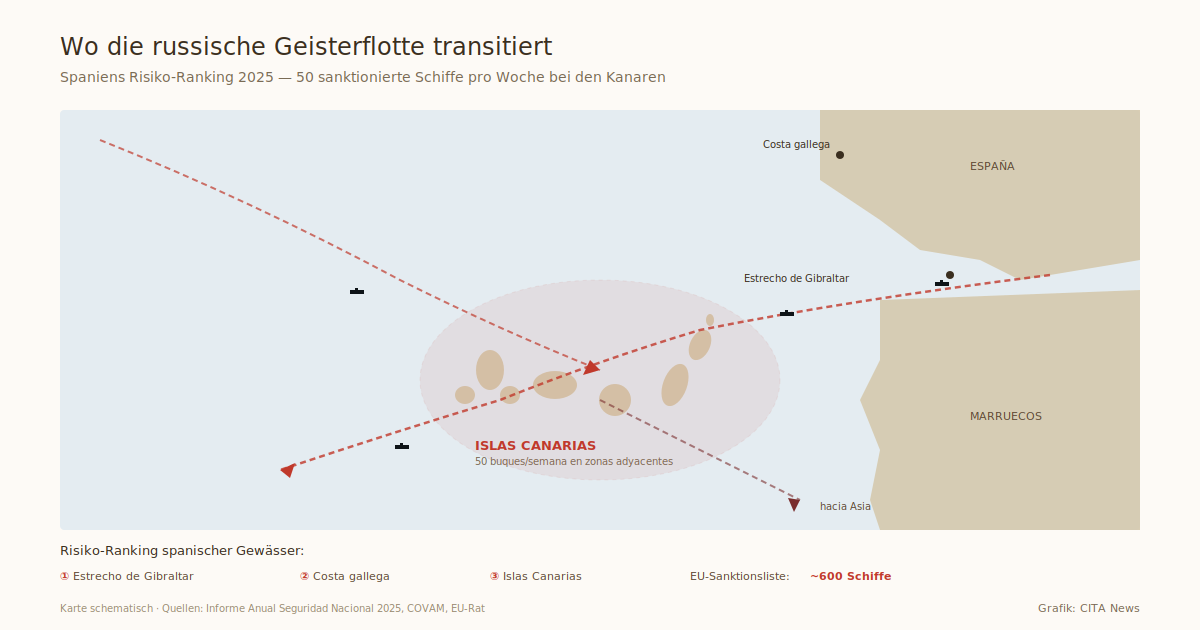
The Canaries as a hub: Spain's 2025 risk ranking lists the archipelago in third place. Graphic: CITA News.
Mooni, Myra and the drift phenomenon
Two specific episodes show how close the risk has already come.
In November 2025 the tanker «Mooni», under sanctions, drifted 21 days west of La Palma. On board: around 750,000 barrels of Russian heavy crude. Without any publicly available photo under its new name, without a Spanish air force reconnaissance flight.
In August 2024 the tanker «Myra» drifted ten days between Gran Canaria and Fuerteventura, also on the international sanctions list. Again no reconnaissance flight.
Ships like these, known in shipping circles as «Walking Dead Tankers», use Spain's Exclusive Economic Zone (EEZ) as a waiting room. They circle until a buyer in Asia gives the signal. They also no longer transmit AIS signals — the international standard identification is switched off to blur the trail.
The drift risks are technically concrete: in case of engine failure west of the islands, the southerly current would push the ship towards Africa. East of the islands, northeast wind plus current would push it towards Lanzarote, Fuerteventura or Gran Canaria.
The nearest high-sea tug is in Las Palmas — around ten hours' transit to the typical drift position.
The legal gap
The security report openly admits: «The legal possibility of acting against shadow fleet ships on the high seas is a difficult question to resolve.»
In international waters beyond the 12-mile zone, flag-state law essentially applies. Spain cannot easily stop a ship flying the Gabonese flag — even if its economic owner is on the EU sanctions list.
Then there is the insurance problem. Most shadow fleet tankers have no regular P&I (Protection and Indemnity) insurance. In case of an accident with oil leakage, there would be no one against whom a polluted country could claim damages.
The EU sanctions list is a legal lever — it forbids EU companies from doing business with listed ships. But it does not forbid these ships from sailing through international waters.
What Spain is doing about it
In January 2025 the Spanish Ministry of Defence began deploying three navy ships to the Alboran Sea, the Gulf of Cadiz and off the Portuguese Atlantic coast. One of them, the offshore patrol vessel BAM «Tornado», is based in Las Palmas.
The task: monitoring, port inspections, data exchange with the European Maritime Safety Agency (EMSA).
In parallel, the EU's Operation Atalanta — originally directed against pirates off the Horn of Africa — has expanded its mandate. Naval intelligence tasks to observe the shadow fleet have been added.
Diplomatically the EU continues working ship by ship. The last sanctions round on 18 December 2025 added 41 tankers — the list now contains nearly 600 vessels.
Canary Islands president Fernando Clavijo (Coalición Canaria, centre-right) had already warned of shadow fleet transit risks in 2025. The Canary government has not yet presented its own action plan. The islands rely on Spain's central government — which in turn relies on the EU.
Frequently asked questions
- What is the Russian shadow fleet?
- A collective term for around 600 tankers sailing under flags of convenience and transporting Russian, Venezuelan or Iranian oil to Asia, evading EU and US sanctions. Owners are obscured through offshore structures.
- Why are the Canaries affected?
- The islands lie on the shipping route between the Mediterranean and Asia. Las Palmas is an important bunker station. In the official risk ranking, the Canaries sit third, after the Strait of Gibraltar and the Galician coast.
- How many ships are involved?
- The Spanish navy counts 50 ships per week near the Canaries that appear on the EU sanctions list. This is a fivefold increase over 2024.
- What risks do the authorities see?
- Accidents and oil pollution, damage to underwater infrastructure such as cables, and theoretical use as drone-launching platforms. The latter is classified as «very unlikely» in the report.
- Can these ships be legally stopped?
- In international waters: as a rule no. The flag-state principle of the law of the sea applies. In ports: technically possible, but limited in practice by the same flag-state principle.
- What happens in case of an accident with oil leakage?
- Most shadow fleet tankers have no regular liability insurance. The polluted country would have no clear addressee for damages. Experts warn of a legal and ecological nightmare.
- Have incidents already occurred?
- Yes. In November 2025 the tanker «Mooni» drifted 21 days west of La Palma with 750,000 barrels. In August 2024 the «Myra» drifted ten days between Gran Canaria and Fuerteventura. Neither was met with a reconnaissance flight.