What's at stake
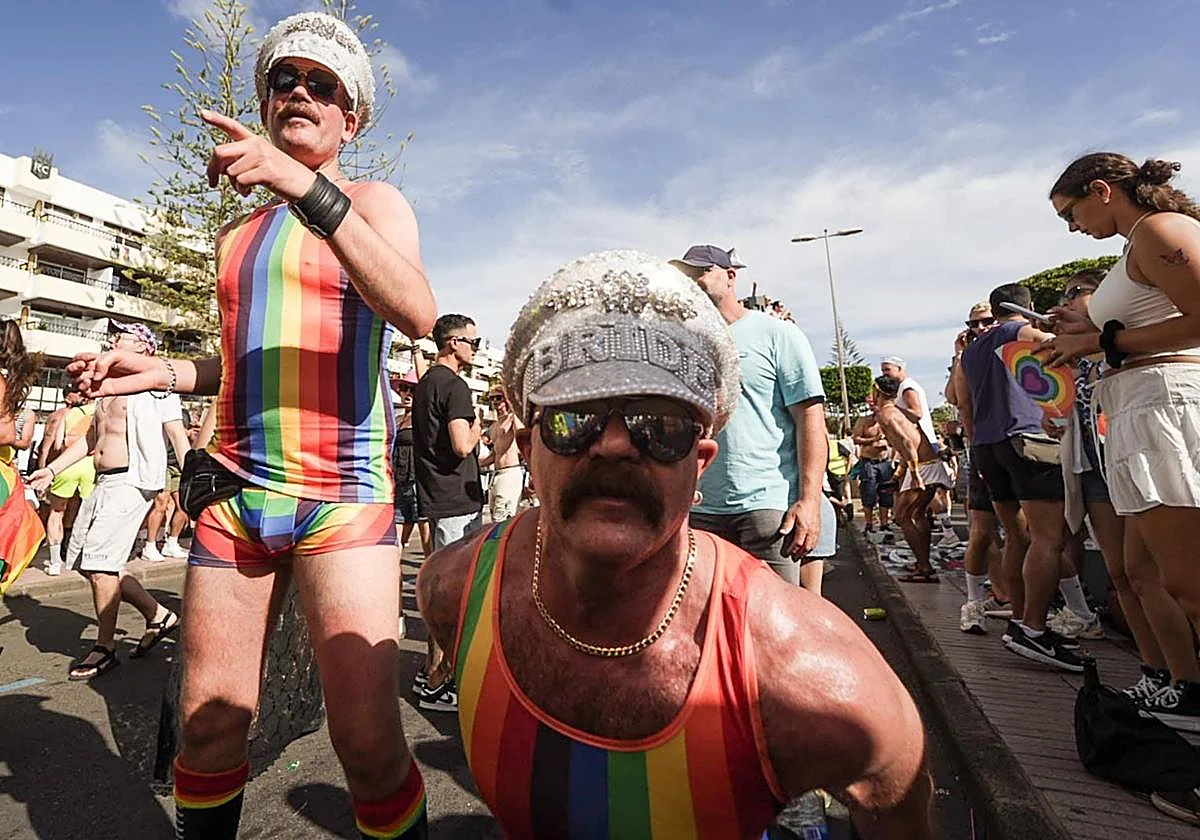
Four days of pop, four days of politics. From 14 to 17 May 2026, the Yumbo Centrum in Maspalomas turns into an open-air stage with a 60-square-metre LED screen.
On that screen, Thursday brings the second Eurovision semi-final live from Vienna; Saturday from 18:00 the grand final.
The catch: Spain has withdrawn from the Eurovision Song Contest 2026. The Spanish public broadcaster TVE isn't airing it. Anyone in Spain wanting to watch Eurovision relies on the contest's YouTube channel — or a pop stage like the one in Maspalomas.
Eurovision Pride is what's left for Spanish Eurofans: a local staging of the show TVE won't broadcast.
Why «Yumbo over Vienna»
The festival was born in 2025 as a symbolic protest against the restrictions Eurovision had imposed on the main stage regarding the waving of LGBTIQ+ flags during broadcasts.
In 2026, in its second edition, the concept goes further. Fernando Ilarduya, president of the organising body Freedom Asociación LGBT Maspalomas, puts it this way: «Eurovision Pride is music, is Pride, but also a voice that does not keep silent.»
Maspalomas, in the municipality of San Bartolomé de Tirajana, has been since the year 2000 one of Europe's major LGBTIQ+ destinations. The Yumbo Centrum is, by its own account, the only LGBTIQ+-specific shopping centre in the world.
Spain and the Israel boycott
Spain will not take part in Eurovision for the first time since 1961. In autumn 2025, Spanish public broadcaster RTVE announced its withdrawal in protest at Israel's continued admission to the contest.
Alongside Spain, Ireland (RTÉ), Slovenia (RTVSLO), Iceland (RÚV) and the Netherlands (AVROTROS) have also withdrawn — five countries, the largest boycott movement in 70 years of Eurovision history.
Background: in April 2025, Spain was the first country to formally raise the discussion of Israel's participation at the EBU broadcasters' union, citing the humanitarian situation in Gaza following the escalation since October 2023.
The consequence: Eurovision loses its third-largest audience (5.88 million viewers in Spain for the 2025 final) and Spain as one of the «Big Five» contributors.
Eurovision Pride turns this withdrawal into a gesture of its own. On the Yumbo screen, the Israel performance from the Vienna show will be replaced by an in-house live performance. The organisers describe it as a «symbolic protest act».
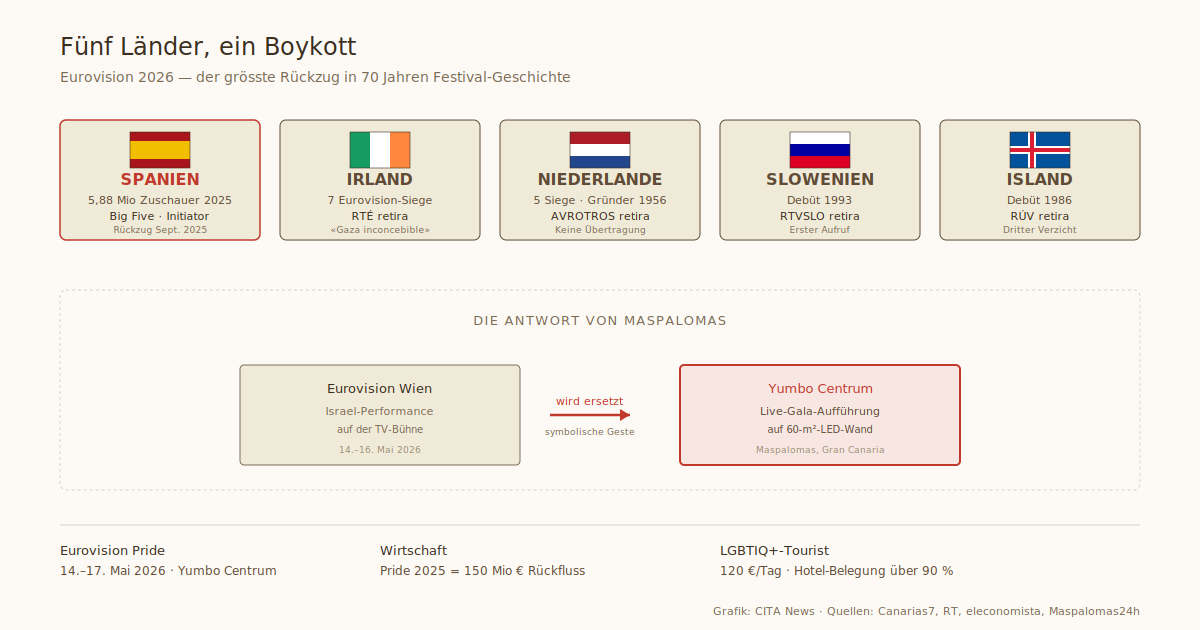
Five countries boycott Eurovision 2026. Maspalomas stages its own response. Graphic: CITA News.
The programme at a glance
Thursday 14 May: Opening gala at the Yumbo from 21:00. Live broadcast of the second Eurovision semi-final.
Friday 15 May: «Xpress package by Sundance» pool party at Axel Beach from 13:00. In the evening at the Yumbo at 21:00, the «Eurovision the Musical» gala with the singers Kimy Touw, Giada, Jia Miles and the gospel choir. From 22:45, «Glow party: the 2010s by Sundance».
Saturday 16 May: Peak day. Live broadcast of the Eurovision final on the big screen from 18:00.
Sunday 17 May: Closing show.
Featured artists: Drag queens Armani D'Vyne, Rebecca León and Kelly Roller (a Drag Race Spain participant), plus the Sala Scala ballet with the show «Origen». Galas are largely free of charge and publicly accessible.
What Maspalomas gets out of it economically
LGBTIQ+ tourism is a central economic segment for Maspalomas and the entire south of Gran Canaria. Maspalomas Pride 2025, according to the organisers, generated a return of 150 million euros.
Per day a LGBTIQ+ tourist spends around 120 euros according to Promotur data — about 100 euros above the Spanish average for outbound travel.
During Maspalomas Pride 2024, hotel occupancy in the south of Gran Canaria reached over 90 percent, in some locations «complete». The total volume of the LGBTIQ+ sector in the region is estimated at around 100 million euros a year.
Eurovision Pride is the second major annual event in the May block. It comes directly after the Maspalomas Pride by Freedom (4-10 May). The organisers speak of «the only European destination with two major international Pride events in the same month».
In the background: the Freedom Asociación debt crisis
Despite the economic weight of the Pride events, the organising body Freedom Asociación LGBT finds itself in rough waters.
In March 2026 it had to shorten Maspalomas Pride by Freedom from ten to seven days — citing an «unsustainable economic situation» and «debts in the hundreds of thousands of euros».
The association complained that, in particular, the hotels and businesses in the Yumbo Centrum had not provided the backing «that an event drawing hundreds of thousands of visitors each year would deserve».
Eurovision Pride 2026 was also born as an economic response to this — an additional event extending the May block without further burdening the Pride core event.
Frequently asked questions
- What is Eurovision Pride?
- A four-day pop festival in Maspalomas combined with LGBTIQ+ activism and political protest. 14-17 May 2026, at the Yumbo Centrum.
- Why can't Eurovision be watched on Spanish TV?
- Spain's public broadcaster RTVE has withdrawn from the contest in protest at Israel's participation. This is Spain's first Eurovision withdrawal since 1961.
- Which other countries have withdrawn?
- Ireland, Slovenia, Iceland, Netherlands — together with Spain, five countries. The largest boycott in 70 years of Eurovision.
- Where can Eurovision be watched in Spain anyway?
- On the EBU's official YouTube channel. In Maspalomas on the big screen at the Yumbo Centrum.
- What replaces the Israel performance in Maspalomas?
- During the Israel performance in the Vienna show, an in-house gala number is shown on the Yumbo screen. The organisers describe it as a symbolic protest act.
- Who organises Eurovision Pride?
- According to Atlántico Hoy, the Freedom Asociación LGBT Maspalomas, an LGBTIQ+ association under president Fernando Ilarduya. It also organises Maspalomas Pride by Freedom.
- Are the events free of charge?
- The galas at the Yumbo Centrum are free and publicly accessible. The pool parties at Axel Beach and Seven Hotel are ticketed.