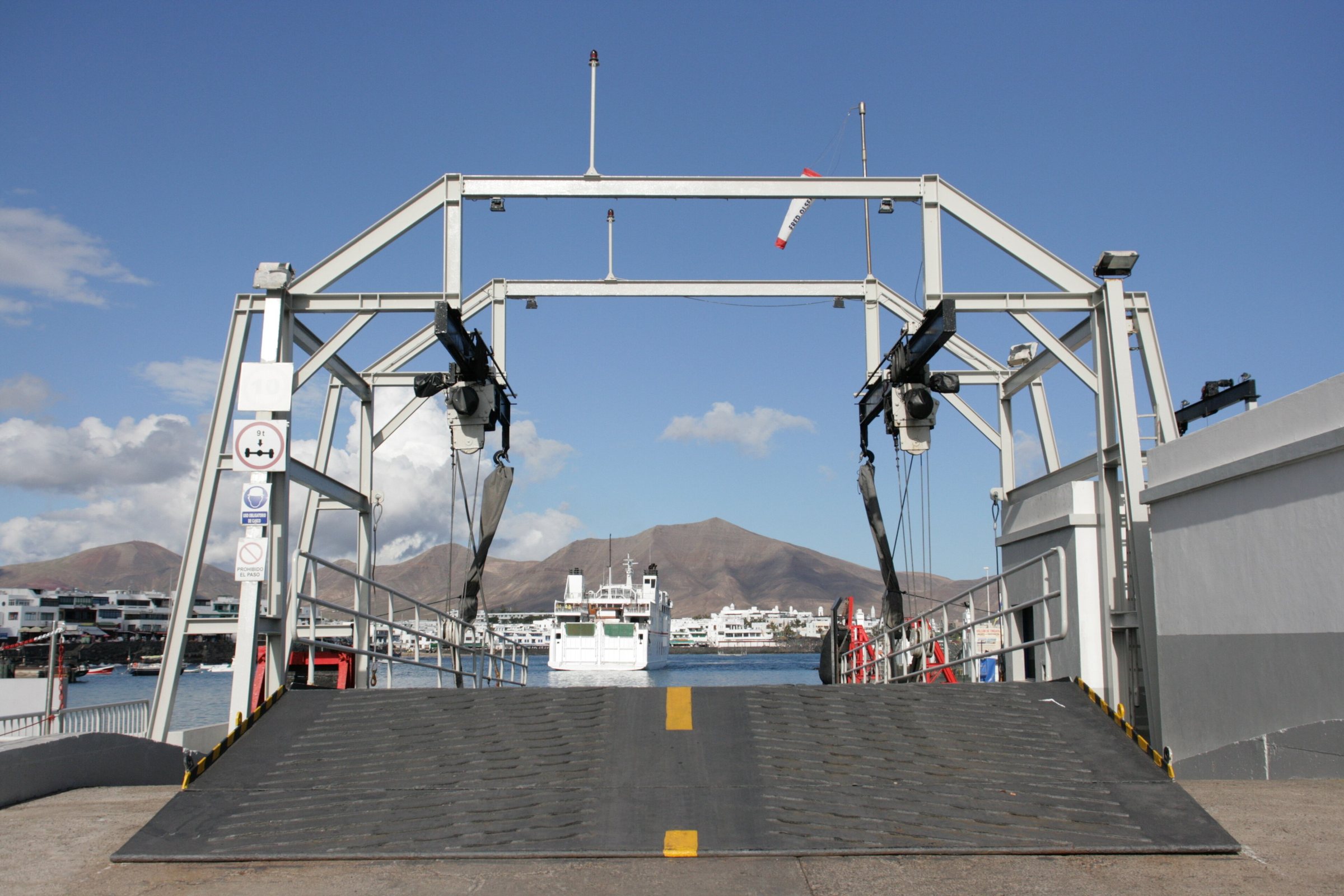
Which operators run the Canary Islands ferries in 2026?
Three operators link the islands in 2026: Fred. Olsen Express, the Baleària group with its Baleària Canarias brand, and Líneas Romero on the short hop to La Graciosa. The details apply to Tuesday 17 November 2026.
Only the timetable at the time of booking is binding. The operators work with dynamic booking data.
Baleària took control of the Canary Islands business of Armas Trasmediterránea on 18 May 2026, according to Forbes, Riviera and Shippax. Ferry Shipping News reported completion on 22 May 2026, and the deal had been announced in August 2025.
The Baleària Canarias brand currently runs alongside the Armas Trasmediterránea brand. Older articles about Naviera Armas therefore describe the position before the takeover.
The group has about 4,500 staff and more than 50 ships, and carries over 8 million passengers a year, says Ferry Shipping News. All jobs stay, and Forbes reports that Baleària plans 45 million euros of investment in the Canary fleet over three years.
The competition authority CNMC approved the takeover, according to its press note of 31 March 2026. Among the conditions for the Canaries, CNMC and Diario de Avisos report an end to the joint operation of the Huelva–Canaries route with Fred. Olsen.
That concerns the mainland route, not traffic between the islands. Whether timetables or fares have changed under Baleària Canarias is unknown.
The research found no official timetable for the new brand. The undated Ferryhopper page lists mostly two crossings a day for Armas on Tenerife–Gran Canaria, Tenerife–La Gomera, Gran Canaria–Fuerteventura and Fuerteventura–Lanzarote, but this is not confirmed for 2026.
Which ferry routes and crossing times link the islands?
The busiest link runs from Santa Cruz de Tenerife to Agaete, in the north-west of Gran Canaria. Fred. Olsen Express gives a crossing time of about 80 minutes, and Ferryhopper also says 1 hour 20.
The fast trimarans Bajamar Express and Bañaderos Express serve the route. The Bajamar Express, built in 2020, is 118 metres long, reaches up to 38 knots and holds 1,100 passengers and 276 cars, according to DirectFerries and OpenFerry.
Agaete is not Las Palmas de Gran Canaria, so you must arrange the road journey to the capital yourself. The link to Morro Jable on Fuerteventura, by contrast, starts from the port of Las Palmas.
From Tenerife, Fred. Olsen Express gives about 50 minutes to La Gomera, which Ferryhopper confirms. La Palma takes 150 minutes and El Hierro 140 minutes.
From Gran Canaria, the operator quotes about 2 hours 10 minutes to La Gomera and about 3 hours 50 minutes to La Palma. El Hierro takes 3 hours 40 minutes, and all times cover the sea leg only and are guides.
Between Lanzarote and Fuerteventura, the ferry from Playa Blanca to Corralejo takes about 25 minutes, says Ferryhopper. Fred. Olsen gives 25 or 35 minutes for Lanzarote–Fuerteventura.
Líneas Romero sails to La Graciosa from Órzola, and DirectFerries calls it the only regular passenger ferry there. Its fast boats do not normally carry vehicles, says Ferryhopper.
How often do the ferries sail, and what changes with the season?
In summer 2026 Fred. Olsen Express ran 16 crossings a day between Tenerife and Gran Canaria, Diario de Avisos reported on 10 June 2026. On Lanzarote–Fuerteventura there were up to 26 a day in summer.
These are summer figures, and the research gives no year-round frequency. The summer extras ended in September.
According to Vozpópuli on 5 June 2026, there are six departures a day between Gran Canaria and Tenerife. Morro Jable–Tenerife sails twice a day and takes about 4 hours.
Between Fuerteventura and Las Palmas there are three rotations. The sources do not say which operator runs them, so the figures give only an order of magnitude.
For summer 2026 Diario de Avisos reported further changes, which have now ended. Las Palmas–Morro Jable had four daily rotations from 22 June to mid-September.
Los Cristianos–El Hierro received two daily rotations, with one each on Wednesday and Saturday, the best connection since 2013. In August, Los Cristianos–La Gomera had five rotations a day.
According to the operators, timetables can differ at weekends, on public holidays and in high season. Demand is growing: at Easter 2026 the operator counted 166,000 passengers, 6% more than in 2025, says Diario de Avisos.
Fred. Olsen Express carried about 4 million passengers, more than 1 million vehicles and about 80,000 pets in 2025, RTVC reported on 9 January 2026. People and vehicles rose by 10%, according to RTVC.
How much do the ferries cost, and does the resident discount apply?
Fred. Olsen Express shows 12.65 euros without a car and 22.46 euros with a car for Tenerife–Gran Canaria. These are entry prices, depending on fare, availability and conditions.
On 10 November 2026 Ferryhopper listed resident fares from about 12.50 euros for this route, so the figures are very likely resident prices. That is not confirmed, and non-residents should expect to pay clearly more.
For standard fares, Ferryhopper gives about 32 to 53 euros for Tenerife–La Gomera, depending on the season. For Líneas Romero between Playa Blanca and Corralejo it is about 17 to 20 euros.
Children under 3 travel free and children aged 3 to 11 pay 50%. These figures come from an intermediary, not from official tariffs, and luggage, vehicle, seat and booking time all affect the price.
Anyone registered in the Canaries gets 75% off the eligible passenger fare, says Ferryhopper on 10 November 2026. Vehicles are not included.
Ferryhopper can apply the discount only for Fred. Olsen Express and Líneas Romero. For residents, the intermediary gives guide fares of about 13 euros for Tenerife–La Gomera and 18.50 euros for Tenerife–La Palma.
The intermediary also lists resident fares of 13.50 euros for Tenerife–El Hierro and 14 euros for Gran Canaria–Fuerteventura. Fuerteventura–Lanzarote costs 5 euros and Lanzarote–La Graciosa 4 euros.
Proof comes from SARA, the automatic residence check, usually with a DNI (national ID card) or other ID. If it fails, you need a “certificado de residencia para viajar” (a residence certificate for travel) from your town hall.
With Fred. Olsen, go to the port office at least one hour before departure. With Líneas Romero, go to the counter at least 40 minutes before boarding, and remember that tourists get no discount.
Under Decree 196/2017 (published in the BOC, the Canary Islands official gazette, on 9 August 2017), residents get 25% on regular services between the islands. On San Sebastián de La Gomera–Playa Santiago–Valle Gran Rey the discount is 75%.
According to a search result, the state has granted 75% since Real Decreto 949/2018 for journeys between non-peninsular territories and the rest of the national territory.
Which ports and rules matter for cars and connections?
Los Cristianos, in the south of Tenerife, is the port for La Gomera, La Palma and El Hierro, while the fast link to Gran Canaria leaves from Santa Cruz de Tenerife. The two ports are not in the same place.
On combined journeys, the crossing times do not include port changes. Total travel time is therefore clearly longer.
Fred. Olsen says there is no direct ferry from El Hierro to Gran Canaria. The route runs from Valverde, or Puerto de La Estaca, to Los Cristianos, then from Santa Cruz de Tenerife to Agaete.
Sailing time alone is about 3 hours 40 minutes, while the whole trip can take 6 to 7 hours. After one year, the La Estaca–Los Cristianos line had almost 1,000 sailings and more than 179,000 passengers, says RTVC, and two operators now serve it.
If you take a car, motorbike or bicycle, you must declare the vehicle when booking. Whether it travels depends on space and fare.
Before travelling, check the departure port, the check-in deadline, the vehicle dimensions and the exact fare. The La Gomera–La Palma link runs at different times depending on the port and connection.
What happens next with the mainland route and the fleet?
Since 24 January 2026 the Buenavista Express has replaced the Sicilia on the Huelva–Canaries route, Baleària said in a press release. The ship was built in 2001 as Fortuny, sold to Liberty Lines and bought by Fred. Olsen on 29 September 2025.
The figures for capacity conflict. Diario de Avisos gives 944 passengers, 390 vehicles and 172 metres, while other sources say 1,250 passengers.
Since 5 June 2026 Fred. Olsen has run Huelva–Las Palmas–Santa Cruz de Tenerife alone, says Diario de Avisos. Until October a chartered Baleària ro-pax ship (a ferry for passengers and freight) kept up four rotations a week.
Whether that continues after October is not confirmed. The price guide of about 115 to 116 euros comes from a Ferryhopper blog of November 2025 and is out of date.
For its fleet, Baleària names the fast ship Mercedes Pinto: 128 million euros, 1,200 passengers, 425 vehicles, 35 knots. The Pepita Castellví is meant to strengthen the lines of the western province.
The Josefina de la Torre is meant to serve as a cargo ship. The research gives no date for its deployment in the Canaries.
Canary Islands law 12/2007 governs maritime transport and provides for public-service obligations with related contracts. The mainland link went to Armas again in 2022, for two years and 4.2 million euros, says Ferry Shipping News.
According to a search result, the contract was extended to mid-2026, but the current status is unconfirmed. Official 2027 timetables and fares for Fred. Olsen and Baleària Canarias are not yet available.