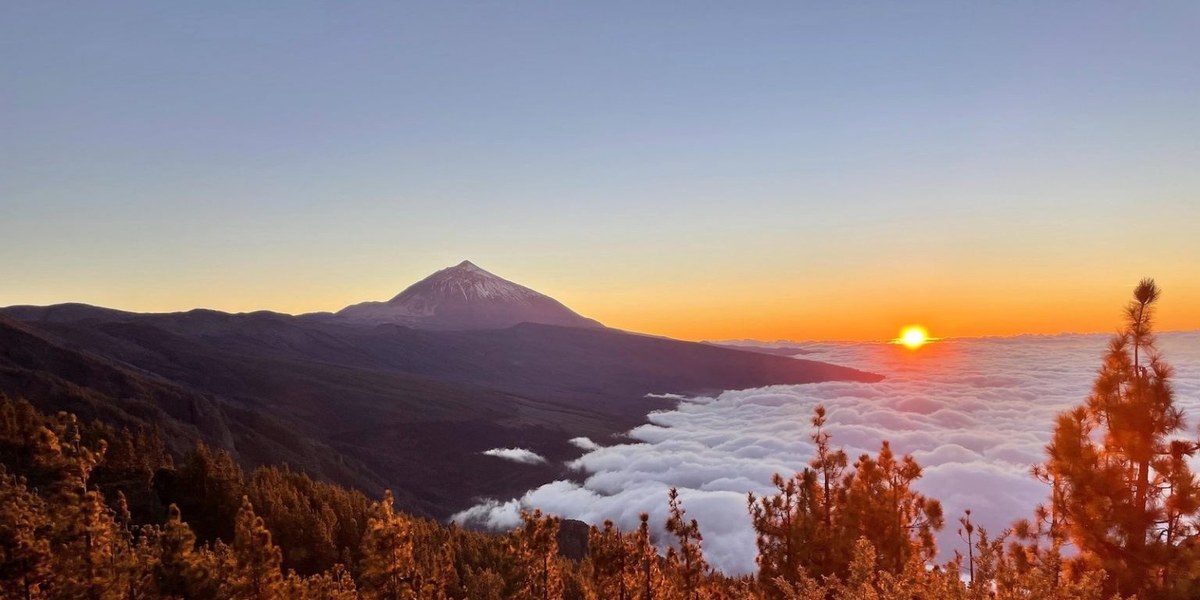
An archive in the barren south
Southern Tenerife is considered dry, barren, sun-scorched. It is precisely there, in the Malpaís de Rasca nature reserve, that an archive lies which retells the climate history of the Canaries. A research team from the University of La Laguna has recovered from the ground a continuous sediment record reaching back 12,000 years — covering the entire Holocene, our present geological epoch.
The find that outgrew its own expectations
Originally the team wanted far less. «Our idea was to analyse the last 2,000 years, matching the first human settlement of the Canaries», explains the geologist Margarita Jambrina, who coordinates the research group for environmental geochemistry and global change at the ULL. «But we were able to go back 12,000 years — we have the complete Holocene.»
The project is called IMPACT and was funded by the Fundación CajaCanarias and the Obra Social «la Caixa»; it has just been completed. It was led jointly by Jambrina and the geoarchaeologist Natalia Égüez of the Instituto de Productos Naturales y Agrobiología of the state research council CSIC. The combination is decisive: here climate science met archaeology.
How to read climate from earth
The method sounds unspectacular and yet is highly precise. The samples taken underwent sedimentological and geochemical analysis: soil micromorphology, stable isotopes, lipid biomarkers. Each layer is a window in time. «We tell the story centimetre by centimetre», says Jambrina. «In the surface layers we find recent activity, and at greater depth we can reconstruct what the landscape looked like thousands of years ago.»
The greatest challenge was not the digging but the chronology: a robust age model assigning each sediment layer a precise timespan. «In geology a good age model is fundamental in order to determine with certainty when particular climate changes took place.»
When the Sahara was green — and Tenerife's south wetter
The most remarkable finding: in southern Tenerife the signature of the African Humid Period was found, the climate event that once turned today's desert into what is called the Green Sahara. It was the most profound climate change in the low latitudes of the last 100,000 years: shifts in the Earth's axis strengthened the African monsoon, and grasses, trees and lakes covered wide stretches of today's Sahara.
That this event also left its mark on Tenerife is what the researchers have now been able to show. Between 12,000 and 8,200 years ago, conditions in the south of the island were wetter than today. At the same time they encountered traces of abrupt climate shifts — specialists call them the 8.2 and 5.5 ka events.
Such studies are practically new for southern Tenerife, Jambrina stresses. And comparison with similar investigations by the group elsewhere in the archipelago brought an important insight: ecosystems did not respond uniformly to the same climate changes.
What was the «Green Sahara»?
The African Humid Period refers to a phase in the late Pleistocene and the Holocene when North Africa was markedly wetter than today. Shifts in the Earth's axis strengthened the African monsoon; grasses, trees and large lakes covered wide stretches of what is now desert. It is regarded as the most profound climate change in the low latitudes of the last 100,000 years. Its waning led to the aridity that still defines the Sahara — and which, as Calima, occasionally reaches the Canaries.
A pig's tooth and the Guanches
The archaeological side of the project brings new things to light about the people who lived here. The Malpaís de Rasca is one of the zones with the highest density of sites. The excavations produced evidence of domestic and pastoral activity by the first populations — among them the remains of domestic animals and faecal biomarkers from livestock.
«We identified a small pig's tooth and indications connected with the presence of sheep», the researcher reports. This is more than a curiosity: it shows that the early inhabitants did not live only from the sea, as the well-known shell middens suggest, but also practised agriculture and animal husbandry.
Right up to the present: pesticides from the 1940s
The archive reaches into our own time. In the upper layers the researchers came upon pesticides used by intensive agriculture in the 1940s — some of them now banned under European law. The sediment therefore records not only natural history but also human intervention, literally layer by layer.
What it means for the future
Why should the past matter when the question is tomorrow's climate? Because modern climate models rest on assumptions about the natural range of climate variability. A continuous sediment archive covering the entire Holocene is therefore, as Jambrina stresses, particularly valuable: it helps to understand this natural variability and to test the models with which future scenarios are calculated.
The project's central lesson is at the same time a hopeful one. «The island landscape has proved resilient in the face of climate fluctuations», says Jambrina. «That is why it is so important to know how it responded in the past — it can help us anticipate how these areas might respond to the climatic challenges of the future.»
Context
The study offers no weather forecast for the coming decades. It provides a yardstick: a continuous archive of natural climate fluctuations makes it possible to test climate models and anticipate how ecosystems respond. The resilience of the island landscape observed in the past is no all-clear for the present — today's rates of change lie far above those of earlier upheavals.
It is not a prediction in the narrow sense. It is something more useful: a yardstick against which to measure what was normal — and what no longer is.