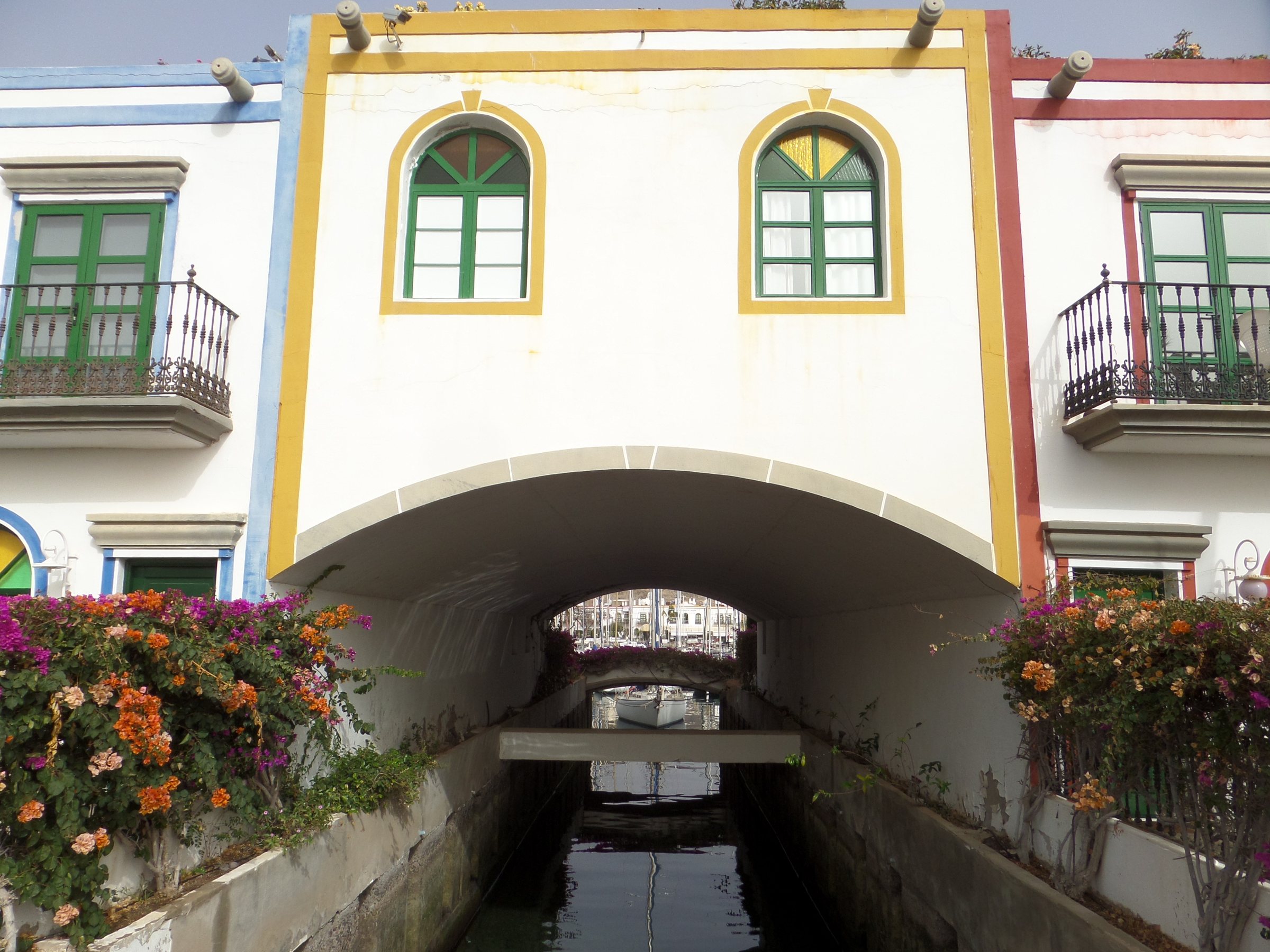
What can you do in Puerto de Mogán?
According to the tourism portal grancanaria.com, the harbour at Puerto de Mogán has 225 berths for fishing boats and yachts. The portal calls the village “one of the most beautiful urban settlements in the Canary Islands”.
It describes a maritime tradition, houses over small canals, bougainvillea and hibiscus. There are also terrace cafés and bars that open in the evening.
Wikipedia describes Puerto de Mogán as a holiday and fishing village at the mouth of a valley on Gran Canaria’s south-west coast. Until the 1980s it was a thinly populated fishing hamlet, it says.
The canals linking the marina and the fishing harbour earned it the nickname “Little Venice”. The sources checked do not say who planned the village or when work began.
The Spanish tourism portal spain.info describes whitewashed houses with coloured door and window frames, a promenade with yachts and a sports harbour. The harbour is also a starting point for deep-sea fishing, and grancanaria.com lists 87 world records for it in the municipality of Mogán.
Wikipedia says very few buildings in the village rise above two storeys. The municipality limits taller buildings, it says, but the sources contain no text of a bylaw.
Excursion boats and a small tourist submarine sail from the harbour every day, according to grancanaria.com. For sunset, the portal recommends the harbour and speaks of a view “behind the houses around the harbour”.
The portal calls Playa de Mogán a small beach of about 200 metres with plenty of services. German-language travel sites describe yellow sand next to the harbour, and no source gave an entry price for the beach.
What are the sights in and around Puerto de Mogán?
The Cañada de los Gatos site lies right next to the beach. It is a pre-Hispanic settlement at the mouth of the Mogán barranco (ravine), with stone houses, cist graves, burial mounds and burial caves.
According to a search preview, the site belongs to the Cabildo’s (island government) network of archaeological parks, the Red de Parques Arqueológicos. The Cabildo’s excavations recorded overlapping dwellings and rooms that were reused.
Only second-hand details exist for opening hours and price, and they give no year. They say the site opens Tuesday to Sunday, from 10:00 to 17:00 between October and March and from 10:00 to 18:00 between April and September.
Entry is said to cost 4 euros.
The blog canarias-lovers.com says there is a café with sea views at the top and that groups can book guided tours. Visitors should allow 30 to 60 minutes.
The blog puts the bus station six minutes’ walk away. Drivers can use a paid car park, though the source did not give the fee.
Grancanaria.com lists the Iglesia de San Antonio, dating from 1814 and holding wood carvings and religious statues, as another sight in the municipality. It also mentions Los Azulejos, a rock formation in colours “from dark red to blue”.
The Presa de Soria is the island’s largest reservoir, and the Ojeda, Inagua y Pajonales nature park lies nearby. The portal gives neither opening hours nor prices for them.
Several archaeological sites in the municipality are listed as a BIC (Bien de Interés Cultural, a cultural asset of special importance), among them Cañada de los Gatos and La Cogolla de Veneguera. A search preview says Cañada de la Mar was declared in 2005.
Wikipedia says the Mogán windmill, built in 1893, has been an ethnological site since 2002.
How do you get to Puerto de Mogán?
According to grancanaria.com, line 91 runs from Las Palmas to Playa del Cura in about 50 minutes. Lines 32 and 01 leave the tourist areas every 20 minutes.
Lines 84 and 38 serve the village centre and La Aldea de San Nicolás. The portal’s details carry no date, and the bus operator Global publishes current timetables.
The extension of the GC-1 motorway opened in 2013 and ends north of the village, says Wikipedia. Several bus lines serve the village.
For drivers, the blog canarias-lovers.com gives journey times to the Cañada de los Gatos site: about 15 minutes from Puerto Rico, 20 from Maspalomas and 55 from Las Palmas. These are undated blog figures.
These offers also include excursions for market day and dolphin watching from Puerto Rico. Official times and prices from the ferry operators were not available.
On parking, a campervan portal reports some free spaces on the outer approach roads. Commercial market sites advise arriving before 09:00 to park for free.
The research found no official parking tariff and no berthing fees for the harbour. It found nothing on how busy the village gets on Fridays either.
What do the Friday market and the submarine cost, and what are the rules?
The weekly market at the harbour takes place on Fridays, but the times contradict each other. Grancanaria.com says “from dawn until two in the afternoon”.
Commercial directories such as mercadillos.org and Musement give 08:00 or 09:00 to 15:30. No statement from the Ayuntamiento (town hall) was found, so check the closing time in advance.
According to the directories, most stalls take cash only. The market is busiest in the late morning, when day visitors arrive from other southern resorts.
Barceló, easyJet and Musement describe it the same way. The number of stalls could not be established.
A small tourist submarine sails from the harbour. It goes by the name Golden Shark or Atlántida.
Musement’s page gives no year for the price. Travellers can get current prices and departures from the operator.
Hosteltur and RTVC report that the municipality of Mogán introduced a tourist tax of 0.15 euros per night on 1 January 2025, officially called TATOS. The Tribunal Superior de Justicia de Canarias (TSJC, the Canary Islands High Court) first suspended it, then lifted the suspension.
According to a Moncloa article of 14 July 2026, the TSJC declared the bylaw void. It is not confirmed whether an appeal is under way or whether the tax is charged now.
A search preview says disturbing dolphins and whales is banned in the Canary Islands. The research did not check the text of the law.
The operator Spirit of the Sea advertises a World Cetacean Alliance certification. That is its own claim and not an official one.
Which tips and dates are still open?
Festival portals say the Fiestas del Carmen in Mogán ran from 10 July to 2 August in 2026. They list a pilgrimage with 22 decorated carts, plus Mass and a procession on land on 16 July.
They also mention a meeting at sea between the images of the Virgen del Carmen of Arguineguín and Playa de Mogán. Accounts of the sea procession contradict each other, and there is no programme for 2027.
No verified insider tips exist, and the research found no museum in the village. The Mirador de Mogán, a viewpoint over the valley and harbour, appears only on German-language travel sites, with no official details.
Official data on walking trails is missing too. Grancanaria.com names Patalavaca, Anfi del Mar, Puerto Rico, Amadores, Tauro, Playa del Cura, Taurito, Los Frailes, Medio Almud and Tiritaña as beaches of the municipality, with no further details.
There is no documented comparison with harbours on other islands. The claim that Puerto de Mogán is the island’s prettiest village is tour operators’ sales talk.
Official information is available at mogan.es, turismo.mogan.es and on the Cabildo de Gran Canaria’s website. For current readings and warnings, see CITA-Wetter (cita.news/de/wetter.html) and AEMET (the state weather service).